Experience true shockwave therapy in Edmonton. Deep, non-invasive treatment to support healing, improve circulation, and break down scar tissue.
Key takeaways
- Shockwave therapy uses focused acoustic pulses to stimulate the body's own repair processes in stubborn, chronic injuries.
- It works by boosting blood flow and new vessel growth, prompting cell repair, breaking down calcium deposits, and calming pain signals, rather than just masking pain.
- The evidence is strong for conditions like plantar fasciitis and calcific tendon problems, and growing for many others, though it is not better than other options for every condition.
- Treatment is non-invasive, takes only a few minutes, needs no anesthesia or downtime, and is usually done as a short series of sessions.
- It works best as part of a plan that also addresses the root cause with exercise and hands-on care.
In this article
- What is True Shockwave therapy?
- How does shockwave therapy work?
- Why does shockwave help the body heal?
- What does shockwave therapy treat, and what does the research say?
- What should you expect during a treatment?
- Does shockwave hurt, and is it safe?
- How does Unpain Clinic use True Shockwave?
- Frequently asked questions
If you have a chronic injury that just will not heal, despite rest, medication, and time, shockwave therapy may be worth understanding. It is a non-invasive treatment that uses acoustic energy to restart the body's healing in tissues that have stalled. This article explains, in plain language, how it works, why it can help the body heal, and exactly what to expect if you come in for treatment.
This is general information, not a substitute for a professional assessment or medical advice.

What is True Shockwave therapy?
True Shockwave therapy is a treatment that delivers focused, high-energy acoustic waves into injured tissue to stimulate healing. The word "true" points to the type of wave. There are two main technologies, and they are not the same.
Focused shockwave, the true shockwave, is generated to create a genuine acoustic shockwave that concentrates its energy at a chosen depth in the body, so it can target a specific structure like a tendon insertion or a spot under the heel. Radial pressure wave devices, by contrast, are pneumatically driven and spread their energy more broadly and superficially, which suits larger, shallower areas like tight muscle. Both have a role, but focused shockwave reaches deeper and more precisely, which is why we call it True Shockwave.
In short, it is a targeted, non-invasive way to deliver mechanical energy to injured tissue. No needles, no incisions, and no medication are involved. The goal is not to numb the area but to prompt the body to repair it.

How does shockwave therapy work?
Shockwave therapy works by converting acoustic energy into a biological healing response, a process often called mechanotransduction. When the focused pulses pass into the tissue, cells sense that mechanical stimulus and respond by ramping up repair activity.
Several things appear to happen at once. Blood flow to the area increases and new small blood vessels form, which brings oxygen and nutrients to tissue that had poor circulation. Cells release growth factors that support repair. In conditions with calcium build-up, the pulses can help break down those deposits so the body can clear them. And the treatment appears to calm overactive pain nerves in the area, reducing pain over time.
This is why shockwave is different from a painkiller. Rather than simply masking the discomfort, it aims to change the underlying tissue, encouraging a stalled, chronic injury to move back into an active healing state. That distinction matters most in long-standing problems that have stopped improving on their own.
Why does shockwave help the body heal?
Shockwave helps because many chronic injuries are stuck. In a fresh injury, the body mounts a strong healing response, but in a long-standing tendon or fascia problem, that response fades and the tissue settles into a degenerated, poorly-healing state. Shockwave is a way to jump-start it.
The clearest evidence for this healing effect comes from bone and tendon research. A review of shockwave for non-healing bone describes how the therapy stimulates the growth of new blood vessels and bone-forming activity, which is how it helps fractures and nonunions that had stopped healing knit back together [1]. The same biological themes, better blood supply and reactivated repair, are thought to underlie its effects in soft tissue.
So the aim is genuine repair, within limits. Shockwave is not a promise of healing for everyone or every condition, and it works best alongside the loading and rehabilitation that rebuild the tissue. But for the right chronic problem, it can be the nudge that gets healing moving again.
What does shockwave therapy treat, and what does the research say?
Shockwave therapy treats a range of chronic musculoskeletal conditions, and the strength of the evidence varies by condition, so it helps to be honest about where it shines and where it is one option among several.
It has strong support for several foot, heel, and tendon problems. For plantar fasciitis, a common cause of heel pain, a meta-analysis found shockwave outperformed ultrasound therapy for activity pain and patient satisfaction [2]. Across tendon problems generally, a 2024 review of 45 trials found shockwave reduced pain [3]. A useful, honest note comes from a review of upper and lower limb tendinopathies, which concluded that shockwave is effective for lower-limb and calcific tendon problems, such as calcific shoulder tendinitis, but is not clearly better than other treatments for upper-limb or non-calcific tendinopathies [4]. In other words, it is a strong tool for some tendons and a reasonable option, not a clear winner, for others.
It has a genuine role in bone healing. For stress fractures and slow-healing bone, reviews support shockwave as a way to stimulate repair, which our guide to stress fractures covers, drawing on evidence that up to a third of stress fractures do not heal with rest alone [5]. Tendon problems around the ankle, like those in our guide to peroneal tendinopathy, fit the same soft-tissue pattern.
The evidence is growing for larger joints and the spine. For knee problems, a 2024 review found shockwave, combined with other care, improved knee osteoarthritis pain and function, though the quality of evidence is still developing, as our guide to knee osteoarthritis relief explains [6]. A 2024 study found shockwave added to physiotherapy helped patellofemoral pain, covered in our guide to patellofemoral pain and rehab tools [7]. And for the low back, a meta-analysis of 632 patients found shockwave improved chronic low back pain and function [8], while a sham-controlled trial found it reduced sacroiliac joint pain, as in our guide to SI joint pain [9].
The honest summary is that shockwave has strong evidence for some conditions, promising and developing evidence for others, and is not a fit for every problem. That is exactly why a proper assessment comes first.
What should you expect during a treatment?
A shockwave session is quick, straightforward, and done in the clinic with no downtime afterward. Knowing the steps ahead of time makes it easy.

- Assessment and set-up. We confirm shockwave is right for you and locate the exact area to treat. You sit or lie comfortably, and we apply a gel to the skin so the waves transmit well.
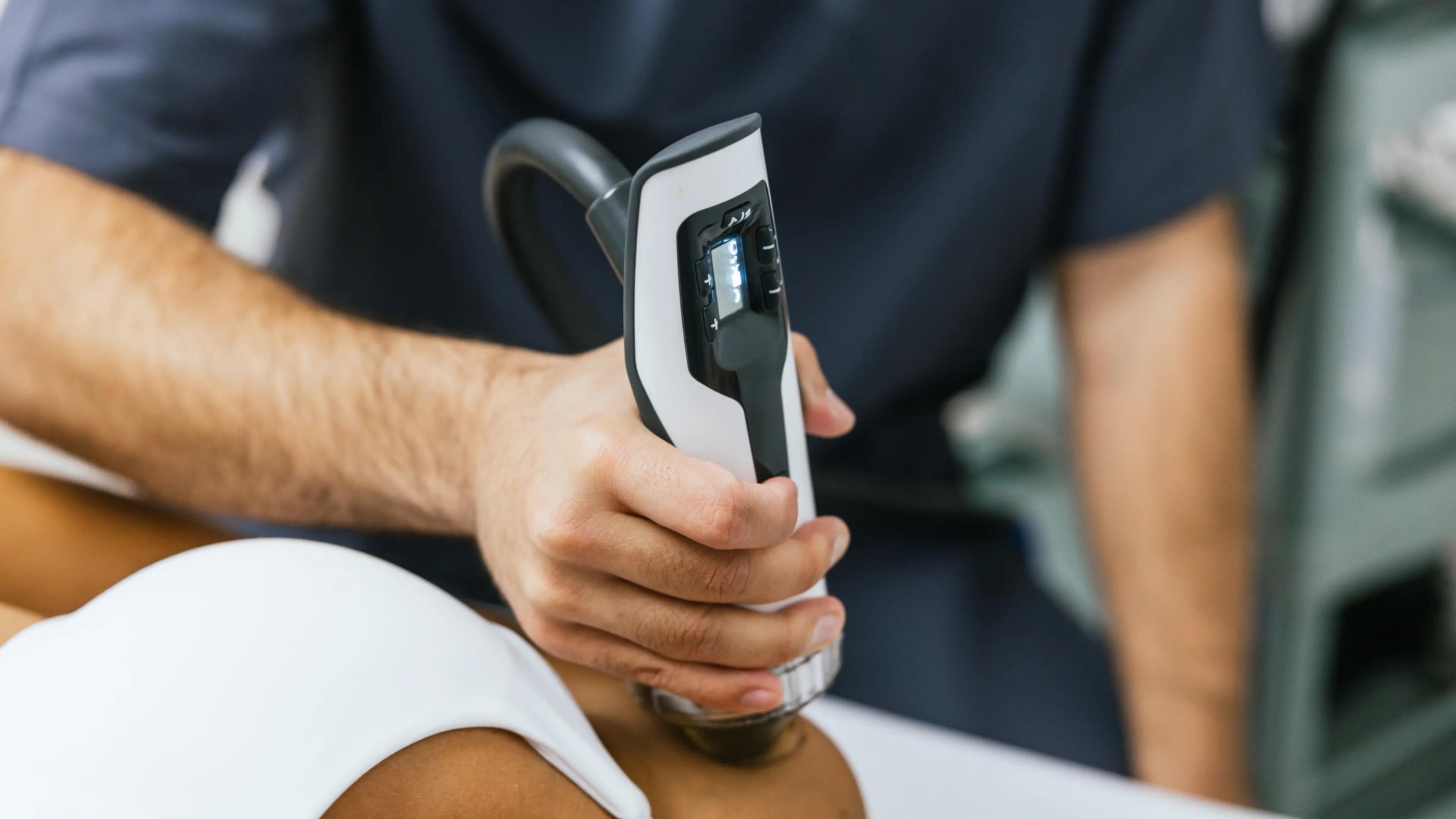
- The treatment itself. We move a handpiece over the area, delivering rapid pulses that feel like a strong tapping or pulsing on the skin. Treating one area usually takes only about five to ten minutes.
- Comfort adjustments. We start gentler and increase the intensity to a level you can tolerate, and we adjust throughout, so tell us how it feels.
- Right after. There is no recovery time. You can drive and return to your day, though we usually suggest easing off very high-intensity activity on the treated area for a day or two.
- A short series. Most conditions are treated with a course of about three to six sessions, usually spaced about a week apart, since the healing response builds between visits.
Many people feel some relief early in the course, while the fuller benefit tends to develop over the following weeks as the tissue responds.
Does shockwave hurt, and is it safe?
Shockwave is generally well tolerated, and it is a safe, non-invasive treatment for most people. During the session you feel a firm tapping, and sore spots can be tender, but we adjust the intensity to keep it manageable, and it does not require any anesthesia.
Afterward, you may notice mild soreness, redness, or occasionally slight bruising in the treated area for a day or two, which settles on its own. Serious side effects are uncommon. That said, shockwave is not for everyone. We avoid or take special care with it during pregnancy, over areas with an active infection or a tumour, in people with bleeding disorders or on blood-thinning medication, near the lungs or major nerves and vessels, and over the growth plates of children. This is exactly why an assessment comes first, so we can confirm it is appropriate and safe for you.
How does Unpain Clinic use True Shockwave?
We use True Shockwave as one powerful tool within a plan built around your specific problem, not as a standalone fix. It starts with a thorough 60 minute, one-on-one assessment to find the root cause of your pain and confirm shockwave is a good fit. From there, we match the technology to the target, using focused shockwave to reach deeper, specific structures and radial pressure waves for broader, more superficial muscle tension.

We also combine it with our other care to treat the whole problem:
- Shockwave plus EMTT. For chronic or inflamed tissue, we often pair shockwave with EMTT, a magnetic field therapy that supports cellular repair over a broader area.
- Neuromodulation for sensitized pain. When pain has become oversensitive, NESA neuromodulation can help calm the nervous system so treatment and movement are better tolerated.
- Hands-on care and exercise. Our physiotherapy, chiropractic care, and massage therapy, plus a tailored exercise program, rebuild the tissue and fix the mechanics that caused the problem, so relief lasts.
Because shockwave restarts healing but exercise rebuilds the tissue, we treat them as partners. We are honest that results vary and that shockwave is not right for every condition, and we will tell you if we do not think it is the best fit for you.

Frequently asked questions
How does shockwave therapy work?
Shockwave therapy delivers focused acoustic pulses into injured tissue, and the cells respond by increasing repair activity. It boosts blood flow and new vessel growth, prompts the release of growth factors, can break down calcium deposits, and calms overactive pain nerves. Rather than masking pain, it aims to restart healing in a chronic injury that has stalled.
Does shockwave therapy hurt?
Most people find it very tolerable. You feel a strong tapping or pulsing sensation, and tender spots can be briefly uncomfortable, but the intensity is adjusted to a level you can handle, and no anesthesia is needed. Mild soreness afterward for a day or two is normal and settles on its own.
How many shockwave sessions will I need?
Most conditions are treated with a course of about three to six sessions, usually spaced roughly a week apart. The exact number depends on the condition, how long-standing it is, and how you respond. Many people notice some relief early, with the fuller benefit developing over the following weeks.
What conditions does shockwave therapy treat?
It treats a range of chronic musculoskeletal problems, with the strongest evidence for plantar fasciitis, calcific tendon problems like calcific shoulder tendinitis, and lower-limb tendinopathies. Evidence is growing for knee osteoarthritis, patellofemoral pain, low back and sacroiliac pain, and slow-healing bone. It is not better than other options for every condition, so an assessment determines whether it fits your case.
Is shockwave therapy safe?
Yes, for most people it is a safe, non-invasive treatment with only minor, short-lived side effects like soreness or redness. It is avoided or used with extra care during pregnancy, over infections or tumours, in people with bleeding disorders or on blood thinners, near the lungs or major nerves and vessels, and over children's growth plates. A pre-treatment assessment confirms it is appropriate for you.
How soon will I see results?
Some people feel relief within the first session or two, but shockwave is not usually an instant fix. Because it works by stimulating healing, the benefit tends to build over the weeks during and after your course of sessions. Pairing it with exercise and addressing the root cause gives the best and most lasting results.
What is the difference between focused and radial shockwave?
Focused shockwave, the true shockwave, concentrates its energy at a chosen depth, so it can precisely target deeper structures like a tendon or a specific painful spot. Radial pressure waves spread energy more broadly and superficially, which suits larger, shallower areas like tight muscle. We choose the technology, or a combination, based on what and where we are treating.
“I came to Dr. Lacina Barsalou with a shoulder injury that healed wrong, and a strong desire to feel some sense of normalcy pain wise. I’ve seen all the therapists and tried all of the different options. Specifically shockwave works great on releasing my scar tissue and tension. Prior to Dr. Lacey, I was getting consistent shockwave with some results but time between appointments always made it hard. With Dr. Lacey, she is working with my body, not against it, and targeting the areas I share with her where I feel physically “stuck.” She is a truly talented assessor with a deep knowledge of the human body. She is kind, gentle, and a true friend to her patients. Sometimes when I see her, I’ve had a bad day, and just a Doctor Lacey hug can help. She is beyond skilled as a health care professional and chiropractor and I will never choose to see anyone else again. Their treatments are worth every penny when they allow you to move properly again. There is a reason that it’s called the “Unpain Clinic.”-Kristen Hyde
About the author
Written by Uran Berisha, Founder of Unpain Clinic and Medical Shockwave Institute. Uran has a Bachelor of Science in Physiotherapy and is an International Educator in Shockwave Therapy.
Medically reviewed by Uran Berisha.
Ready to find out if shockwave is right for you?
If chronic pain has not responded to rest, medication, or standard treatment, the next step is a one-on-one assessment where we find the root cause and tell you honestly whether True Shockwave is a good fit. Your first visit is 60 minutes, assessment only, and includes:
- A full history and a look at your goals
- Head-to-toe orthopedic and movement testing
- A plain-language explanation of what is driving your pain
- A personalized treatment plan
No referral needed. No pressure, no contracts. If we do not think this approach is a good fit for you, we will tell you honestly. Book your initial assessment and let's find out what is really going on and how to fix it.
References
- Furia JP, Rompe JD, Cacchio A, Maffulli N. Shock wave therapy as a treatment of nonunions, avascular necrosis, and delayed healing of stress fractures. Foot and Ankle Clinics. 2010;15(4):651-662. https://doi.org/10.1016/j.fcl.2010.07.002
- Al-Siyabi Z, Karam M, Al-Hajri E, Alsaif A, Alazemi M, Aldubaikhi AA. Extracorporeal shockwave therapy versus ultrasound therapy for plantar fasciitis: a systematic review and meta-analysis. Cureus. 2022;14(1):e20871. https://doi.org/10.7759/cureus.20871
- Majidi L, Khateri S, Nikbakht N, Moradi Y, Nikoo MR. The effect of extracorporeal shock-wave therapy on pain in patients with various tendinopathies: a systematic review and meta-analysis of randomized control trials. BMC Sports Science, Medicine and Rehabilitation. 2024;16(1):93. https://doi.org/10.1186/s13102-024-00884-8
- Elgendy MH, Khalil SE, ElMeligie MM, Elazab DR. Effectiveness of extracorporeal shockwave therapy in treatment of upper and lower limb tendinopathies: a systematic review and meta-analysis. Physiotherapy Research International. 2024;29(1):e2042. https://doi.org/10.1002/pri.2042
- Leal C, D'Agostino C, Gomez Garcia S, Fernandez A. Current concepts of shockwave therapy in stress fractures. International Journal of Surgery. 2015;24(Pt B):195-200. https://doi.org/10.1016/j.ijsu.2015.07.723
- Zhou M, Dong Z, Wei C, Feng L, Wang X, Liu H, et al. Efficacy and safety of extracorporeal shock wave therapy combined with sodium hyaluronate in treatment of knee osteoarthritis: a systematic review and meta-analysis. Journal of Traditional Chinese Medicine. 2024;44(2):243-250. https://doi.org/10.19852/j.cnki.jtcm.20231226.002
- Neculaes M, Hernandez-Lucas P, Ioana-Bianca I, Lucaci P. Contribution of shockwave therapy in the functional rehabilitation program of patients with patellofemoral pain syndrome. Journal of Clinical Medicine. 2024;13(23):7260. https://doi.org/10.3390/jcm13237260
- Liu K, Zhang Q, Chen L, Zhang H, Xu X, Yuan Z, Dong J. Efficacy and safety of extracorporeal shockwave therapy in chronic low back pain: a systematic review and meta-analysis of 632 patients. Journal of Orthopaedic Surgery and Research. 2023;18(1):455. https://doi.org/10.1186/s13018-023-03943-x
- Moon YE, Seok H, Kim SH, Lee SY, Yeo JH. Extracorporeal shock wave therapy for sacroiliac joint pain: a prospective, randomized, sham-controlled short-term trial. Journal of Back and Musculoskeletal Rehabilitation. 2017;30(4):779-784. https://doi.org/10.3233/BMR-150405
Related Topics