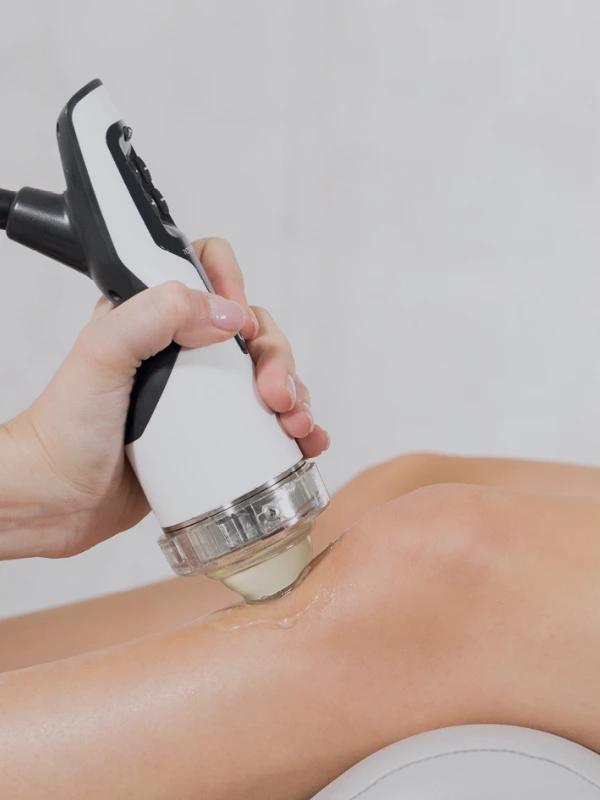
Discover how shockwave therapy may help Jumper’s Knee heal faster. Non-surgical, evidence-based treatment in Edmonton at Unpain Clinic.
Key takeaways
- Jumper's knee, or patellar tendinopathy, is a stubborn overuse injury of the tendon just below the kneecap.
- Exercise is the foundation of recovery, and it is what rebuilds the tendon, so any other treatment works best built around it.
- For jumper's knee specifically, the research on shockwave is limited, and studies have not shown it clearly beats good conservative care.
- Where shockwave earns its place is in stubborn, chronic cases that have not responded to a proper exercise program, used as an adjunct.
- The fastest, strongest recovery comes from the whole plan: exercise, fixing the root cause, and shockwave where it fits, not any single tool.
In this article
- What is jumper's knee, and why is it so stubborn?
- Can shockwave therapy help jumper's knee?
- How does shockwave therapy work?
- What does the research say about shockwave for jumper's knee?
- How does shockwave help you recover faster and stronger?
- What should you expect during shockwave treatment?
- How does Unpain Clinic treat jumper's knee?
- What can you do at home?
- Frequently asked questions
If jumper's knee has been holding you back, you have probably wondered whether shockwave therapy is the answer that finally gets you moving again. It can be part of the answer, and this guide gives you an honest picture of where it helps and where it does not. Jumper's knee, the common name for patellar tendinopathy, is stubborn, but it does recover with the right plan. For the full walkthrough of symptoms, straps, taping, and exercises, see our complete guide to jumper's knee; this article focuses on where shockwave fits.
This is general information, not a substitute for a professional assessment or medical advice.
What is jumper's knee, and why is it so stubborn?
Jumper's knee is an overuse injury of the patellar tendon, the cord connecting your kneecap to your shinbone, that comes from repetitive loading in sports with a lot of jumping and sprinting. Over time, small tears build up and the tendon tissue becomes degenerative rather than simply inflamed, which is why clinicians call it patellar tendinopathy. The pain is load-related, flaring when you stress the knee and easing when you stop.
It is stubborn for a few reasons. Tendons have a relatively poor blood supply, so they heal slowly, and if high-impact activity continues without recovery time, the damage accumulates. In chronic cases the tendon's internal structure changes and the healing response stalls, so the ache can drag on for months.
Often the deeper driver is elsewhere in the chain. Tight quads, weak glutes, or limited ankle mobility can overload the tendon with every movement, so lasting recovery means addressing those factors, not just the tendon. This is the root-cause view we take, and it is the backdrop for understanding where a treatment like shockwave does and does not help.

Can shockwave therapy help jumper's knee?
Shockwave therapy can help in the right situation, but it is important to be honest about what that situation is. For jumper's knee specifically, it is not a first-line fix for every case, and the strongest evidence puts exercise, not shockwave, at the centre of recovery. Where shockwave earns a role is as an adjunct for stubborn, chronic cases that have not responded to a proper exercise program.
That honesty actually helps you, because it points your effort where it counts. A structured, progressive loading program is what rebuilds the tendon and resolves most cases. Shockwave is a non-invasive option that may support that process when things are stuck, by aiming to restart stalled healing in the tendon. It is best thought of as a complement to your rehabilitation, not a replacement for it.
So the realistic answer is yes, with context. If you have chronic jumper's knee that has plateaued despite doing the right exercises, shockwave is a reasonable, low-risk thing to add. If you have not yet done a proper loading program, that is where to start, and our complete guide to jumper's knee lays that out.

How does shockwave therapy work?
Shockwave therapy delivers acoustic pulses into the tendon through a handpiece on the skin, with no needles or medication, and those pulses prompt a biological healing response. The mechanism is what makes it a candidate for a stalled tendon injury: the pulses increase blood flow, encourage the growth of small new blood vessels, and stimulate repair activity, while also appearing to calm local pain nerves.
This matters because tendons heal slowly partly due to their limited blood supply, so a treatment that boosts circulation and reactivates repair has a logical rationale for chronic tendinopathy. Our explainer on how shockwave therapy works covers this in more detail.
The key is that the rationale is strong, but the results are condition-specific. Shockwave clearly helps some conditions more than others, which is exactly what the research on jumper's knee shows, and why it is worth looking at the evidence honestly rather than assuming it works equally well everywhere.

What does the research say about shockwave for jumper's knee?
The research says the evidence for shockwave in jumper's knee is limited and mixed, and that is worth knowing before you invest time and money. Being straight about it helps you make a good decision.
A 2023 systematic review and meta-analysis that looked at patellar tendinopathy, Achilles tendinopathy, and plantar fasciitis found that shockwave had a negligible effect on pain and function for patellar tendinopathy compared with placebo, whether used alone or added to eccentric exercise. Tellingly, the same review found shockwave had a large effect for plantar fasciitis [1]. In other words, shockwave is not weak in general, its benefit just depends heavily on the condition, which our guide to shockwave for plantar fasciitis reflects. A 2022 systematic review and meta-analysis focused on jumper's knee in athletes similarly found no significant long-term differences between shockwave and other conservative treatments, and concluded that no clear, generalizable claims can be made about its effectiveness for patellar tendinopathy [2].
That said, there is a place for it. A review of shockwave in chronic patellar tendinopathy reported good results in chronic cases and recommended considering it when conventional treatments have not worked [3], and other management guidance frames shockwave as offering limited clinical benefit that is best reserved for when exercise and other conservative measures are not enough [8].
The honest summary is this. For jumper's knee, exercise is the proven foundation, and shockwave has not been shown to clearly outperform good conservative care. It is reasonable as an adjunct for stubborn, chronic cases that have stalled, but it is not a substitute for doing the rehabilitation. We would rather tell you that than oversell it.
How does shockwave help you recover faster and stronger?
Where shockwave contributes to a faster, stronger recovery, it does so as part of a comprehensive plan, not on its own. The recovery that gets you back to sport comes from stacking the right things together, and shockwave can be one of them for the right person.
Here is how it fits. Exercise rebuilds the tendon's capacity and is the engine of recovery. Fixing the root cause, the tight quads, weak glutes, or stiff ankle overloading the tendon, keeps it from staying overloaded. And for a chronic case that has plateaued, shockwave may help by restarting stalled healing in the tendon, which can create momentum so your rehabilitation starts working again. In that sense, shockwave does not replace the work, it can help you get unstuck so the work pays off, and it may let you progress your loading program with less pain.
So the path to recovering faster and stronger is the whole plan. It is not shockwave alone, and it is not exercise alone for a case that has stalled, it is the combination, matched to where you are. That is the honest version of how a treatment like shockwave earns its place, and it is how we use it.

What should you expect during shockwave treatment?
A shockwave session for jumper's knee is quick and done in the clinic with no downtime. Knowing the steps makes it easy.
- Assessment and set-up. We confirm shockwave is appropriate for your case and locate the exact spot on the tendon. You sit comfortably, and gel is applied to the skin.
- The treatment. A handpiece delivers rapid pulses over the tendon and its attachment, felt as a firm tapping. A session usually takes only about ten to fifteen minutes.
- Comfort adjustments. It can feel a bit sharp over tender spots, so we start lower and build the intensity to a level you can tolerate, adjusting throughout.
- Right after. There is no recovery time, so you can carry on with your day, though we suggest easing off very high-impact activity on the knee for a day or two.
- A short course. Treatment is typically once a week for around three to five sessions, since the healing response builds between visits.
Some mild soreness in the area for a day or two afterward is normal, and any discomfort during the pulses stops as soon as they do.
How does Unpain Clinic treat jumper's knee?
We treat jumper's knee by building the plan around the exercise that works, finding and fixing the whole-body factors overloading your tendon, and adding shockwave and other tools where they genuinely help. It starts with a thorough 60 minute, one-on-one assessment of your knee, hips, ankles, and movement, since imbalances above or below the knee often overload the patellar tendon, a point our founder makes often about treating the root cause rather than just the sore spot.

From there, a plan usually combines several of the following:
- A progressive exercise program. Since exercise is the most effective treatment, this is the centrepiece. We coach isometric work early for pain, progress to eccentric decline squats and heavy slow resistance to rebuild the tendon, and strengthen the hips, glutes, and core to fix the mechanics behind the overload.
- Manual therapy. Our physiotherapy, chiropractic care, and massage therapy release tight quads and improve knee and ankle mobility, so the tendon is under less strain.
- Shockwave for stubborn cases. For chronic jumper's knee that has not responded to a proper exercise program, we may add focused shockwave therapy as an adjunct. We are honest that the evidence for shockwave in jumper's knee specifically is limited, so we use it to complement the exercise that does the real work.
- EMTT and neuromodulation. Where pain has become sensitized over many months, EMTT and NESA neuromodulation may help calm the area so you can progress your exercises more comfortably.
- Education and prevention. We coach landing technique, pacing, and a gradual return to sport, so the injury is less likely to come back.
We are honest that recovery takes consistency and that results vary. Because exercise rebuilds the tendon while the other tools support the process, we keep the strengthening at the core, and we will tell you if we do not think a treatment is worth it for you. For the bigger picture on knee pain, our guide to what causes knee pain is a useful companion.

What can you do at home?
A consistent home routine does much of the work. Keep everything within a comfortable range, use pain as your guide, and check with your clinician if you are unsure.

- Modify, do not fully rest. Ease off the jumping and running that flare it, swap in low-impact options like cycling or swimming, and avoid deep knee bends for now, while staying gently active.
- Do your loading exercises. Start with isometric wall sits or quad sets for pain, then progress to slow eccentric decline squats to rebuild the tendon, done every other day within a tolerable range.
- Strengthen your hips and core. Clamshells, side-lying leg lifts, band walks, and bridges take load off the tendon by improving how your knee is controlled during activity.
- Use a strap during activity. An infrapatellar strap worn just below the kneecap can reduce pain enough to let you stay active and do your rehab.
- Ice a flare, and return gradually. Ice after activity if the knee is sore, and rebuild impact and sport slowly once pain settles, keeping up your strength work to prevent relapse.
If your pain is not improving with consistent effort, an assessment can confirm the diagnosis and whether an adjunct like shockwave makes sense for your case.
Frequently asked questions
Does shockwave therapy work for jumper's knee?
The evidence is limited and mixed for jumper's knee specifically. High-quality reviews have found shockwave has a negligible effect for patellar tendinopathy compared with placebo, and no clear long-term advantage over other conservative treatments. It may still help as an adjunct for stubborn, chronic cases that have not responded to exercise. So it can be worth trying in the right situation, but it is not a substitute for a proper loading program, which is the proven foundation.
Is shockwave better than exercise for jumper's knee?
No. Exercise is the proven first-line treatment and the foundation of recovery, and shockwave has not been shown to outperform good conservative care for jumper's knee. Shockwave is best used alongside exercise, particularly for chronic cases that have plateaued, rather than in place of it. The strongest results come from the combination, with the strengthening doing the heavy lifting.
How many shockwave sessions would I need for jumper's knee?
If shockwave is used, a typical course is about three to five sessions, usually once a week, since the healing response builds between visits. The exact number depends on how you respond and is decided with your clinician. It is always paired with your exercise program rather than used on its own.
Does shockwave therapy hurt?
Most people find it tolerable. You feel a firm tapping over the tendon that can be briefly sharp on tender spots, but the intensity is adjusted to your comfort and no anesthesia is needed. Some mild soreness for a day or two afterward is normal, and any discomfort during the pulses stops as soon as they do.
How soon would I see results from shockwave for jumper's knee?
Shockwave is not an instant fix, and because the evidence in jumper's knee is limited, results vary and are not guaranteed. If it helps, the benefit tends to build over the weeks during and after a course, especially when combined with your exercise program. If several weeks bring no change, it is worth reassessing the plan rather than continuing indefinitely.
When should I consider shockwave for my jumper's knee?
The best time to consider it is when you have chronic jumper's knee that has not responded to a proper, consistent exercise program and root-cause work. In that situation, shockwave is a reasonable, low-risk adjunct to try. If you have not yet done a structured loading program, that is the higher-value place to start, since it is the treatment with the strongest evidence.
“I took my son to Dr.Lacina. We had been seeing several other health professionals throughout the summer and Dr. Lacina performed the most thorough assessment of any of them! She treated him for his back pain via shockwave therapy and chiropractic. She also identified that he may benefit from shockwave to his knee and ankle by listening intently to him during the assessment and treated him as part of the same appointment. Although he ended up having a more major injury than initially suspected, she was amazing to deal with and has followed up with me personally several times and continued to offer additional advice. She is highly educated and knowledgeable in her field. I recommend Dr. Lacina at the Unpain Clinic for any sort of ailment you may have currently or if you are suffering from past injuries.”- Rhelda Baschuk
About the author
Written by Uran Berisha, Founder of Unpain Clinic and Medical Shockwave Institute. Uran has a Bachelor of Science in Physiotherapy and is an International Educator in Shockwave Therapy.
Medically reviewed by Uran Berisha.
Ready to get your knee moving again?
If jumper's knee is holding you back, the next step is a one-on-one assessment where we find out why your tendon is overloaded and build you a clear, honest plan, whether that is a loading program, hands-on care, shockwave as an adjunct, or a combination. Your first visit is 60 minutes, assessment only, and includes:
- A full history and a look at your goals
- Head-to-toe orthopedic and movement testing of your knee, hips, and ankles
- A plain-language explanation of what is driving your pain
- A personalized recovery roadmap
No referral needed. No pressure, no contracts. If we do not think a treatment is a good fit for you, we will tell you honestly. Book your initial assessment and let's get you back to jumping, running, and playing without that ache.
References
- Charles R, Fang L, Zhu R, Wang J. The effectiveness of shockwave therapy on patellar tendinopathy, Achilles tendinopathy, and plantar fasciitis: a systematic review and meta-analysis. Frontiers in Immunology. 2023;14:1193835. Conclusion: shockwave has a negligible effect for patellar tendinopathy but a large effect for plantar fasciitis. https://doi.org/10.3389/fimmu.2023.1193835
- Stania M, Król T, Marszałek W, Michalska J, Król P. Treatment of jumper's knee with extracorporeal shockwave therapy: a systematic review and meta-analysis. Journal of Human Kinetics. 2022;84:124-134. Found no significant long-term differences between shockwave and conservative treatments in athletes with jumper's knee. https://doi.org/10.2478/hukin-2022-0089
- Leal C, Ramon S, Furia J, Fernandez A, Romero L, Hernandez-Sierra L. Current concepts of shockwave therapy in chronic patellar tendinopathy. International Journal of Surgery. 2015;24(Pt B):160-164. Reported good results in chronic patellar tendinopathy and recommended shockwave when conventional treatments fail. https://doi.org/10.1016/j.ijsu.2015.09.066
- Berisha U (Host). Eliminate the cause of your knee pain with True Shockwave therapy. Unpain Clinic Podcast, Episode 5 (July 28, 2021). Discusses treating root causes such as hip and ankle issues, and how shockwave is used to support tissue healing and blood flow rather than only masking pain.
- Unpain Clinic. Shockwave Therapy Edmonton: Focal vs Radial for Heel Pain. Blog article, September 2025. Explains shockwave mechanisms and evidence across tendinopathies, noting that for patellar tendinopathy the evidence is mixed and shockwave is best combined with exercise, and details typical treatment protocols and patient sensations.
- Unpain Clinic. Shockwave Therapy for Heel Spurs and Plantar Fasciitis in Edmonton. Blog article, September 29, 2025. Reports that shockwave reduced chronic heel pain and improved function in trials, supporting shockwave as an effective non-invasive option for stubborn tendon and fascia problems.
- Unpain Clinic. Erase your Achilles pain with the Unpain method. Podcast/YouTube, July 3, 2021. Shares a whole-kinetic-chain approach for Achilles tendinopathy, noting that combining shockwave with eccentric exercise led to the best outcomes, which parallels the approach for jumper's knee.
- Khan K, et al. Management of patellar tendinopathy. British Journal of Sports Medicine. 2018;52(24):1575-1576. Indicates that shockwave provides limited clinical benefit in patellar tendinopathy and is best considered when exercise and other conservative measures are not sufficient.
- Unpain Clinic Podcast. The Truth About Chronic Knee Pain. Highlights that knee pain often stems from dysfunction in the hips or ankles, and that treatments like shockwave combined with correcting movement patterns can yield lasting relief.
- Unpain Clinic. Physical Therapy for Tendonitis in Edmonton (FAQ). Explains tendonitis versus tendinosis and standard treatments, including that shockwave is used by physiotherapists to help relieve tendon pain.
Related Topics