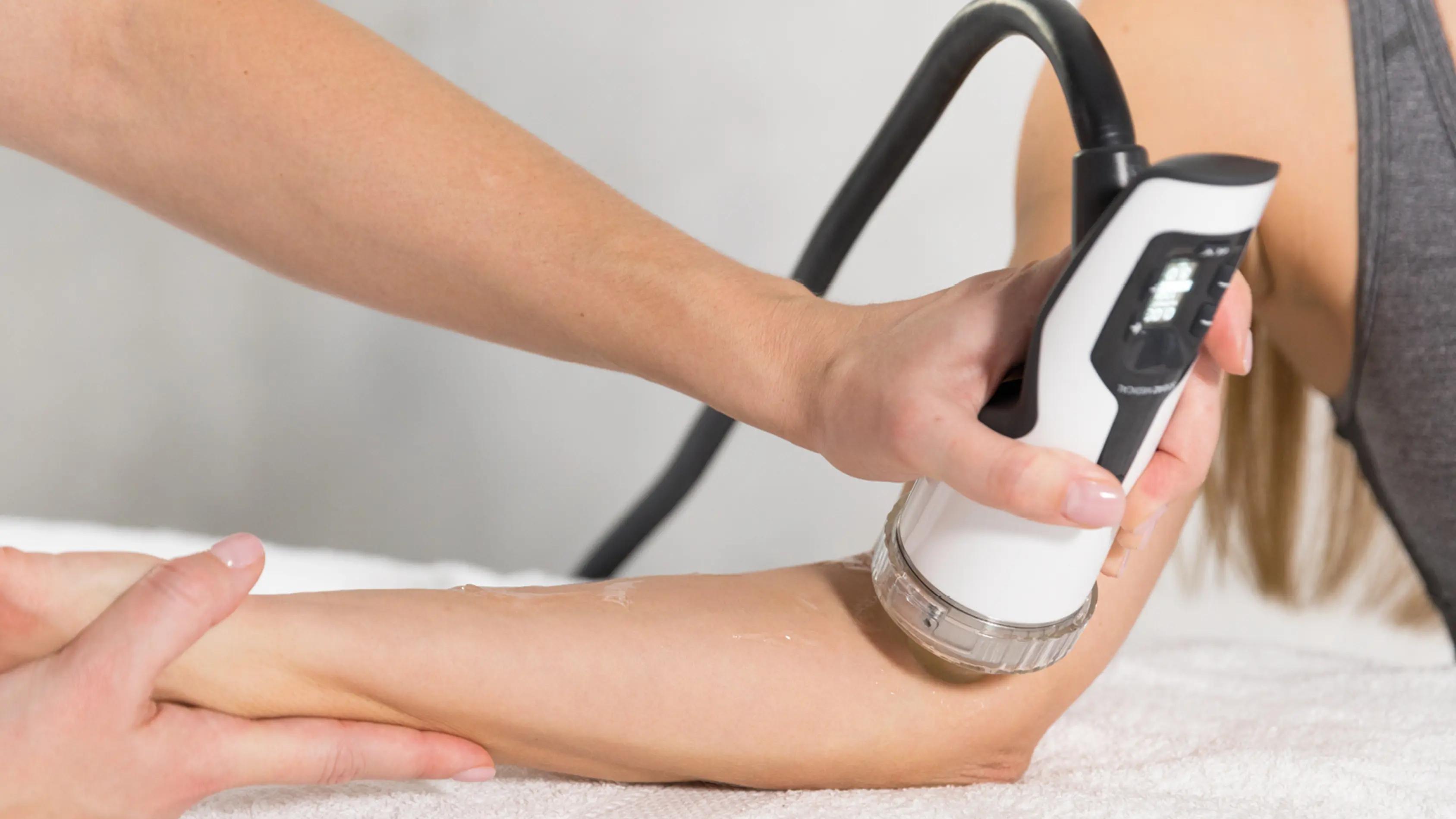
Struggling with Golfer’s Elbow? Learn how shockwave therapy for Golfer’s Elbow may help chronic tendon pain when rest and physio fail.
When the "Right" Things Stop Working
You've done what you were told to do.
You rested. You iced. You stretched. You tried physiotherapy. Maybe you changed your grip, took time off the gym, or stopped golfing for a season. And yet that sharp little sting on the inside of your elbow still shows up when you pour coffee, carry groceries, lift a kettlebell, or swing a club.
It's frustrating. It's also one of the most common reasons people start searching for shockwave therapy for golfer's elbow not because they're chasing a trend, but because they want a real, non-surgical plan that finally moves the needle.
Here's what we'll cover in plain language:
- What golfer's elbow actually is (and why it gets stuck)
- What current research says about shockwave therapy for medial epicondylitis
- How shockwave therapy is thought to work
- What to realistically expect from a treatment course
- How we approach this condition at Unpain Clinic in Edmonton

What Is Golfer's Elbow, Really?
Golfer's elbow is the everyday name for medial epicondylitis pain and sensitivity along the bony bump on the inside of your elbow. That's where your wrist flexor and forearm pronator tendons attach.
In plain English: it's usually not the joint that's the problem. It's the tendon attachment that's been overloaded and irritated over time.
And despite the name, you don't need to play golf to get it. We see it in:
- Gym-goers (deadlifts, pull-ups, kettlebells)
- Office workers and gamers
- Tradespeople, mechanics, hairstylists, dental professionals
- Climbers, racquet sport players, throwers
- Parents lifting toddlers all day
If your daily life involves gripping, pulling, lifting, or repetitive wrist motion, the inside of your elbow is on the front line.

Why "Just Rest It" Often Fails
Most people assume tendon pain should behave like a paper cut: rest a few weeks, and it heals.
Stubborn elbow tendinopathy doesn't usually follow that script. In chronic cases, research describes it less as a simple inflammation and more as tendinosis changes in the tendon's structure and a stalled healing response. That's one reason anti-inflammatories and time off often feel disappointing.
The pattern usually looks like this:
- You stop the activity because it hurts.
- It calms down a bit.
- You return to normal life or sport.
- The pain comes back because the tendon never regained capacity.
Standard conservative care (rest, stretching, NSAIDs, eccentric loading) is a solid foundation, but for some people it isn't enough on its own. If you'd like a deeper look at why a typical home routine often plateaus, our companion article Why Your Golfer's Elbow Remedy Hasn't Worked Yet walks through the common missing pieces.
What the Research Says About Shockwave Therapy for Golfer's Elbow
Here's the honest version: direct research on shockwave therapy specifically for golfer's elbow is more limited than research on tennis elbow (its lateral counterpart). We'll show you both, and be clear about what each one means.
Direct evidence on medial epicondylitis
- A randomized trial in newly diagnosed medial or lateral epicondylitis compared low-energy shockwave therapy with steroid injection. The shockwave group received roughly 2,000 impulses, low energy flux density 0.06–0.12 mJ/mm², once a week for three weeks. Both groups improved, and over follow-up the groups looked similar suggesting shockwave can be a reasonable option, especially when injections aren't desired.
- A more recent RCT focused specifically on medial epicondylitis compared PRP injections with extracorporeal shockwave therapy in 54 patients. Both groups improved in pain and function at 12 and 24 weeks. PRP showed an edge by six months, but the authors concluded both approaches appeared safe and effective.
- A BJSM systematic review noted that, within their included studies, all randomized trials happened to be on lateral epicondylitis — so the strongest evidence base sits on the outside of the elbow, not the inside.
What tennis elbow research can carefully suggest
Tennis elbow and golfer's elbow aren't the same condition, but they're closely related overuse tendon problems. Clinicians often look to tennis elbow research as the closest cousin when setting expectations:
- A 2025 umbrella review of meta-analyses concluded that shockwave therapy can reduce pain compared with placebo in lateral epicondylitis, with some heterogeneity in the data.
- A 2022 network meta-analysis (40 RCTs) found shockwave outperformed placebo for short- and medium-term pain and ranked highest for grip strength recovery among non-surgical options.
- A 2024 meta-analysis across multiple tendinopathies found statistically significant pain reductions, with lateral epicondylitis among the conditions favoring shockwave.
- Not every review is positive. A 2023 review in JSES International pooled two trials and found no benefit over no active treatment.
The honest takeaway
Shockwave therapy is not magic, and study results depend heavily on the device, energy level, dose, chronicity, and what it's being compared against. But overall, for stubborn tendon pain, there is credible evidence that it can help particularly for lateral elbow tendinopathy, with direct (though smaller) support for medial epicondylitis.
How Shockwave Therapy Is Thought to Work
Shockwave therapy formally extracorporeal shockwave therapy (ESWT) delivers focused acoustic pulses into targeted tissue. (For a longer plain-language explainer, see Shockwave Therapy Explained.) Researchers describe several proposed mechanisms (none of them a fully settled "this is the one"):
- Mechanotransduction: Controlled micro-stress may stimulate biological signaling that nudges stalled healing forward.
- Pain modulation: Hyperstimulation of pain receptors may alter how pain signals are transmitted (similar in concept to gate-control theory).
- Vascular and tissue-regeneration signals: Some studies describe increased blood flow and growth factor activity in the area.
The honest framing: these are well-supported hypotheses, not a single proven pathway. What matters clinically is that the stimulus is real, the response is measurable, and the body does the rest of the work with proper loading between sessions.

What to Realistically Expect
The most realistic expectation isn't "one session and I'm cured." It's a structured course followed by reassessment.
In the research:
- Medial epicondylitis protocols often run weekly sessions for about three weeks, with improvement continuing in the weeks that follow.
- Outcomes in the PRP vs. shockwave trial were tracked at 12 and 24 weeks meaning real change tends to build over months, not days.
During treatment, you'll feel a rapid tapping or pulsing sensation. Some areas are tender; dose can be adjusted for tolerance.
After treatment, mild short-term soreness is common, followed by gradual improvement across weeks. Progress isn't always linear some weeks feel like a step back before the next step forward.
There are no guarantees. How well you respond depends on how long you've had symptoms, how much load your arm has to handle in daily life, and whether the tendon is the only issue or part of a bigger movement pattern. Our FAQ page covers more of the common questions about what to expect during and after a session.
How Unpain Clinic Approaches Golfer's Elbow
When you come to our clinic, what you usually want is simple: tell me what's going on, and give me a plan that finally works.
Step 1: A real assessment, not a quick look
Before any shockwave is delivered, we want to know:
- Is this truly medial epicondylitis, or is something else mimicking it?
- What loads flare it: gripping, pulling, wrist flexion, repetitive work?
- What's keeping it chronic: technique, training dose, strength gaps further up the chain, or recovery bottlenecks?
We don't treat elbows in isolation. The shoulder, neck, scapula, and even grip mechanics often play a role. That whole-body framing comes up often on the Unpain Clinic Podcast including episodes like Pain and Beyond: Exploring the Body's Complexities.

Step 2: Shockwave therapy as the main modality for stubborn tendons
If we identify a tendon driver, shockwave is one of the primary tools we use. We deliver focused shockwave to the area of greatest tendon involvement, adjusting intensity for tolerance similar to how dosing is handled in the published trials.

Step 3: Loading and recovery between visits
Sessions alone don't rebuild tendons. The structured loading work you do between sessions is part of why progress happens. We adjust your training, grip-heavy tasks, and recovery so the tendon has space to adapt instead of being re-irritated every day.
Step 4: Reassessment with real benchmarks
Because outcomes in the research keep evolving out to 12 and 24 weeks, we plan in phases, not single appointments. You'll know what we're measuring and when we expect to see it change.
Where to learn more
If you like to research before you commit, here are Unpain Clinic resources where shockwave therapy is discussed:
- Podcast: Why Cortisone Shots May Not Be Your Best Bet — Exploring Alternative Therapies for Pain Relief
- Podcast: Pain and Beyond: Exploring the Body's Complexities
- Article: Why Your Golfer's Elbow Remedy Hasn't Worked Yet
- Article: Shockwave Therapy Explained — Benefits, Uses & How It Works
What You Can Do at Home Between Sessions
General education — not a personal prescription.
Your job between sessions isn't to stop using your arm. It's to stop re-injuring the tendon while keeping the arm moving.
A few generally safe ideas:
- Reduce peak-grip moments for a few weeks: heavy carries, max pull-ups, thick-handled deadlifts. You're not quitting you're creating space for adaptation.
- Scale, don't stop. Use straps where they make sense, lighten loads, increase reps, choose neutral wrist positions.
- Gentle forearm mobility in a comfortable range (wrist flexion/extension, pronation/supination).
- Progressive loading under guidance, especially if all you've been doing is stretching. Chronic tendinosis often needs structured loading to actually change.
Seek urgent medical care if you have severe swelling after trauma, rapidly worsening numbness or weakness, fever with redness, or any other concerning systemic symptoms.

Frequently Asked Questions
Is shockwave therapy safe for golfer's elbow?
Clinical research describes shockwave therapy as a non-invasive option with a generally favorable safety profile in upper-limb tendon conditions. Studies typically screen out specific groups for example, pregnancy, bleeding/clotting disorders, malignancy, systemic or local infection, and pacemakers reflecting standard precautions your provider will review with you.Our FAQ covers more on contraindications.
How many sessions will I need?
Many elbow protocols use a short course of weekly sessions, often around three, followed by reassessment. Because meaningful change in medial epicondylitis is measured out to 12–24 weeks, plan in phases: initial sessions, then a longer adaptation window where function rebuilds.
Does it hurt?
It can be uncomfortable over a sensitive tendon. In published RCTs, clinicians adjusted impulses in the first week if pain tolerance was an issue — so some discomfort is expected and managed, not ignored.
Can it help if I've had golfer's elbow for years?
Chronic cases are exactly why many people consider shockwave. Evidence supports pain reduction in many studies, though results across reviews are mixed.For medial epicondylitis specifically, at least one RCT shows shockwave can improve pain and function over months, though it may not outperform every comparator in every study.
Who should not have shockwave therapy?
This is screened individually. Common research exclusion categories include pregnancy, bleeding/clotting disorders, malignancy, systemic infection, local infection at the treatment site, and pacemakers. Your clinician will review your history before treatment.
Is shockwave therapy covered by insurance?
Coverage varies by plan and province. Ask your insurer directly, and our team can help with documentation when you're ready to book an assessment.
What about side effects?
Most people report temporary soreness during or after treatment. Treatment parameters are routinely adjusted for tolerance and safety, and systematic reviews generally describe shockwave as safe when applied appropriately.
Final Thought
Golfer's elbow feels personal because it interferes with normal life lifting, training, sport, work, even shaking hands. When rest and standard physiotherapy haven't ended the cycle, it's reasonable to want a plan that's more targeted than "wait and see."
Based on the best available evidence, shockwave therapy for golfer's elbow is a credible non-surgical option that may reduce pain and improve function supported by direct trial evidence in medial epicondylitis and stronger (but still mixed) evidence in the closely related tennis elbow research.
It's not a guarantee. But for stubborn elbow pain, it's a reasonable next step when you want a structured plan built around measurable progress instead of guesswork.
Book Your Initial Assessment
At Unpain Clinic, we don't just ask "Where does it hurt?" — we work to understand why it hurts.
What's included in your initial assessment
- Comprehensive history and goal setting
- Orthopedic and muscle testing
- Movement analysis
- Imaging decisions, if needed
- Pain pattern mapping
- A personalized treatment roadmap
- Insurance and benefit guidance
The details
- 60 minutes
- Assessment only — no treatment in this visit
- You'll see a licensed Registered Physiotherapist or Chiropractor
What happens next
If shockwave therapy or another part of our care is a fit for you, we'll schedule your first treatment and start executing your plan.
👉 Book Your Initial Assessment
Author: Uran Berisha, B.Sc. PT, RMT
Shockwave Therapy Educator & Founder
Unpain Clinic & I Love Shockwave
References
- Testa G, et al. Extracorporeal Shockwave Therapy Treatment in Upper Limb Diseases: A Systematic Review. Journal of Clinical Medicine. 2020.
- Lee SS, et al. Effectiveness of Initial Extracorporeal Shock Wave Therapy on the Newly Diagnosed Lateral or Medial Epicondylitis. Annals of Rehabilitation Medicine. 2012.
- Singh SA, et al. Effectiveness of ultrasound-guided platelet-rich plasma injection in comparison with extracorporeal shock wave therapy on improving pain and function in medial epicondylitis of elbow: a randomized controlled trial. International Journal of Advances in Medicine. 2024.
- Dingemanse R, et al. Evidence for the effectiveness of electrophysical modalities for treatment of medial and lateral epicondylitis: a systematic review. British Journal of Sports Medicine. 2014.
- Zhu P, et al. Comparison of extracorporeal shockwave therapy, ultrasound therapy, and corticosteroid injections for treatment of lateral epicondylitis: an umbrella review of meta-analyses. Journal of Orthopaedics and Traumatology. 2025.
- Liu WC, et al. Extracorporeal Shock Wave Therapy Shows Superiority Over Injections for Pain Relief and Grip Strength Recovery in Lateral Epicondylitis: A Systematic Review and Network Meta-analysis. Arthroscopy. 2022.
- Majidi L, et al. The effect of extracorporeal shock-wave therapy on pain in patients with various tendinopathies: a systematic review and meta-analysis of randomized control trials. BMC Sports Science, Medicine and Rehabilitation. 2024.
- Cheema AS, et al. Transcutaneous electrical nerve stimulation (TENS) and extracorporeal shockwave therapy (ESWT) in lateral epicondylitis: a systematic review and meta-analysis. JSES International. 2023.
- Buchbinder R, et al. Shock wave therapy for lateral elbow pain — Cochrane Database of Systematic Reviews. Reference review on lateral elbow ESWT.
Related Topics