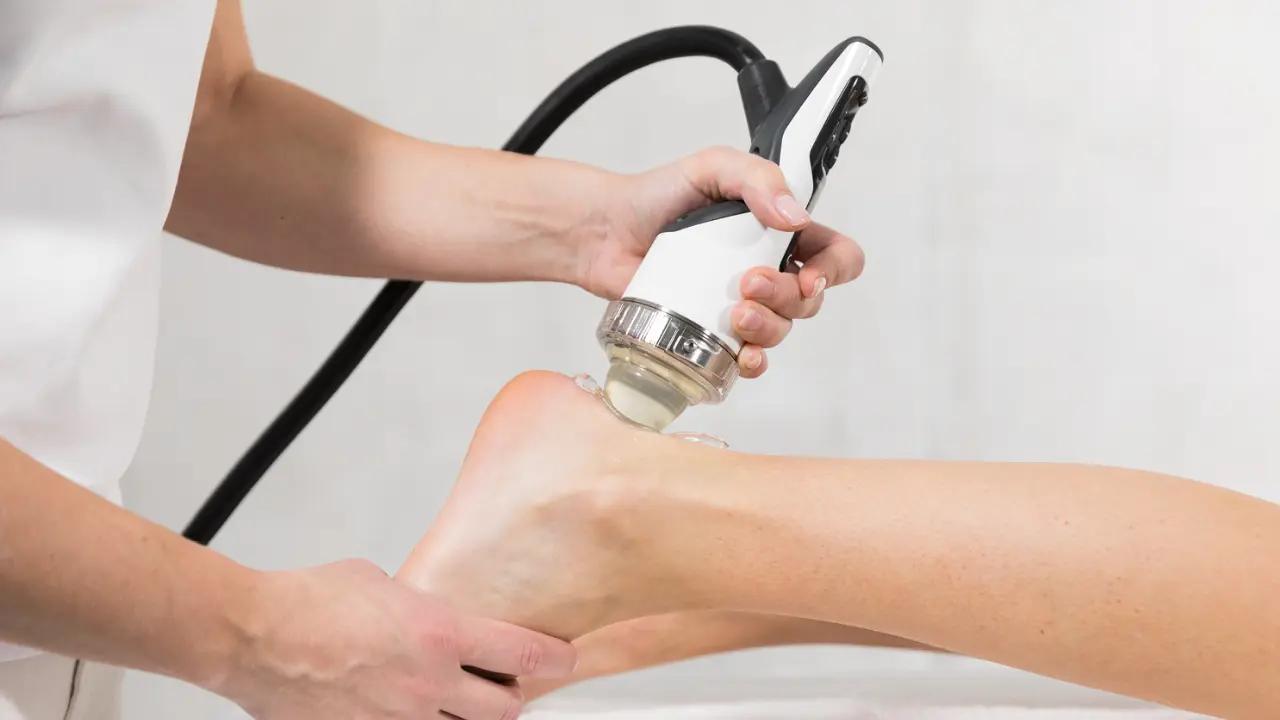
Shockwave therapy for Achilles tendinopathy may help reduce chronic tendon pain and support healing. Learn the evidence, expectations, and care plan.
Key takeaways
- Achilles tendinopathy is a degenerative overuse injury, not simple inflammation, and the tendon needs targeted loading and stimulus to heal, not just rest.
- The evidence is strongest for mid-portion Achilles tendinopathy, where shockwave combined with eccentric exercise gives the best results.
- For insertional Achilles tendinopathy, the evidence for shockwave is more mixed, and exercise modifications matter.
- Shockwave works by boosting blood flow, breaking down scar tissue, and triggering new collagen, essentially restarting a stalled healing process.
- At Unpain Clinic in Edmonton, shockwave is never used alone. We find why the tendon became overloaded, fix the mechanics, and pair shockwave with a structured exercise program.
In this article: what Achilles tendinopathy is, why it lingers, the honest picture from the research, how we treat it, what you can do at home, and common questions.
If every morning brings a sharp pain in the back of your heel that eases as you warm up and then returns after activity, your Achilles tendon is telling you something is not healing. Rest, ice, and painkillers may quiet the pain for a while, but the underlying tendon degeneration usually stays, which is why the pain comes right back. Shockwave therapy offers a non-surgical way to restart that stalled healing, and the research supports it, especially for the most common type of Achilles problem, when it is paired with the right exercise program.
This article walks through what is happening in the tendon, what the evidence honestly shows, and how we use shockwave at Unpain Clinic as part of a whole-body plan. For more detail, see our full guide to Achilles tendinopathy causes, treatments, and self-care.
This is general information, not a substitute for a professional assessment or medical advice. Results vary from person to person.
What is Achilles tendinopathy, and why won't it heal on its own?
Achilles tendinopathy is a condition where the Achilles tendon, the thick cord connecting your calf muscles to your heel, becomes painful and weakened from accumulated micro-tears and failed healing. Unlike a short-term tendonitis with active inflammation, chronic tendinopathy is mostly degeneration: the collagen fibres become disorganized and frayed, and abnormal blood vessels grow into the damaged area. This is why anti-inflammatory medication and rest often provide only temporary relief. The tendon needs a stimulus to remodel and rebuild, not just suppression of inflammation.
There are two main types. Mid-portion Achilles tendinopathy causes pain and thickening about 2 to 6 centimetres above the heel and is the more common type, often seen in runners and middle-aged adults. Insertional Achilles tendinopathy affects where the tendon attaches to the heel bone, sometimes with a bone spur, and treatment approaches differ slightly.
Why does it happen and persist? It is usually an overuse injury with contributing factors: a sudden jump in training, tight calves or limited ankle mobility, poor footwear or hard surfaces, and often biomechanical issues further up the chain. Weakness in the glutes or core can shift extra strain down to the Achilles, and over time the tendon's repair process cannot keep up with the damage. The nervous system may start to guard the area, causing a limp that weakens the tendon and calf further, which is why the problem can cycle on for months or years. As many as one in four people with Achilles tendinopathy eventually need surgery when conservative care fails [1], which is exactly why getting the right conservative treatment matters.

Why do standard treatments often fall short?
Standard treatments fall short because they tend to manage the symptom without rebuilding the tendon. Complete rest leads to tendon weakness, so the pain returns the moment you resume activity. Anti-inflammatories and cortisone can dull pain briefly, but they do not repair damaged collagen, and repeated cortisone weakens tendon tissue. Standard physiotherapy exercises are important, but if they only strengthen the calf and ignore weak glutes, tight hamstrings, or a stiff hip, the tendon keeps getting overloaded.
Where it hurts is not always why it hurts. Weak gluteal muscles or an old lower back issue can alter your gait and put excessive load on the Achilles, so a whole-body assessment is what separates lasting results from another round of rest and relapse.
What does the research say about shockwave therapy for Achilles tendinopathy?
The research is promising, honest about its limits, and clearest about one thing: shockwave works best when combined with exercise rather than used alone.
It is safe and effective for mid-portion Achilles tendinopathy. A 2022 systematic review of randomized trials concluded that shockwave therapy is a safe and effective modality for chronic mid-portion Achilles tendinopathy, with significant pain reduction and functional improvement, especially when combined with eccentric exercise and stretching [1]. A Sports Medicine Open analysis the same year found that adding shockwave to a loading program led to a clinically important improvement in tendon function scores for mid-portion cases [3].
It works best alongside exercise, not as a standalone. The best outcomes in the literature come from pairing shockwave with a structured loading program. In the landmark trial by Rompe and colleagues, people who received shockwave plus eccentric training had faster pain relief and higher activity levels at 12 weeks than those doing exercise alone [4]. Exercise builds strength and resilience in the new tissue that shockwave stimulates.
For insertional Achilles tendinopathy, the evidence is weaker. One systematic review found that shockwave was no better than placebo for insertional cases on average [3]. The biology differs, often involving bone spurs and compression, so the same protocol does not always translate. It does not mean shockwave never helps insertional pain, but expectations should be tempered and the exercise program modified to avoid compressing the tendon against the heel.
The overall quality of evidence is still developing. A 2023 meta-analysis noted that variability in study designs and small sample sizes make it hard to draw a firm conclusion that shockwave is clearly superior to other conservative treatments [2]. That is a fair assessment. Most experts consider shockwave an optional add-on to exercise therapy: helpful in many chronic cases, but not a guaranteed cure-all. The encouraging part is that no study has found serious harm from shockwave in Achilles treatment, and several have found meaningful benefits for people who had not improved with exercise alone.
How does it work? Shockwave sends high-energy sound waves into the tendon and surrounding tissue, creating a small mechanical stress that restarts a stalled healing process. It promotes new blood vessel growth in tissue that normally has poor circulation, triggers cellular regeneration and new collagen production, breaks down scar tissue and calcifications, and calms pain by reducing substance P and recalibrating nerve sensitivity. Our explainer on how shockwave therapy works goes deeper.

How does Unpain Clinic treat Achilles tendinopathy?
At Unpain Clinic in Edmonton, shockwave is one of our core tools for Achilles tendon issues, but it is never used alone. We start by finding why the tendon is under strain, because the true cause is often not in the Achilles itself.

A whole-body assessment. We examine your calf flexibility, ankle mobility, glute and core strength, gait, and any old injuries that may be altering how you move. It is common to find that weak hips or an imbalanced leg are quietly overloading the Achilles, creating the perfect conditions for injury.
Shockwave as the centrepiece. Focused shockwave targets the damaged tendon, and we also treat the calf and soleus where there is tension or trigger points, since tight calves feed directly into Achilles overload. Both radial shockwave and focused shockwave are available, and we choose based on the location and depth of the problem. Sessions deliver a few thousand pulses in just a few minutes, and most people describe a tolerable tapping sensation that the area adjusts to quickly. There is no anaesthesia and no downtime. We typically schedule one session per week, with most cases needing about three to five sessions and tougher, long-standing cases sometimes going to six or more.
Exercise built around the shockwave. We often do the shockwave first to reduce pain and prime the tendon, then coach exercises in the same visit so you can load the tissue while it responds best. That includes eccentric heel drops for mid-portion cases, modified to flat ground for insertional cases to avoid compressing the tendon, plus isometric calf holds for pain relief and glute strengthening to fix the mechanics above. You get a home program to continue between visits.
Hands-on care and supporting modalities. Our physiotherapy, chiropractic care, and massage therapy release tight calves and hamstrings, mobilize a stiff ankle, and address anything else the assessment found. For cases where the nervous system is amplifying the pain, EMTT or NESA neuromodulation may be added. But shockwave plus structured exercise stays at the centre, because that is the combination with the strongest evidence.
As Uran Berisha discussed in our podcast episode Erase Your Achilles Pain With the Unpain Method, the key is not to treat the Achilles in isolation: release the tight calves, activate the glutes, fix the movement patterns, and use shockwave to do what the tendon cannot do on its own, restart the healing at a cellular level. For insertional cases, we adjust the protocol, focusing shockwave more at the musculotendinous junction and avoiding deep heel drops, since forcing the tendon against the bone spur can aggravate it.
How do the common Achilles treatments compare?
Rest and activity modification settle a flare but leave the tendon weak, so the pain returns the moment you resume loading. Anti-inflammatories and cortisone dull the ache but do not rebuild collagen, and repeated steroid weakens the tendon further. Eccentric and progressive loading exercise is the treatment with the strongest standalone evidence, since it stimulates tendon remodelling and builds capacity, though it takes weeks of consistency. Shockwave sits between quick relief and slow rebuilding: it restarts healing in a chronically stalled tendon and, in trials, improved outcomes when added to exercise, especially in mid-portion Achilles cases where other conservative care had plateaued. PRP injections show some promise but results vary and they are more invasive. Surgery is a genuine last resort, typically considered only after six to twelve months of proper conservative care. The most durable results come from combining the tools that rebuild, exercise and shockwave, while fixing the whole-body mechanics that drove the overload.
What can you do at home for Achilles tendinopathy?
What you do between visits is just as important as in-clinic care. These tips are evidence-based and meant to complement professional treatment. Keep everything within a comfortable range and check with your clinician before starting new exercises.

- Practise relative rest, not complete rest. Cut back on running, jumping, and other high-impact activity that aggravates the tendon, and swap in low-impact options like cycling or swimming. Keep daily movement going, since gentle activity supports blood flow and healing. Follow the 10 percent rule: increase training load by no more than about 10 percent per week.
- Start with isometric calf holds. Rise onto both tiptoes, shift weight to the sore side, and hold for 30 to 45 seconds, using a counter for balance. Lower and repeat four to five times. This engages the tendon without movement and can calm pain while maintaining muscle capacity.
- Progress to eccentric heel drops. Stand with the balls of your feet on a step, rise onto both tiptoes, lift the healthy leg, and slowly lower the sore heel over three to five seconds. For insertional pain, stop at step level rather than dropping below it. Do three sets of 15 once or twice a day, expecting mild discomfort that settles afterward. This is the gold-standard exercise for Achilles rehab and stimulates collagen repair over weeks.
- Stretch the calves gently. Do a wall stretch with the knee straight to target the upper calf, then with the knee bent for the lower calf. Hold about 30 seconds, two to three times per leg, two to three times a day. The stretch should be a mild pull, never sharp pain.
- Wear supportive footwear. Choose cushioned shoes with a slight heel lift, and avoid flat shoes, flip-flops, or prolonged barefoot walking on hard surfaces. A simple heel gel cup can reduce strain on the tendon during recovery.
- Use ice for flares. Apply an ice pack for 10 to 15 minutes after activity or at the end of a tough day, with a cloth between the ice and skin. It will not heal the tendon, but it calms a sore day.
- Track your progress. Rate your morning stiffness and pain on a 0 to 10 scale each day and note what activity you did. Over time you should see the trend line dropping, which keeps you motivated and flags setbacks early.
Frequently asked questions about shockwave therapy and Achilles tendinopathy
Is shockwave therapy safe for Achilles tendinopathy?
Yes, shockwave is considered very safe when performed by a qualified provider. It is non-invasive, with no surgery, injections, or medication, and the most common side effects are mild and short-lived, like redness, soreness, or slight swelling for a day or two. Unlike cortisone, it does not weaken the tendon, and unlike surgery, there is no risk of infection or nerve damage. Your provider will screen for the few situations where it is not appropriate before starting.
How many shockwave sessions will I need for Achilles tendinopathy?
Most plans range from about three to six sessions, spaced one week apart, with a reassessment along the way. Research suggests three sessions may be an ideal minimum, and tougher cases may need five or six. You will not usually feel instant relief after one session. Improvements tend to appear gradually, with early gains around two to three weeks and the fullest benefit at six to twelve weeks as new collagen matures.
Does shockwave therapy hurt?
Most people describe a tolerable rapid tapping, often rated around 2 to 3 out of 10 for discomfort. The intensity starts low and is adjusted to a therapeutic level you can handle, and the tender phase usually passes within the first minute. Each session is only a few minutes of active treatment, and any discomfort stops immediately when the device pauses. Afterward the area may feel mildly sore for a day or two.
Can shockwave help if I have had Achilles tendinopathy for years?
Yes, and chronic cases are often exactly where it helps most, since shockwave is designed to restart healing in tissue that has been stuck in a degenerative state. Many of the research trials specifically included people with six months to several years of symptoms and still found improvements. Longstanding cases usually need the full course and a few months of exercise alongside, but even a tendon that has been painful for years can respond.
Does shockwave work for insertional Achilles tendinopathy?
The evidence is stronger for mid-portion Achilles and more mixed for insertional cases. Some people with insertional pain do improve with shockwave combined with modified exercise, but on average the results are less consistent than for mid-portion cases. If your pain is at the heel-bone attachment, we adjust the approach and set realistic expectations upfront.
Who should not have shockwave therapy?
Shockwave is avoided in pregnancy, in people with bleeding disorders or on strong blood thinners, over an active infection, open wound, or tumour, and over a complete tendon rupture. It is also used with caution near electronic implants and over open growth plates in adolescents. Your provider will review your history first.
What are the side effects of shockwave therapy?
Side effects are usually minor: temporary soreness, redness, or a small bruise at the treatment site, and occasionally brief tingling from nerve stimulation. There are no systemic side effects, since no medication is involved, and no long-term adverse effects have been reported in the literature when it is applied properly.
Is shockwave therapy covered by insurance?
It depends on your plan. Public health plans in Canada generally do not cover shockwave, but because it is delivered by licensed physiotherapists or chiropractors, many extended health plans cover the visit itself under physiotherapy or chiropractic. Check with your provider, and ask the clinic about how they bill and about package pricing.
“Recently Dr Lacina Barsalou treated me with shockwave for two separate injuries. Last season she successfully treated my Achilles tendinitis. After treatment the pain was significantly reduced and it healed well. More recently she has been treating me for a fall on stairs where I injured both knees and hip. Dr B can readily pinpoint the source of pain, administer shockwave therapy and offer home exercise to support the treatment. Her treatment and advice for both injuries has helped me tremendously. I highly recommend shockwave, the Unpain Clinic and Dr Lacina Barsalou. I’ve found it to be a miracle like therapy for pain and injury.”-Barbara Burton
About the author
Written by Uran Berisha, Founder of Unpain Clinic and Medical Shockwave Institute. Uran has a Bachelor of Science in Physiotherapy and is an International Educator in Shockwave Therapy. Medically reviewed by Uran Berisha.
Book your initial assessment
Achilles tendinopathy can feel like an endless road, but with the right approach it is a problem you can overcome. The most durable results come from combining shockwave, which restarts the healing, with a structured exercise program that rebuilds the tendon, all inside a plan that fixes why it became overloaded in the first place. If you have been stuck in the cycle of rest and relapse, our assessment is designed for you. We ask not just where it hurts, but why. Your first visit is 60 minutes, assessment only, and includes a full history and goal setting, head-to-toe orthopedic and muscle testing, motion analysis, imaging decisions if needed, pain-pattern mapping, and a personalized treatment roadmap.
You will see a licensed physiotherapist or chiropractor, and if we are a good fit, we schedule your first treatment and start your plan. No referral needed, no pressure, and no long-term upsells, just honest, effective care. We will tell you honestly if this approach is not right for you. Book your initial assessment at Unpain Clinic.
References
- Feeney, K.M. (2022). The Effectiveness of Extracorporeal Shockwave Therapy for Midportion Achilles Tendinopathy: A Systematic Review. Cureus, 14(7), e26960. https://pubmed.ncbi.nlm.nih.gov/35989757/
- Stania, M., et al. (2023). The Efficacy of Extracorporeal Shock Wave Therapy as a Monotherapy for Achilles Tendinopathy: A Systematic Review and Meta-Analysis. Journal of Chiropractic Medicine, 22(4), 294 to 301. https://pubmed.ncbi.nlm.nih.gov/38205224/
- Paantjens, M.A., et al. (2022). Extracorporeal Shockwave Therapy for Mid-portion and Insertional Achilles Tendinopathy: A Systematic Review of Randomized Controlled Trials. Sports Medicine Open, 8(1), 68. https://pubmed.ncbi.nlm.nih.gov/35552903/
- Rompe, J.D., Nafe, B., Furia, J.P., and Maffulli, N. (2007). Eccentric loading, shock-wave treatment, or a wait-and-see policy for tendinopathy of the main body of the Achilles tendon. American Journal of Sports Medicine, 35(3), 374 to 383. https://pubmed.ncbi.nlm.nih.gov/17244902/
- Yang, G., et al. (2022). Biological response of extracorporeal shock wave therapy in tendinopathy. Frontiers in Veterinary Science. https://www.frontiersin.org/journals/veterinary-science
- Berisha, U. (Host). (2021). Erase Your Achilles Pain With the Unpain Method. Unpain Clinic Podcast, Episode 4. https://www.unpainclinic.com/en/podcast/erase-your-achilles-pain-with-the-unpain-method
- Unpain Clinic. (2025). Achilles Tendinopathy: Causes, Treatments, and Self-Care Tips. https://www.unpainclinic.com/en/articles/achilles-tendinopathy-causes-treatments-self-care
Related Topics