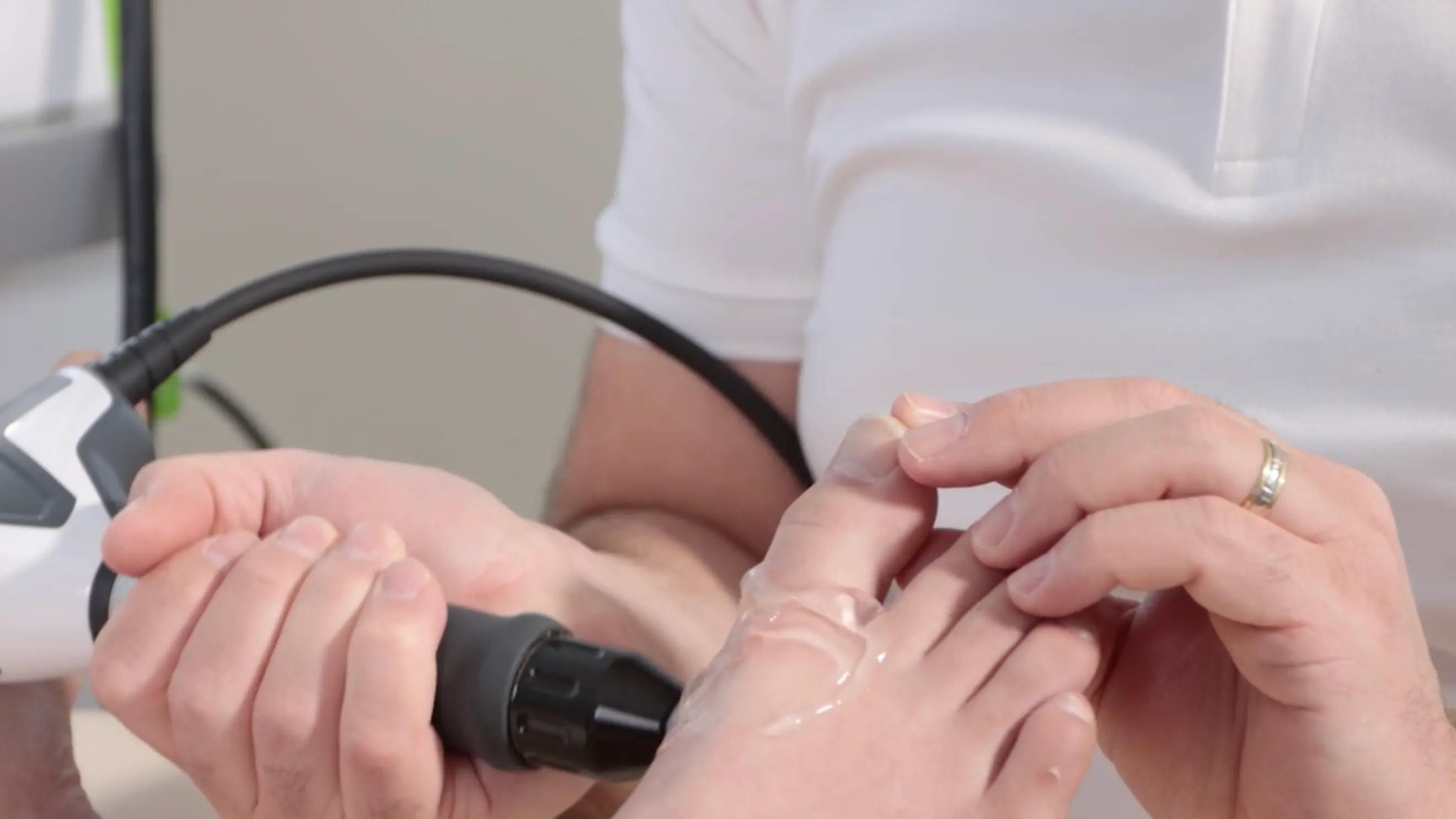
Discover how shockwave therapy can help relieve chronic pain from Hallux Rigidus. A non-surgical solution backed by science at Unpain Clinic.
KEY TAKEAWAYS
- Hallux rigidus is arthritis of the big toe joint. The classic signs are pain on push-off, a stiff toe that does not bend up as far as it used to, and a bump on the top of the joint.
- Rest, anti-inflammatories, and stiff-soled shoes can take the edge off, but they do not change the underlying joint, so pain commonly returns once you are back on your feet.
- Focused shockwave therapy is one of the few non-surgical options with published evidence behind it for hallux rigidus, especially in early to mid-stage cases.
- A short course of weekly sessions is usually enough to know whether it is helping. Most plans land at three to six visits.
- At Unpain Clinic in Edmonton, shockwave is one piece of a layered plan that also includes manual therapy, mobility work, and footwear advice. We tell you honestly if we do not think it will help.

If every step sends a jolt through your big toe, and you have already tried rest, wide shoes, and the usual anti-inflammatories without lasting relief, you are not stuck. Hallux rigidus is one of the more common arthritic conditions in the foot, and shockwave therapy has become a real non-surgical option for it. This guide covers what hallux rigidus actually is, why standard treatments often plateau, what the research says about shockwave for the big toe, and how we put a plan together at Unpain Clinic in Edmonton.
WHAT IS HALLUX RIGIDUS AND WHY DOES IT HURT?
Hallux rigidus literally means "stiff big toe." It is a form of degenerative arthritis affecting the first metatarsophalangeal joint, the one at the base of the big toe that has to bend every time you push off to walk. Over time, the cartilage in that joint wears down, small bone spurs can form on the top of the joint, and the toe loses its ability to bend upward. That motion, called dorsiflexion, is what lets you roll over your big toe at the end of each step. When it is restricted, walking becomes painful, and the body starts compensating in ways that often create new problems further up the chain.
Hallux rigidus is the most common form of arthritis in the foot, and it is common enough in adults over 50 that any foot clinic in Edmonton will see it weekly. A retrospective cohort study from a tertiary centre in Saudi Arabia that reviewed outcomes across operative and non-operative management approaches confirmed what most foot specialists see in clinic, which is that the condition is well represented across age groups and is consistently disabling enough to drive people to seek care.
The typical symptoms are easy to recognize once you know what to look for. There is pain in the big toe joint, especially when the toe bends upward, such as during push-off in walking or running. There is stiffness and a noticeable loss of motion compared with the other foot. There is often a bony bump on the top of the joint, sometimes tender to the touch. People struggle with certain shoes, especially high heels or anything tight at the front. And there is often a subtle change in how the person walks, because the foot starts to roll outward to avoid loading the painful toe.
The condition usually has more than one cause. Prior injuries to the big toe, repetitive impact from running or labour-heavy work, and certain foot mechanics like flat feet or a long first metatarsal can all push a joint toward early wear. There is also a genetic component, since hallux rigidus tends to cluster in families. By the time the toe is painful most days, the joint changes are well established.
WHY DOES REST, ICE, AND IBUPROFEN NOT FIX HALLUX RIGIDUS?
Standard early care for hallux rigidus is exactly what most people try on their own first. Rest, anti-inflammatory medications, cushioned or stiff-soled shoes, and sometimes a cortisone injection. These approaches can settle a flare. None of them change the underlying joint.
That is why the same pattern keeps repeating. You rest the foot, the pain calms down, you get back to normal activity, and within days or weeks the pain is back. Bone spurs do not dissolve with ice. Cartilage does not regrow with ibuprofen. A cortisone injection can buy weeks to months of relief, but once it wears off, the joint is the same joint it was before the injection. Repeated injections into a small arthritic joint also come with their own risks over time.
Many people then end up in a frustrating place: too much pain to ignore, not enough damage on imaging to justify surgery yet, and not enough progress on conservative care to feel like things are moving forward. This is the gap that newer non-invasive options have started to fill. The most promising of these for hallux rigidus is shockwave therapy.
DOES SHOCKWAVE THERAPY WORK FOR HALLUX RIGIDUS?
The short answer is that the published evidence is small but consistently positive, especially for early to mid-stage cases.
The most directly relevant study is a Cuban cross-sectional study of 26 patients with hallux rigidus treated with extracorporeal shockwave therapy at the Frank País Orthopedic Complex. Before treatment, every patient was in pain. After five weekly shockwave sessions, 69.2 percent of the patients reported they were no longer in pain. Function scores on a standardized foot and ankle scale improved from mostly "poor" before treatment to "good" or "excellent" in over 80 percent of patients afterward. The patients who improved the least were those with the most advanced joint damage, which is consistent with how shockwave behaves across other arthritic conditions.
This was not a randomized trial, and the sample was small. So we hold it in the right context. But the result lines up with the broader pattern in the shockwave literature for foot and ankle conditions. A 2024 systematic review and meta-analysis of randomized trials in BMC Sports Science, Medicine and Rehabilitation found that shockwave therapy meaningfully reduced pain across a range of tendinopathies, including plantar fasciitis, lateral elbow pain, Achilles tendinopathy, and rotator cuff tendinopathy. The picture across multiple conditions is the same: in chronic, localised musculoskeletal pain that has not settled with standard care, shockwave is one of the few non-invasive tools that consistently moves the needle.
Safety has also held up across the wider literature. A systematic review of shockwave therapy across orthopedic conditions published in the British Medical Bulletin concluded that shockwave is a safe modality with a low rate of serious adverse events when applied by trained clinicians. That matches what we see clinically. Most patients feel some local soreness after a session, and that resolves on its own.
What this means for someone with hallux rigidus is that shockwave is worth considering before any surgical conversation, especially if your case is early to mid-stage and you have a reasonable amount of joint motion left.
HOW DOES SHOCKWAVE THERAPY ACTUALLY WORK ON AN ARTHRITIC TOE JOINT?
Focused shockwave therapy uses acoustic waves, not electricity, delivered through a handheld applicator. The waves transfer mechanical energy into the tissue at the target depth. That energy triggers a local biological response. Blood flow in the area improves, the controlled inflammation that healing actually requires gets restarted, and the local environment shifts from a stalled, chronically irritated state to one that is doing repair work again.
There is also a real effect on pain itself. Chronic musculoskeletal pain often involves abnormal nerve ingrowth into tissue that should not have nerves growing into it, which is part of what keeps a chronic site painful long after the original injury. A 2022 review in the Scandinavian Journal of Pain describes this in detail for tendon pain. The most effective treatments for chronic tendon-style pain target this disordered innervation rather than just masking symptoms, which is part of why focused shockwave does something different than a painkiller.
In an arthritic big toe, those mechanisms add up to two things you can actually feel. Pain at the joint tends to come down over a course of sessions, often noticeably so within the first two or three. Joint motion sometimes improves, because pain is no longer guarding the joint and because the soft tissue around it has a chance to loosen up.
What shockwave will not do is regrow cartilage that is already gone, dissolve a large mature bone spur, or restore a joint that is essentially bone on bone. If your hallux rigidus is at the end-stage point where the joint barely moves and the pain is constant, shockwave can still reduce pain, but the conversation may eventually shift to a surgical opinion. We are honest about that at the assessment rather than running a course of sessions on a joint where the math does not work.

WHAT DOES SHOCKWAVE THERAPY FOR HALLUX RIGIDUS LOOK LIKE AT UNPAIN CLINIC EDMONTON?
Most people we see for a stiff, painful big toe arrive after having tried a few things on their own. A typical first visit is a 60-minute one-on-one assessment. We take a full history, look at how the toe moves, check the soft tissue around the joint, and assess the foot and ankle as a whole. The mechanics of the ankle, the arch, and the calf often matter more than people expect. A tight calf or a restricted ankle puts more demand on the big toe at push-off, which can drive symptoms even on a joint that does not look that bad on imaging.
If shockwave is a good fit, we usually start with focused shockwave applied directly to the irritated tissue at the top and sides of the joint. A typical course is three to six weekly sessions, each running about 15 to 20 minutes. Most people feel a strong tapping sensation that we adjust to your tolerance. There is no needle and no recovery downtime. Some report mild soreness in the toe for a few hours after a session, which is part of the healing response and resolves on its own.
We often pair shockwave with EMTT for the surrounding region of the foot and lower leg, particularly when there is a broader area of inflammation or when the toe joint is part of a wider problem. For patients whose chronic pain has clearly sensitised the nervous system, we may also discuss NESA neuromodulation as an additional layer. Not everyone needs both.
Manual therapy and exercise are always part of the plan. Gentle joint mobilization of the first MTP can preserve and sometimes improve the motion you have. Soft tissue work on the calf, the plantar fascia, and the small muscles of the foot reduces the load on the joint. A short, specific exercise program at home builds strength in the muscles that support the arch and the big toe, which makes the work we do in clinic hold longer.
Footwear matters more than most people realize. A shoe with a stiff sole, a slight rocker, and a roomy toe box reduces how much the big toe has to bend during walking, which can cut pain immediately. We will look at what you are wearing and give you specific suggestions. For some patients, a rigid carbon-fibre insole or a Morton's extension under the big toe helps during the healing phase.
If you want a deeper look at how the technology works, our article on how focused shockwave therapy works walks through the mechanics.

“Unbelievable service and care from
Dr. Lacina Barsalou.
Top notch Professional Treatment.
I am fortunate to have found such
a wonderful place where my needs
and pains are addressed at the
source allowing me to get back to
a normal range of being able to move
freely and pain free.
So Appreciated !” - Wayne Dehr
WHAT CAN I DO AT HOME TO MANAGE HALLUX RIGIDUS?
What you do between sessions matters as much as what we do in clinic. None of these is a cure, but together they make a real difference.
- Keep the toe moving gently within a comfortable range. Use your hand to lift the big toe upward into a comfortable stretch, hold for about 20 to 30 seconds, and release. Do this a few times a day. Sharp pain means back off.
- Strengthen the small muscles of the foot. Towel curls (scrunching a small towel toward you with your toes) and resisted toe extension with a light band both build the muscles that support the arch and the big toe. A few sets, once or twice a day.
- Choose footwear that lets the toe rest. A stiff-soled shoe with a slight rocker reduces how much your big toe has to bend with each step. A wide toe box keeps the joint from being compressed. Around the house, avoid bare feet on hard floors if it aggravates the joint.
- Use ice on flare days. Rolling the foot over a frozen water bottle for 5 to 10 minutes can settle a hot, swollen joint. Heat can also help for stiffness, but ice is usually safer when inflammation is the main problem.
- Keep moving with low-impact activities. Cycling, swimming, and the elliptical are all kinder to the big toe than running or hiking on uneven ground. Pause the activities that flare you for now, and reintroduce them gradually as the joint settles.
If you have done all of this consistently for two to three months without progress, that is your cue to get reassessed. There may be a missing piece in the plan.
WHAT WE DO NOT OFFER
To save you time and set honest expectations:
- We do not perform injections, including cortisone injections into the joint.
- We do not prescribe oral or topical pain medications. We are physiotherapists and registered massage therapists, not physicians.
- We do not perform surgery, including cheilectomy or fusion. If your hallux rigidus has progressed to the point where surgery is the right next step, we will tell you and refer you to a foot and ankle surgeon.
- We do not promise cures. Hallux rigidus is a structural condition, and anyone who guarantees a complete reversal of joint damage should be approached with caution. What we offer is an honest plan, regular review, and a team that will tell you if we are not the right fit.
FREQUENTLY ASKED QUESTIONS
Is shockwave therapy safe for hallux rigidus?
Yes, for most people. It is non-invasive, requires no anaesthesia, and has no significant downtime. The most common after-effects are mild soreness or warmth around the treated joint for a few hours. A systematic review across orthopedic conditions in the British Medical Bulletin concluded that shockwave therapy is a safe modality when applied by trained clinicians. We do screen for contraindications such as active infection in the foot, bleeding disorders, or pregnancy before starting.
How many sessions does shockwave therapy for hallux rigidus usually need?
A typical course is three to six weekly sessions. Mild cases sometimes resolve in three. More stubborn cases may need five or six. We reassess as we go, and we will tell you honestly if a course is not moving you in the right direction.
Does shockwave hurt?
The pulses are uncomfortable on a tender joint, and most people rate them around a four or five out of ten during the session. We adjust the intensity to what you can tolerate. After the session, a few hours of mild soreness is common. There is no incision, no needle, and no medication to react to.
Can shockwave therapy help if I have had hallux rigidus for years?
Often yes. Shockwave was developed for chronic, long-standing musculoskeletal problems where the body's normal healing has stalled. A long duration is not a barrier on its own. What matters more is how much joint motion you still have and how advanced the structural changes are. We assess this at your first visit before recommending a course.
Is hallux rigidus the same as a bunion?
No. A bunion is a deviation of the big toe toward the second toe, with a prominent bump on the inside of the foot. Hallux rigidus is arthritis of the same joint, with stiffness and a bump usually on the top, not the inside. The two can coexist, but they are different problems and call for different plans.
Will I avoid surgery if I do shockwave therapy?
Sometimes. For mild to moderate hallux rigidus, a good non-surgical plan can delay surgery by years or avoid it entirely. For advanced hallux rigidus where the joint is essentially fused on its own, surgery may still be the right answer eventually. We will tell you which side of that line you are on after the assessment.
Do I need a doctor's referral to come to Unpain Clinic?
No referral is needed. Physiotherapists and registered massage therapists in Alberta are primary contact providers, so you can book directly. Some extended health plans require a doctor's referral for reimbursement, so it is worth checking your benefits.
ABOUT THE AUTHOR
Written by Uran Berisha, PT, RMT, Founder of Unpain Clinic and Medical Shockwave Institute. Uran is a physiotherapist based in Edmonton, Alberta, and an International Educator in Shockwave Therapy. Medically reviewed by Uran Berisha, PT, RMT.
READY TO STOP CHASING THE PAIN AND START TREATING THE CAUSE?
If your big toe pain has not budged with the usual rest, ice, and shoe changes, the next step is a 60-minute one-on-one assessment in Edmonton where we look at the joint and the chain around it, and build you a clear, written plan. No referral needed. No pressure. We will tell you honestly if shockwave is the right call, and we will tell you just as honestly if it is time for a surgical opinion instead. You can book a one-on-one assessment when you are ready.
REFERENCES
The following sources are linked inline in the body above. The full citations are listed here for completeness.
- Ibarbia Carreras M, Planas Montalvo EW, Marrero Riverón LO. Effectiveness of Wave of Shock Extracorporeal in Patients with Hallux Rigidus. Biomedical Journal of Scientific & Technical Research. 2021;34(2). doi:10.26717/BJSTR.2021.34.005516 https://biomedres.us/articles/Effectiveness-of-Wave-of-Shock-Extracorporeal-in-Patients-with-Hallux-Rigidus-in-the-CCOI-Frank-Pas.ID.005516.php
- Alshehri AS, Alzahrani FA, Alqahtani LS, Alhadlaq KH, Alshabraqi HA, Aljaafri ZA. Outcomes of operative versus nonoperative management for hallux rigidus: a tertiary care center experience. Cureus. 2023;15(10):e46991. doi:10.7759/cureus.46991. PMID: 38022308. PMCID: PMC10640908. https://pubmed.ncbi.nlm.nih.gov/38022308/
- Majidi L, Khateri S, Nikbakht N, Moradi Y, Nikoo MR. The effect of extracorporeal shock-wave therapy on pain in patients with various tendinopathies: a systematic review and meta-analysis of randomized controlled trials. BMC Sports Science, Medicine and Rehabilitation. 2024;16(1):93. doi:10.1186/s13102-024-00884-8. PMID: 38659004. https://pubmed.ncbi.nlm.nih.gov/38659004/
- Schmitz C, Császár NB, Milz S, Schieker M, Maffulli N, Rompe JD, Furia JP. Efficacy and safety of extracorporeal shock wave therapy for orthopedic conditions: a systematic review on studies listed in the PEDro database. British Medical Bulletin. 2015;116(1):115-138. doi:10.1093/bmb/ldv047. PMID: 26585999. https://pubmed.ncbi.nlm.nih.gov/26585999/
- Ackermann PW, Alim MA, Pejler G, Peterson M. Tendon pain: what are the mechanisms behind it? Scandinavian Journal of Pain. 2023;23(1):14-24. doi:10.1515/sjpain-2022-0018. PMID: 35850720. https://pubmed.ncbi.nlm.nih.gov/35850720/
Related Topics