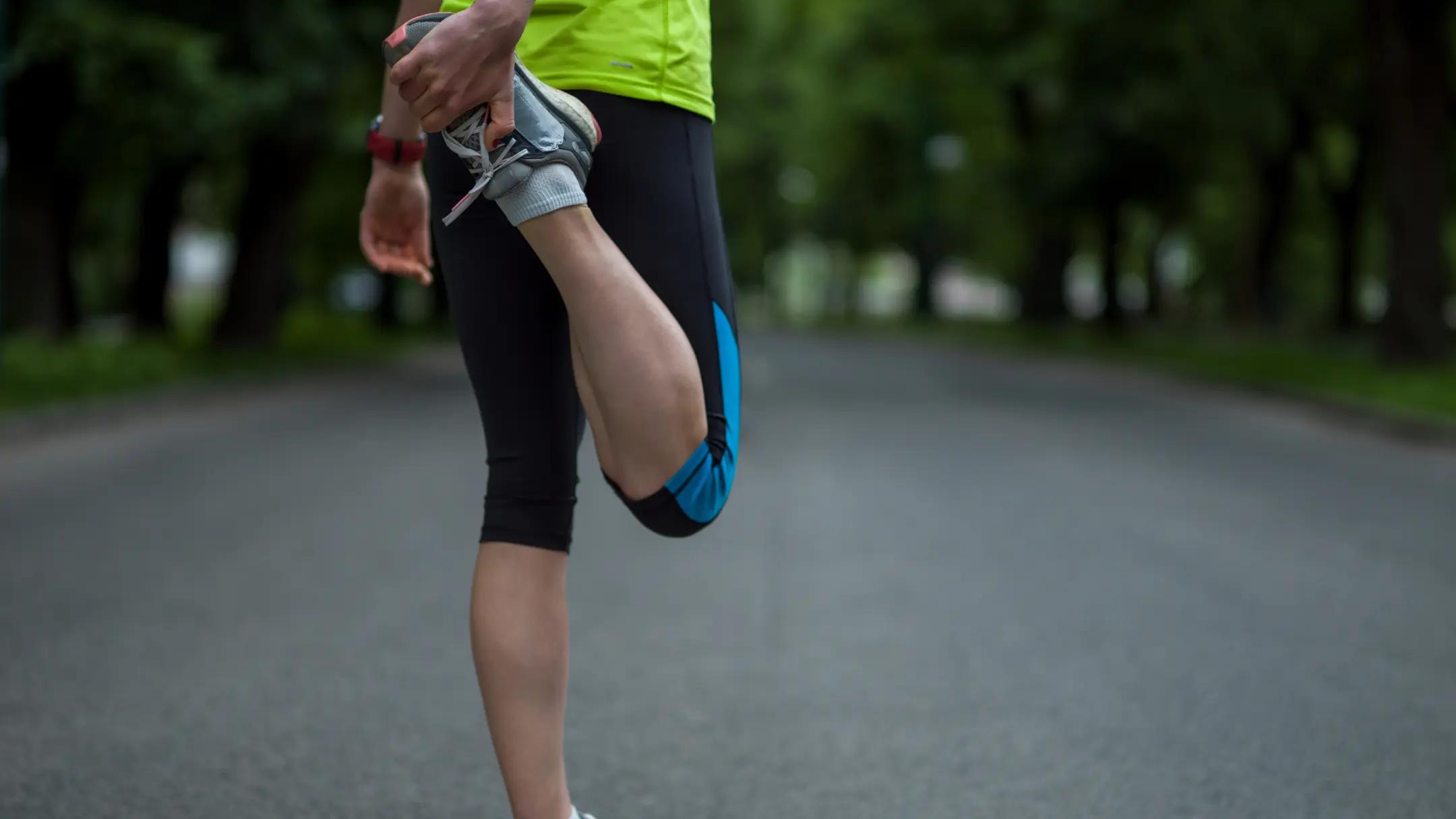
Learn why iliotibial band syndrome pain happens and how to relieve outer knee pain with proven exercises and treatments from Unpain Clinic.
The first two kilometres feel great. Your legs are loose, your breathing settles, the road opens up in front of you. Somewhere around three or four kilometres in, there is a sharp, burning point on the outside of the knee that was not there yesterday. It grows. You try to run through it. Within a few minutes you are limping to a stop. Walking home feels almost normal. Twenty-four hours later you are ready to try again, and the same thing happens.
If that story is yours, you are almost certainly dealing with iliotibial band syndrome, one of the most common and most frustrating running-related knee injuries. It has a predictable pattern, a well-studied cause, and a treatment plan that works for most people. What it does not have is a quick fix, which is why the standard rest-ice-stretch loop keeps ending in the same place.
This article walks through what iliotibial band syndrome actually is, what has changed in the last two decades about how we understand it, what the research honestly shows about which treatments work, and how we approach it at Unpain Clinic in Edmonton. It also covers what you can safely do at home while you figure out your next step.
KEY TAKEAWAYS
- Iliotibial band syndrome is the most common cause of outer knee pain in runners, accounting for roughly one in ten running-related injuries. It is also common in cyclists, hikers, and anyone doing a lot of repetitive knee flexion and extension.
- The old "friction" explanation has been replaced. The landmark anatomy study by Fairclough and colleagues in the Journal of Anatomy showed that the IT band does not actually slide back and forth over the outer knee. It stays anchored, and the pain comes from compression of a richly-innervated fat and connective tissue layer beneath the band.
- Hip abductor strengthening is the anchor of conservative treatment. The systematic review of conservative treatments for ITBS in runners in Frontiers in Sports and Active Living confirms that programs including hip abductor strengthening produce meaningful pain reduction and functional improvement.
- Shockwave therapy has been directly tested against manual therapy in runners with ITBS in a small randomised trial. The Weckström and Söderström trial in the Journal of Back and Musculoskeletal Rehabilitation found both treatments produced similar meaningful pain reduction when combined with an exercise program. Shockwave is a reasonable adjunct in the right presentation, not a stand-alone first-line treatment.
- Most ITBS resolves in 4 to 8 weeks with the right plan, if the plan actually addresses the drivers (hip and glute weakness, training pattern, sometimes footwear and gait). A quick return to full mileage before the drivers are addressed is the most common reason ITBS becomes chronic.
- A proper physiotherapy assessment identifies the specific pattern behind your ITBS and gives you a plan built around your specific presentation. In Alberta, no referral is required to see a physiotherapist.
IN THIS ARTICLE
- What is iliotibial band syndrome, and why does it hurt where it does?
- Why does ITBS happen? The real causes behind that outer knee pain
- How do you tell if it is ITBS and not something else?
- What does the research say about treatment for ITBS?
- How does treatment for IT band syndrome work at Unpain Clinic Edmonton?
- What can you safely do at home?
- Frequently asked questions

WHAT IS ILIOTIBIAL BAND SYNDROME, AND WHY DOES IT HURT WHERE IT DOES?
The iliotibial band (usually shortened to IT band, or ITB) is a thick, tendon-like sheet of connective tissue that runs down the outside of the thigh from the pelvis to just below the knee. At the top it blends with the tensor fasciae latae (TFL) and gluteus maximus muscles at the hip. At the bottom it attaches to a small bony bump on the outside of the tibia called Gerdy's tubercle. Its job is to help stabilise the knee and hip during walking, running, and standing on one leg.
Iliotibial band syndrome is what happens when the tissue at the outer knee, right around the bony bump on the side of the femur (the lateral femoral epicondyle), becomes irritated and painful. The pain has a very specific character: sharp, sometimes burning, tightly localised to the outside of the knee, and worst when the knee is bent to about 30 degrees. That angle is not a coincidence. It is the moment in the running or walking cycle when the IT band presses most firmly against the tissues beneath it.
For decades, the standard explanation was a "friction syndrome": the IT band sliding back and forth over the outer knee like a rope sawing across a pulley, wearing out the tissues underneath. In 2006, that explanation was seriously challenged by a landmark study.
The Fairclough and colleagues anatomy study in the Journal of Anatomy used cadaver dissections and MRI in living subjects to look carefully at what the IT band actually does at the knee. What they found reshaped the field. The IT band is anchored to the femur by fibrous strands. It does not slide back and forth over the bony bump; it just cannot, because it is held in place. Beneath it, though, there is a layer of fat and connective tissue that is richly supplied with nerves and blood vessels. When the knee bends to around 30 degrees, the IT band presses down on this innervated tissue. Do that thousands of times in a run, in a leg that has other things loading the IT band, and the compressed tissue becomes inflamed and painful.
Practically, this changes how we think about treatment. If the problem were friction, the answer might be to make the IT band "less sticky" or to lubricate it. Since the problem is compression, the answer is to reduce how hard the IT band is pressing, which means reducing its tension and correcting the mechanics upstream at the hip that increase how much it has to hold the leg together.
WHY DOES ITBS HAPPEN? THE REAL CAUSES BEHIND THAT OUTER KNEE PAIN
Iliotibial band syndrome is rarely caused by one thing. It is almost always a combination of factors that individually would not cause a problem, but together push the tissue past its capacity.
Hip abductor weakness is the most consistent finding.
The muscles on the side of the hip (particularly the gluteus medius, but also the gluteus minimus and deeper hip stabilisers) control how the thigh moves in space when you land on one leg. When they are weak or slow to activate, the thigh tends to collapse inward (adduct) and rotate internally with each step. That inward collapse tightens the IT band and increases how hard it compresses the tissue at the outer knee. This pattern is one of the most reproducible findings in the ITBS literature, and it is why hip strengthening is at the centre of every serious treatment plan.
Tight or overactive lateral thigh muscles compound the problem.
The tensor fasciae latae at the front of the hip and the vastus lateralis (the outer quadriceps) both attach into or influence the IT band. When these muscles are short, tight, or held in constant low-level contraction, they add to the resting tension in the IT band. The IT band itself is not particularly stretchy; it is more like a tendon than a muscle. Trying to stretch the band directly is limited by its structure. What is worth changing is the tone in the muscles feeding into it.
Training pattern often lights the fuse.
A sudden jump in weekly mileage, adding hills or downhill routes, running on cambered surfaces (the same side of the road, week after week), a new pair of shoes with a very different geometry, or returning to running after a layoff with too much too fast are all classic ITBS triggers. Downhill running in particular loads the IT band more because it holds the knee in the compressed zone (around 30 degrees of flexion) for longer during each stride, and because it demands more braking work from the muscles that attach into the band. Slower jogging tends to be worse than faster running for the same reason: more time spent at the vulnerable knee angle.
Foot and ankle mechanics contribute.
Feet that flatten and roll inward excessively (overpronation), a stiff ankle that limits how the knee bends over the foot, or a stiff big toe that changes how you push off can all reroute force patterns up the leg in ways that stress the IT band. This is why an assessment that only looks at the knee often misses the driver.
Anatomy plays a role, some of it not modifiable.
A more prominent lateral femoral epicondyle, a bow-legged knee alignment (genu varum), a leg-length discrepancy, or an unusual pelvic alignment can all make one IT band work harder than the other. These are useful things to know because they change how aggressive the training pattern can be, but they are not the reason the pain is there today. Something modifiable is almost always in the mix.
The takeaway: ITBS is a "how you are loading it" problem more than a "there is something wrong with the band" problem. The plan follows from that.
HOW DO YOU TELL IF IT IS ITBS AND NOT SOMETHING ELSE?
Iliotibial band syndrome is usually a clinical diagnosis. A careful history and a targeted physical exam are enough to reach it with high confidence in most cases.
The classic pattern:
- Sharp or burning pain on the outside of the knee, right around the bony bump on the side (the lateral femoral epicondyle) or slightly below and behind.
- Pain that starts after a specific amount of running or activity, not from the first step. Many runners describe feeling fine for the first 10 to 15 minutes, then noticing the pain build until they have to stop.
- Worse with downhill running or descending stairs, better with rest.
- Worst when the knee is at about 30 degrees of flexion. This is why sitting with the knee bent at that angle for a long time (in a car, at a desk with the knee slightly bent) can also flare it.
- Point tenderness right on the bony bump on the outside of the knee, sometimes with a rope-like tightness up the outside of the thigh.
Common look-alikes that need to be sorted from ITBS:
- A lateral meniscus tear tends to produce pain deeper in the knee joint, often with catching, locking, or swelling. Onset is usually linked to a specific twisting event rather than to running distance.
- A lateral collateral ligament injury usually follows a specific injury (a fall, a tackle, a twisted knee) and produces pain along the ligament itself, slightly behind and higher than the classic ITBS spot.
- Popliteus tendinopathy produces outer knee pain in runners but tends to sit further back, behind the knee joint.
- Lateral patellofemoral pain (a sub-type of "runner's knee") sits on the outside of the kneecap rather than on the bony bump of the femur.
- Referred pain from the hip or lower back can occasionally masquerade as ITBS.
The Noble compression test is a useful clinical exam manoeuvre: with you lying on your back, the examiner presses firmly on the outer knee just above the joint line while slowly bending and straightening your knee. Reproduction of your familiar outer knee pain at around 30 degrees of flexion is a positive test and strongly suggests ITBS.
Imaging is usually not required for a straightforward ITBS diagnosis. An X-ray is normal in ITBS and is only useful for ruling out other conditions. An MRI can show swelling and fat pad changes at the outer knee in more chronic or atypical cases, but a good clinical assessment usually gets you what you need without it.
WHAT DOES THE RESEARCH SAY ABOUT TREATMENT FOR ITBS?
The evidence base for ITBS has grown substantially in the last decade. A few clear conclusions stand out.
Hip abductor strengthening is the anchor conservative treatment.
The systematic review of conservative treatment strategies for ITBS in runners in Frontiers in Sports and Active Living synthesised the available studies of non-surgical treatment. The pattern in the results is consistent: programs that include structured hip abductor and glute strengthening reduce pain and improve function. Combined approaches (strengthening plus manual therapy, or strengthening plus shockwave, or strengthening plus gait retraining) tended to outperform single interventions. Isolated interventions without a strengthening component tended to underperform. This is the strongest evidence-based recommendation in ITBS care: build a program around targeted hip and glute strengthening, and add other things to it as needed.
Manual therapy and myofascial work are useful adjuncts.
Hands-on techniques (soft-tissue work to the tensor fasciae latae, vastus lateralis, and gluteal muscles; joint mobilisation for a stiff hip or ankle contributing to the pattern) have supportive evidence within combined-treatment programs. As stand-alone interventions the direct evidence is weaker, but as part of a well-designed plan they reliably help patients get to their strengthening exercises with better tolerance.
Gait retraining and running form work help specific patients.
Small changes to running mechanics (increasing step rate, reducing overstride, correcting a crossover gait pattern where the feet land toward the midline) reduce load on the IT band in patients whose ITBS is driven by specific form issues. The evidence here is smaller-scale, but for patients whose mechanics are contributing, the effect can be substantial.
Shockwave therapy is a reasonable adjunct with modest direct evidence.
The Weckström and Söderström randomised trial in the Journal of Back and Musculoskeletal Rehabilitation directly tested radial shockwave therapy against manual therapy in 24 runners with ITBS, with both groups also doing an exercise program. At 4 weeks, both treatments produced meaningful pain reduction, with no significant difference between them. At 8 weeks, both continued to improve. The trial is small and would ideally be replicated in a larger study, but it establishes that shockwave is at least comparable to manual therapy in this population when combined with the core exercise plan. Other smaller trials have compared shockwave to dry needling with broadly similar findings: multiple approaches can help when they are built on top of the strengthening foundation.
Practically, this means shockwave therapy is a reasonable option in ITBS when other conservative measures have plateaued, when patients want an option to consider alongside their exercise program, or when trigger points and tissue tone are prominent contributors to the presentation. It is not a stand-alone first-line treatment. It is an adjunct that works with the plan, not instead of it.
Some things that get recommended have weaker evidence than reputation suggests.
Aggressive foam rolling directly on the IT band is often recommended and often tolerated poorly. The band is not designed to stretch, and pressing hard on inflamed tissue can worsen the pattern. Rolling the surrounding muscles (tensor fasciae latae, quadriceps, gluteals) is more useful. Stretches marketed as "IT band stretches" primarily affect the muscles feeding the band rather than the band itself, which is still worthwhile but should be understood for what it is. Corticosteroid injections can reduce pain in the short term but do not address any driver of the problem, and are used sparingly. Surgery is very rare in ITBS and reserved for cases that have not responded to at least six months of well-delivered conservative treatment.
The bottom line from the research is straightforward. A conservative plan built around hip abductor and glute strengthening, combined with manual therapy where it helps, gait or training adjustments where they apply, and adjunct modalities like shockwave where they fit the presentation, is the plan with the strongest evidence.
"The single most useful shift I can offer a runner with IT band syndrome is that this is a hip and load problem, not a band problem. Once we accept that, the plan writes itself: strengthen what is weak, unload what is overworked, adjust the training pattern that lit the fuse, and use adjunct treatments where they help, not in place of the work that actually changes the presentation. Most people get better in weeks with that approach. The ones who stay stuck are usually the ones still trying to fix the band directly." Uran Berisha, Founder of Unpain Clinic and Medical Shockwave Institute

HOW DOES TREATMENT FOR IT BAND SYNDROME WORK AT UNPAIN CLINIC EDMONTON?
Your first appointment is a 60-minute physiotherapy assessment. The goal on that first visit is not to start treatment. It is to confirm the diagnosis, identify what is actually driving your ITBS (which muscles are weak, which are tight, how you are loading through the leg, what changed in your training), and build a plan that fits your specific case.
The assessment includes a full history (how the pain started, your training pattern, what you have already tried, what you actually want to get back to), a targeted physical exam (Noble compression test, palpation of the outer knee and IT band, muscle strength testing for the glutes and hip abductors, hip and ankle range of motion, single-leg squat and step-down analysis), a gait screen if you can walk comfortably enough for one, and screening for anything that would need a physician referral first.
At the end of the assessment, you get a clear explanation of what is driving your pain, a personalised plan, and a straight answer on realistic timelines. Most ITBS cases show meaningful improvement within 4 to 8 weeks of consistent care when the plan actually addresses the drivers. Some cases (particularly chronic ITBS in high-mileage runners, or presentations complicated by anatomy or other injuries) take longer.
Treatment is built around a small set of tools working together, with the strongest-evidence intervention at the centre.
The core is a progressive hip and glute strengthening program. This is not optional and it is not a supplement to other treatments. It is the treatment. The specific exercises depend on your assessment, but the standard set includes side-lying hip abductions, clamshells, glute bridges progressing to single-leg bridges, banded lateral walks, single-leg squats and step-downs with attention to knee alignment, and progressions into more running-specific control work. The program starts where you can safely start and progresses as you can tolerate it.
Manual therapy is used where it makes the exercise plan easier. Soft-tissue work on the tensor fasciae latae, vastus lateralis, and gluteal muscles reduces the tone feeding into the IT band. Joint mobilisation for a stiff hip capsule or a limited ankle changes the loading pattern that has been feeding the problem. Sometimes we treat trigger points in the gluteus medius or vastus lateralis directly. The goal is not to spend the whole appointment on hands-on work; it is to use it to unlock progress in the strengthening plan.
Gait retraining and training pattern work sit alongside the strengthening. Small adjustments in step rate, stride width, and where your feet land can meaningfully reduce IT band load in patients whose form is contributing. We also work with you on the training pattern that lit the fuse: what to change in your weekly mileage, how to sequence hill work, which surfaces to prefer, and how to return to full training without triggering the same pattern.
Where shockwave therapy is indicated by the assessment, we use it as an adjunct. Focused shockwave therapy can be applied directly to trigger points in the IT band, the tensor fasciae latae, and the gluteal muscles when they are prominent contributors. Radial shockwave therapy can be used for broader muscle work across the lateral thigh and hip. We are honest with patients that the direct randomised evidence for shockwave in ITBS is limited but positive, and that it works with the exercise plan, not instead of it.
Most treatment plans run 4 to 8 weeks with re-assessment every few sessions. If progress is not tracking as expected, we adjust the plan. Return-to-running is graded and specific, with clear thresholds for how far and how fast you can run before adding more.
The dedicated iliotibial band syndrome service page has more detail on the condition-specific pathway.

WHAT CAN YOU SAFELY DO AT HOME?
This is general education, not individual medical advice, and results vary. If your pain has been ongoing for more than a couple of weeks and is not settling with these steps, an assessment is the right next move.
Reduce the load that flares your knee, but do not go to zero.
The single most useful short-term change is to stop the specific activity that reliably produces the pain. If you run and the pain shows up at 20 minutes, do not run for 20 minutes. That does not mean stopping all movement. Walking, easy cycling on a stationary bike with the seat set higher than usual, swimming, and pool running keep you moving without loading the IT band the same way. Complete rest often makes ITBS worse over a few weeks, because the strength you need to rehabilitate the pattern erodes.
Start hip abductor strengthening now.
Even before you see a physiotherapist, safe starting exercises exist that fit most cases. Side-lying hip abductions (lying on your side, lifting the top leg toward the ceiling in a controlled manner), clamshells (lying on your side with knees bent, opening the top knee while keeping the feet together), and glute bridges (lying on your back, knees bent, lifting the hips off the floor by squeezing the glutes) are safe places to begin. Two or three sets of 10 to 15 repetitions, most days of the week, over weeks, is the pattern that works. Quality of the movement matters more than the number of repetitions.
Foam roll the surrounding muscles, not the IT band itself.
Rolling directly on the IT band is often uncomfortable and does not address the driver. Rolling the tensor fasciae latae (the muscle at the front of the hip, just below the bony point of your pelvis), the vastus lateralis (the outer quadriceps), and the gluteal muscles is more useful and better tolerated. Spend a minute or two on each area, daily if that helps.
Stretch the muscles that feed the IT band, mindfully.
A kneeling hip flexor and TFL stretch (kneel on the affected side, foot forward on the other side, tuck the pelvis under, and reach the arm on the affected side overhead and slightly toward the opposite side) targets the tensor fasciae latae. A figure-4 glute stretch (sitting or lying, cross the affected ankle over the opposite knee and gently pull the uncrossed leg toward you) targets the glutes. Hold each stretch for 20 to 30 seconds, two or three times per day.
Adjust your training pattern before you return to running.
When the pain has settled enough to trial running, come back gradually. Start with short intervals of run-walk on flat, even ground. Avoid downhills for the first weeks. Increase your total weekly volume by no more than 10 percent from one week to the next. Keep doing the strengthening work. This is where most people rush and re-flare the pattern.
Use heat and ice as tools, not as treatments.
Heat before activity can help the tissues loosen up. Ice after a flare can help symptoms settle. Neither of these changes the underlying pattern, but both are useful for symptom management on specific days.
Check your shoes and your surfaces.
If your shoes are heavily worn, particularly on the outside edge, replace them. If you have been running the same cambered route in the same direction week after week (a road with a slope, always favouring one side), change routes or reverse direction on alternating days.
Some symptoms are not "wait and see" symptoms. Sudden severe knee pain after a specific event, a knee that gives way or locks, significant swelling inside the joint, or fevers with knee pain all warrant medical assessment rather than a home program.

FREQUENTLY ASKED QUESTIONS
What does iliotibial band syndrome feel like?
Iliotibial band syndrome classically produces sharp or burning pain on the outer side of the knee, right around the bony bump on the side of the femur. The pain typically shows up after a specific amount of running or activity, not from the first step, and gets worse the longer you continue. It is worst when the knee is bent to about 30 degrees, which is why downhill running and descending stairs often flare it more than flat running. Pain usually settles quickly with rest and returns just as reliably when the activity resumes, until the underlying drivers are addressed.
Should I stop running completely if I have ITBS?
Usually not completely, but you should stop the specific pattern that reliably produces the pain. If you flare at 20 minutes of running, do not run for 20 minutes. Substitute cycling, swimming, pool running, or brisk walking so you stay moving and keep fitness without loading the IT band the same way. Once your strengthening program has produced measurable change and your pain is settling, a graded return to short run-walk intervals on flat ground is the reasonable next step.
Why does stretching my IT band not seem to help?
The IT band itself is a thick, tendon-like structure that does not stretch the way muscles do. What most "IT band stretches" actually target are the muscles that feed into the band, particularly the tensor fasciae latae, the gluteal muscles, and the outer quadriceps. Stretching those muscles is worthwhile because reducing the resting tone in them lowers the tension on the band. Trying to stretch the band directly is limited by its anatomy, which is one reason people often find IT band stretches disappointing on their own.
Is foam rolling my IT band a good idea?
Rolling directly on the IT band is often painful and adds little. Rolling the surrounding muscles (the tensor fasciae latae at the front of the hip, the outer quadriceps, and the gluteal muscles) is more useful and better tolerated. If you have been foam rolling the IT band aggressively and finding it uncomfortable without meaningful improvement, redirecting the work to the surrounding muscles is a reasonable change.
Does shockwave therapy work for IT band syndrome?
The direct evidence is limited but positive. The one directly relevant randomised trial in runners with ITBS found that radial shockwave therapy and manual therapy produced similar meaningful pain reduction when combined with an exercise program. Shockwave is a reasonable adjunct in the right presentation, particularly when trigger points and tissue tone are prominent contributors. It is not a stand-alone first-line treatment for ITBS, and it works with the strengthening plan, not instead of it.
How long does IT band syndrome take to heal?
Most cases show meaningful improvement within 4 to 8 weeks of consistent treatment that actually addresses the drivers. Simple presentations caught early can improve in a few weeks. Chronic cases that have been going for months, or cases in high-mileage runners with anatomical contributors, can take longer. The single biggest predictor of a slow recovery is trying to fix the band directly (rolling, stretching, ice) without addressing the hip strength, training pattern, and mechanics that are actually driving the load.
Do I need an MRI for ITBS?
Usually not. Iliotibial band syndrome is a clinical diagnosis in most cases. A careful history and physical exam (including the Noble compression test) get to the diagnosis with high confidence. Imaging becomes more useful when the diagnosis is uncertain, when the response to well-delivered treatment is not what was expected, or when a differential diagnosis (a meniscus tear, an inflammatory process, an unusual finding) needs to be ruled out.
When should I book a physiotherapy assessment for ITBS?
If your outer knee pain has been coming back every time you try to increase running or activity, if it has been going for more than a few weeks despite reducing training, or if you have already tried the standard rest-ice-stretch cycle and are back where you started, a proper assessment is likely to save you time. ITBS is a condition where the specific driver in your case shapes what works. A generic protocol underperforms an assessed plan.
PATIENT TESTIMONIAL
“I was referred to Unpain Clinic by my chiropractor. Have been having sciatic problems for years. Recently knee problems. Have seen Uran the therapist for treatments. Have had great results with pain relief and mobility. I have just had treatment but the results are already there. When you research this therapy you will find that it takes a few months for this treatment to really take affect. Just the relief I have had already is well worth the treatment. I would recommend this treatment as very useful. Also this clinic has very capable people.”- Kurt W
ABOUT THE AUTHOR
Written by Uran Berisha, Founder of Unpain Clinic and Medical Shockwave Institute. Uran has a Bachelor of Science in Physiotherapy and is an International Educator in Shockwave Therapy. Medically reviewed by Uran Berisha. Learn more about the clinic at Unpain Clinic.
BOOK YOUR INITIAL ASSESSMENT
If iliotibial band syndrome has been keeping you off the road and generic advice has not sorted it out, the next step is a 60-minute physiotherapy assessment at Unpain Clinic Edmonton. The assessment confirms the diagnosis, identifies what is actually driving the pain in your case, screens for anything that would need a physician referral first, and lets you leave with a clear, specific plan built around the evidence. No referral is required to see a physiotherapist. Book your initial assessment with Unpain Clinic.
WHAT WE DO NOT OFFER
We do not perform corticosteroid injections, PRP injections, or surgery. We do not prescribe medications. We do not sell or endorse specific shoe brands. If your presentation suggests a meniscus tear, a ligament injury, an inflammatory arthritis, or anything requiring urgent medical evaluation, we will tell you plainly and help you find the right next step.
REFERENCES
- Fairclough J, Hayashi K, Toumi H, Lyons K, Bydder G, Phillips N, Best TM, Benjamin M. The functional anatomy of the iliotibial band during flexion and extension of the knee: implications for understanding iliotibial band syndrome. Journal of Anatomy. 2006;208(3):309-316. doi:10.1111/j.1469-7580.2006.00531.x. PMID: 16533314. PMCID: PMC2100245. https://pubmed.ncbi.nlm.nih.gov/16533314/
- Sanchez-Alvarado A, Bokil C, Cassel M, Engel T. Effects of conservative treatment strategies for iliotibial band syndrome on pain and function in runners: a systematic review. Frontiers in Sports and Active Living. 2024;6:1386456. doi:10.3389/fspor.2024.1386456. PMID: 39247485. PMCID: PMC11377285. https://pubmed.ncbi.nlm.nih.gov/39247485/
- Weckström K, Söderström J. Radial extracorporeal shockwave therapy compared with manual therapy in runners with iliotibial band syndrome. Journal of Back and Musculoskeletal Rehabilitation. 2016;29(1):161-170. doi:10.3233/BMR-150612. PMID: 26406193. https://pubmed.ncbi.nlm.nih.gov/26406193/
Related Topics