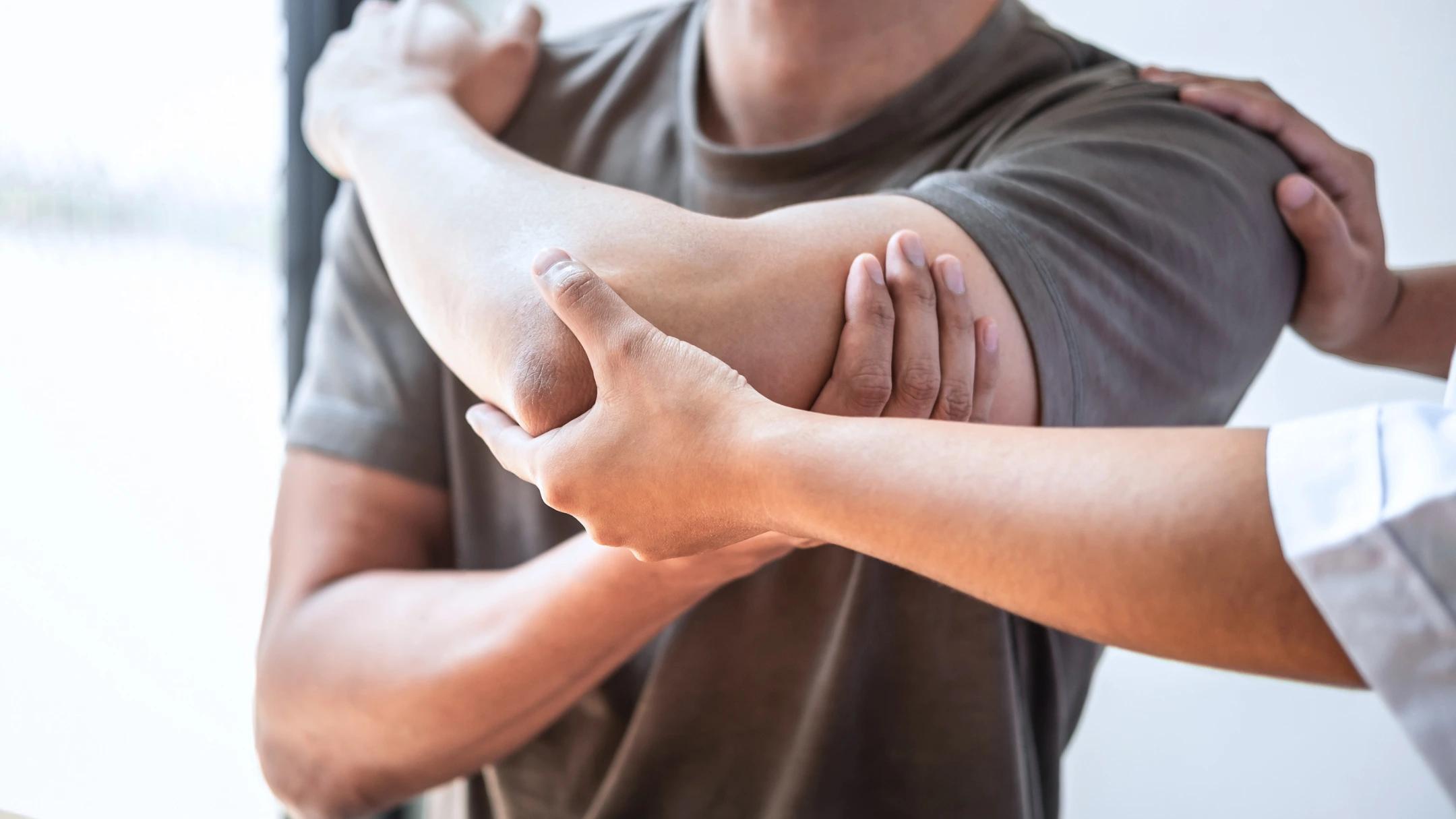
Golfer’s elbow pain that won’t settle with rest? Learn causes, evidence-based treatment options, safe exercises, braces, and what to do next.
Key takeaways
- Golfer's elbow, or medial epicondylitis, is an overuse tendon injury on the inner side of the elbow, and roughly 90 percent of cases are not caused by golfing but by work, tools, or other grip-heavy activity.
- Rest alone rarely fixes it, because in chronic cases the problem is tendon degeneration and scar tissue, not simple inflammation, and the tendon needs targeted loading to heal.
- Eccentric exercise is the treatment with the strongest evidence: it stimulates the tendon to remodel and can turn around cases that other treatments could not.
- Shockwave therapy has real research support for stubborn elbow tendon pain, with a 2024 review of 18 trials showing significant pain relief maintained at three and six months.
- At Unpain Clinic in Edmonton, we combine shockwave, EMTT, exercise, and hands-on care in a whole-body plan that treats why the tendon became overloaded, not just the sore spot.
In this article: what golfer's elbow is, why rest is not enough, what the research shows, how we treat it at Unpain Clinic, what you can do at home, and common questions including the difference from tennis elbow.
If you have a nagging ache on the inner side of your elbow that flares every time you grip, lift, or twist something, and rest has not solved it, you are dealing with golfer's elbow. The frustration is real, but so are the solutions. This guide walks through why the pain lingers, what the evidence says actually works, and what to do next when rest is not enough.
This is general information, not a substitute for a professional assessment or medical advice. Results vary from person to person.

What is golfer's elbow, and why does it keep hurting?
Golfer's elbow, medically called medial epicondylitis, is an overuse injury of the tendons that connect the forearm muscles to the bony bump on the inner side of the elbow. Despite the name, you do not have to be a golfer to get it. Up to 90 percent of cases come from work-related or daily activities that involve repetitive gripping, wrist flexion, or forearm rotation, things like carpentry, tools, heavy computer use, throwing sports, or weekend DIY [3].
What is happening inside the tendon. Early on there can be some inflammation, but in chronic cases the picture shifts to degeneration. Tiny micro-tears accumulate, and instead of laying down smooth, strong fibres, the body produces weaker, disorganized tissue, sometimes called tendinosis. Scar tissue, abnormal blood vessels, and even small calcium deposits can form. This is why taking a few weeks off feels better, but the pain returns the moment you go back to the activity. Rest does not reverse the structural tendon changes. The root issue, that messy, poorly healed tissue, needs to be actively treated.
Symptoms include pain and tenderness at the inner elbow, often radiating into the forearm, and it hurts to grip, shake hands, turn a doorknob, or swing a club. The elbow can feel stiff, and you may have weakness in the hand or wrist. Sometimes there is numbness or tingling into the ring and little fingers if the nearby ulnar nerve is irritated. Significant swelling or redness is not typical.

Why isn't rest enough?
Rest is not enough for three reasons. First, if the condition has been building for a while, a few weeks off will not undo the underlying tendon degeneration. Second, many daily tasks use the same forearm muscles, so truly unloading the area is almost impossible. Third, tendons have a limited blood supply that slows healing, and the problem is more common over age 40, when tendon repair is already less efficient.
The result is a familiar cycle: you rest, feel a bit better, return to activity, and the pain flares right back. Breaking that cycle takes treatment that targets the tendon itself and the mechanics driving the overload. That is the difference between managing the symptom and fixing the cause.
What does the research say about treating golfer's elbow?
The research points to two standout treatments for golfer's elbow that has not responded to rest: eccentric exercise and shockwave therapy, supported by emerging tools like EMTT, and best delivered inside a whole-body plan.
Eccentric exercise rebuilds the tendon. Eccentric loading, slowly lengthening the muscle-tendon unit under resistance, stimulates tendon remodelling and increases its tolerance to stress. A clinical study of stubborn golfer's elbow found that adding an eccentric wrist flexor exercise to standard physiotherapy produced dramatic improvement where other treatments, including cortisone, had failed, with average disability scores dropping from about 35 to about 8 over six weeks of daily work [4]. Exercise does not worsen tendon pain when done properly. It is the cornerstone of rehabilitation.
Shockwave therapy jump-starts healing in chronic cases. A 2024 systematic review of 18 randomized trials found that shockwave therapy significantly relieved pain in upper-limb tendon injuries compared with placebo, with benefits maintained at three and six months [2]. In a head-to-head trial, shockwave matched cortisone injection by eight weeks and achieved a higher rate of good-to-excellent outcomes, without the tissue-weakening risk of repeated steroid [1]. Shockwave works by breaking down old scar tissue, boosting blood flow, and triggering the release of growth factors for new collagen. Our explainer on how shockwave therapy works goes deeper.
EMTT adds an electromagnetic boost. Extracorporeal magnetotransduction therapy uses pulsed magnetic fields to reduce inflammation and encourage cellular repair. A 2025 double-blind randomized trial found that EMTT significantly improved pain and function in chronic musculoskeletal conditions compared with sham, with lower pain scores and better function lasting out to twelve weeks [5]. It is non-invasive and quick, and we often pair it with shockwave to cover both the mechanical and cellular sides of repair.
Braces and taping manage pain, not the cause. A counter-force forearm strap distributes force away from the injured tendon and can reduce pain during activity, and kinesiology tape may add support. They are useful aids that let you keep working or playing while you rehabilitate, but they do not heal the tendon.
Injections and surgery are last resorts. Cortisone gives quick short-term relief but can weaken the tendon over time and does not cure a tendinopathy. Platelet-rich plasma injections show some promise but results vary. Surgery is rarely needed and is considered only after six to twelve months of failed conservative care. At Unpain Clinic, our goal is to resolve your pain non-surgically.

How does Unpain Clinic treat golfer's elbow?
At Unpain Clinic in Edmonton, we find why the tendon became overloaded and treat the cause, not just the sore spot. By the time someone has tried rest without success, there are usually underlying issues, like tight forearm muscles, weak shoulder blade stabilizers, or a stiff upper back, that put extra strain on the elbow. We assess and fix those, alongside treating the tendon itself.

Shockwave therapy. Focused shockwave is one of our primary tools for golfer's elbow. A probe is applied to the inner elbow and delivers controlled acoustic pulses that break down scar tissue, increase blood flow, and trigger new collagen production. Sessions take only a few minutes, involve no needles, and leave only mild temporary soreness. A course is usually three to six sessions, once a week, and many people notice improvement after just two or three. The results tend to last because the therapy helps the tissue heal rather than masking pain.
EMTT. EMTT is paired with shockwave for tougher cases. A loop applicator sends pulsating magnetic energy into the elbow, and you feel little more than a mild tapping or warmth. It reduces inflammation and gives the tendon cells an extra repair signal, and in stubborn cases we have seen the combination break through a plateau that conventional physiotherapy alone could not shift.
Neuromodulation. When chronic elbow pain has left the nerves hypersensitive, NESA neuromodulation and related tools help calm the alarm system and reduce pain signalling, which in turn lets you do your exercises with less discomfort. It is especially useful when the pain includes tingling or shooting sensations.
Manual therapy. Our physiotherapy, chiropractic care, and massage therapy release tight forearm flexors and surrounding fascia, mobilize a stiff wrist or neck joint that may be contributing, and restore normal movement. Many people remark that their whole arm feels lighter afterward.
A customized exercise program. Exercise is the other half of the plan. We start with isometric holds if pain is high, progress to eccentric wrist flexor work using a FlexBar or light weight, add grip strengthening, and build in shoulder and upper back exercises to fix the mechanics that overloaded the elbow. We coach the form with you and give you a home program that is realistic with your schedule.
Whole-body assessment. We look beyond the elbow because a tight hip, a weak core, or a poor swing or lifting technique can quietly overload the forearm. By fixing those upstream factors, we make sure the elbow stays healthy once it heals. You can read more at our guide on how to treat golfer's elbow.
How do the common golfer's elbow treatments compare?
Rest and activity modification settle the acute flare but do not reverse chronic tendon degeneration, so the pain returns when you resume the activity. Anti-inflammatory medication and ice can take the edge off a bad day, though they do not promote tendon healing. A cortisone injection gives the fastest relief, often within days, but the effect fades and repeated shots can weaken the tissue. A counter-force brace reduces pain during activity by offloading the tendon, which is useful, but it does not fix the underlying problem. Eccentric exercise is the treatment with the most durable evidence, since it actually remodels and strengthens the tendon, but it takes weeks of consistency and works best when the pain is manageable enough to do the loading. Shockwave therapy sits between quick relief and slow rebuilding: it jump-starts healing in a chronic tendon and, in studies, matched or surpassed steroid injection by eight weeks without the downsides. EMTT and neuromodulation support the process by reducing inflammation and calming the nerve side of the pain. Surgery is a genuine last resort for cases that fail many months of proper conservative care. The most durable results come from combining the tools that rebuild, exercise and shockwave, while using braces and medication as short-term support and fixing the whole-body mechanics that drove the overload.
What can you do at home for golfer's elbow?
What you do between visits makes a real difference. These tips are meant to complement professional care, not replace it. Keep the effort consistent, use pain as your guide, and check with your clinician before starting new exercises if you are unsure.

- Do your prescribed exercises. Wrist flexor stretches, held about 30 seconds several times a day, keep the forearm loose, and eccentric strengthening, like slowly lowering a light weight in wrist flexion or using a FlexBar, rebuilds the tendon. Mild discomfort is normal; sharp pain means ease off.
- Modify activity, but stay active. You do not have to stop everything, just avoid overloading the tendon. Reduce volume or intensity of the aggravating activity for a few weeks, use a forearm strap during work or play, and take mini-breaks to stretch throughout the day. Listen to the pain: a twinge is fine, a stabbing ache means you have done too much.
- Use ice or heat for comfort. Ice for 10 to 15 minutes after a flare or activity settles acute pain. Heat before activity warms the muscles and can ease stiffness. Neither is a cure, but both help manage symptoms.
- Check your equipment. A larger, cushioned grip on a golf club or racquet reduces strain on the flexor tendons, and padded or anti-vibration gloves help if you work with tools. Small tweaks to gear can prevent a lot of re-irritation.
- Tape if it helps. A strip of kinesiology tape along the forearm, shown to you by your physiotherapist, can offload the tendon and remind you to use better form.
- Maintain overall strength. Once the acute pain settles, keep up shoulder, upper back, and core work alongside your forearm exercises, because strong proximal muscles share the load and protect the elbow long-term.
- Be patient. Tendon injuries heal over weeks, not days. You will improve along the way, but full tissue remodelling takes time, so keep the exercises going even after the pain fades, and build back gradually.

Frequently asked questions about golfer's elbow
What is the difference between golfer's elbow and tennis elbow?
They are close relatives but on opposite sides of the elbow. Golfer's elbow is pain on the inner side, at the wrist-flexor tendon attachment, and flares with gripping, wrist flexion, or turning the palm down. Tennis elbow is pain on the outer side, at the wrist-extensor tendon, and flares with wrist extension or lifting with the palm down. Both are treated with similar principles: eccentric exercise, manual therapy, and modalities like shockwave. The main anatomical difference is that golfer's elbow sometimes involves the ulnar nerve, causing tingling in the ring and little fingers.
How long does golfer's elbow take to heal?
Mild cases caught early can improve in four to six weeks of consistent rehab. More chronic cases often take three to six months to fully rehabilitate, though pain usually decreases well before full healing is complete. With shockwave, many people report meaningful improvement within two to three sessions, roughly a month. If you have had the pain for a year or more, expect a few months of concerted effort, but it will get better.
Will golfer's elbow go away on its own?
It can eventually settle, but that "eventually" can mean six to twelve months or longer, and during that time you are living with pain and limitation. Many cases linger or repeatedly flare because the underlying tendon degeneration never fully corrects itself without active treatment. In our experience, intervening with exercise and shockwave produces faster, more reliable recovery than waiting it out.
Does shockwave therapy hurt?
You will feel a tapping or thumping sensation, and it can sting briefly over very tender spots, but the intensity is adjustable and most people find it tolerable. The discomfort stops the moment the session ends, and afterward the area may feel mildly sore for a day or two. Most people describe it as well worth it for the results.
How many shockwave sessions will I need?
A typical course for golfer's elbow is three to six sessions, spaced about a week apart. Many people notice improvement after two or three. Each session builds on the last, and the benefit often continues to grow for weeks after the course ends as the tendon remodels.
What brace works best for golfer's elbow?
A counter-force forearm strap, worn about one to two inches below the elbow crease, offloads the tendon during activity and is the most commonly recommended support. A compression sleeve can add warmth and proprioception. These are aids to keep you active while you rehabilitate, not long-term replacements for strengthening.
Do I need a referral to be seen?
No referral is needed to see a physiotherapist or chiropractor in Alberta. You can book an assessment directly, and if you have imaging or reports from a doctor, those are welcome but not required.
“They are the Shockwave leaders in Edmonton. Their equipment is always up to date and their team training is second to none. I have done Shockwave at several offices, no one produces results as good as Unpain. Keep up the good work Uran.”-Kris Stepney
About the author
Written by Uran Berisha, Founder of Unpain Clinic and Medical Shockwave Institute. Uran has a Bachelor of Science in Physiotherapy and is an International Educator in Shockwave Therapy. Medically reviewed by Uran Berisha.
Book your initial assessment
Golfer's elbow can be stubborn, but it does not have to run your life. When rest is not enough, the answer is not to wait longer but to actively treat the tendon and fix the mechanics behind the overload. Shockwave jump-starts the healing, eccentric exercise rebuilds the tendon, and a whole-body plan makes sure it stays gone. If you are tired of the cycle of try everything and feel nothing, our assessment is designed for you. We ask not just where it hurts, but why. Your first visit is 60 minutes, assessment only, and includes a full history and goal setting, head-to-toe orthopedic and muscle testing, motion analysis, imaging decisions if needed, pain-pattern mapping, and a personalized treatment roadmap.
You will see a licensed physiotherapist or chiropractor, and if we are a good fit, we schedule your first treatment and start your plan. No referral needed, no pressure, and no long-term upsells, just honest, effective care. We will tell you honestly if this approach is not right for you. Book your initial assessment at Unpain Clinic.
References
- Lee, S.S., Kang, S., Park, N.K., et al. (2012). Effectiveness of initial extracorporeal shock wave therapy on the newly diagnosed lateral or medial epicondylitis. Annals of Rehabilitation Medicine, 36(5), 681 to 687. https://pubmed.ncbi.nlm.nih.gov/23185733/
- Xiong, Y., Wen, T., Jin, S., et al. (2024). Efficacy and safety of extracorporeal shock wave therapy for upper limb tendonitis: a systematic review and meta-analysis of randomized controlled trials. Frontiers in Medicine, 11, 1394268. https://www.frontiersin.org/journals/medicine/articles/10.3389/fmed.2024.1394268/full
- Konarski, W., et al. (2023). Current concepts of natural course and management of medial epicondylitis: a clinical overview. Orthopaedic Reviews, 15(3), 84275. https://orthopedicreviews.openmedicalpublishing.org/d/001c.84275/
- Tyler, T.F., et al. (2014). Clinical outcomes of the addition of eccentrics for rehabilitation of previously failed treatments of golfer's elbow. International Journal of Sports Physical Therapy, 9(3), 365 to 370. https://pubmed.ncbi.nlm.nih.gov/24944855/
- Hollander, K., et al. (2025). Extracorporeal magnetotransduction therapy (EMTT) for musculoskeletal disorders: a double-blind, placebo-controlled, randomized trial. Journal of Back and Musculoskeletal Rehabilitation (in press). https://portal.fis.tum.de
- Unpain Clinic. How to Treat Golfer's Elbow Injury in Edmonton. https://www.unpainclinic.com/en/articles/golfers-elbow-treatment-edmonton
Related Topics