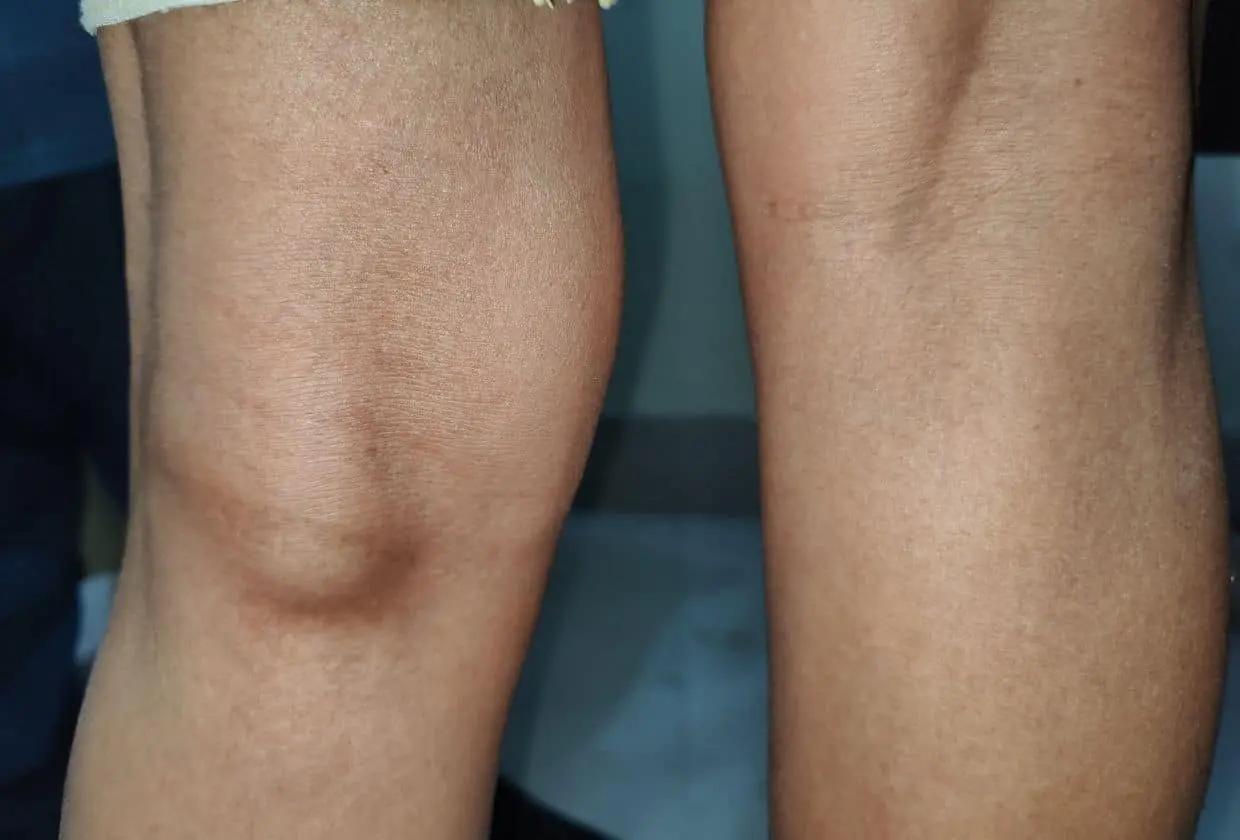
Struggling with swelling or tightness behind your knee? Learn what a Baker’s Cyst is, why it forms, and how to treat it without surgery.
Key takeaways
- A Baker's cyst, also called a popliteal cyst, is a fluid-filled sac at the back of the knee. It is almost always a signal that something else in the knee is irritated.
- The cyst itself is benign. The pain usually comes from the underlying problem, most often knee osteoarthritis or a meniscus tear.
- Draining the cyst gives short-term relief, but the fluid tends to return if the knee keeps producing it. Treating the root cause is what makes the cyst settle for good.
- Most people improve without surgery. At Unpain Clinic in Edmonton, we treat the whole knee using focused shockwave therapy, EMTT, hands-on care, and a home exercise plan.
In this article: what a Baker's cyst is, how to spot one, why it keeps coming back, what the research says, how we treat it, what you can do at home, and common questions.
A Baker's cyst is a fluid-filled swelling behind the knee that forms when the joint is under stress, usually from knee osteoarthritis or meniscus-related knee pain. The lump is not the real problem. It is your knee telling you that something inside it needs attention. This article is based on our podcast episode, Eliminate the Cause of Your Knee Pain With True Shockwave Therapy.
What is a Baker's cyst, and why did one form behind your knee?
A Baker's cyst is a pocket of joint fluid that bulges out at the back of the knee, into a small cushion called the popliteal bursa. When the knee makes more fluid than it can handle, that fluid has to go somewhere. It pushes back into the bursa behind the knee and forms a soft lump, a bit like too much air inflating a balloon.
In adults, a Baker's cyst rarely appears on its own. It shows up because the knee joint is already irritated. The two most common reasons are wear-and-tear arthritis and a worn or torn meniscus, the cartilage that cushions the joint. Both of these make the knee produce extra fluid, and that extra fluid feeds the cyst.
The cyst is a symptom, not the disease. That single idea changes how you should think about it. If you only chase the lump, you miss the reason it keeps filling. If you calm the knee down, the lump usually loses its fuel supply and shrinks.

How do you know if the lump behind your knee is a Baker's cyst?
The clearest sign of a Baker's cyst is a soft, tight swelling behind the knee, usually on the inner side, that becomes more obvious when you straighten your leg. Many people also feel a dull ache, stiffness, or a sense of fullness that makes it hard to fully bend or kneel.
Common things people notice include a bulge that ranges from the size of a pea to a golf ball, a feeling that something is blocking the joint when you bend it, and discomfort that gets worse after a long walk or a busy day on your feet. Some cysts cause no symptoms at all and are only found by chance on a scan.
One symptom always deserves urgent attention. Sudden, sharp calf pain with swelling and redness can mean a burst cyst, but it can also look exactly like a blood clot. If that happens, get it checked the same day to rule out a clot. It is better to be cautious than to guess.

Why does a Baker's cyst keep coming back?
A Baker's cyst keeps returning because the knee keeps making the fluid that feeds it. Draining the sac with a needle can shrink it for a couple of weeks, but if the joint is still irritated, it simply refills. This is the frustration so many people describe: drain it, and it comes back.
The usual sources of that ongoing irritation are worth naming plainly.
Knee osteoarthritis. Wear-and-tear arthritis inflames the joint, and the body makes extra fluid to try to protect it. That fluid backs up into the cyst. Our guide to what actually helps knee osteoarthritis goes deeper on this.
A meniscus tear. A worn or torn meniscus, common in middle age, irritates the joint and can act like a one-way valve that lets fluid out but not back. You can read our take on non-surgical options for a meniscus tear.
Inflammatory arthritis or an old injury. Conditions like rheumatoid arthritis, or the aftermath of a past knee injury or surgery, can keep the joint lining inflamed and the fluid flowing.
Tight muscles and poor movement. Tight calves and hamstrings, a stiff ankle, or a weak hip can load the knee unevenly and keep it irritated. This is the part most treatment misses, and it is exactly what we look for.
What does the research say about Baker's cysts?
The research is reassuring: a Baker's cyst is a well-understood, benign condition that is closely tied to the health of the knee joint. Here are three findings that matter for how you treat it.
Baker's cysts travel with knee arthritis. In people with knee osteoarthritis, studies have found a Baker's cyst in roughly 20 to 40 percent of cases, and the link grows stronger as the arthritis becomes more advanced [1]. In a separate ultrasound study of people with knee pain, about one in four had a popliteal cyst, and that number rose with age [2].
Treating the knee tends to beat treating the cyst alone. A randomized trial in people with knee arthritis and a Baker's cyst found that those who received shockwave therapy had greater improvements in pain, knee movement, and function than those who received standard ultrasound therapy [3]. As one clinical review put it, when an active cyst is left in place, the "efficacy of therapy declines" over the medium term, meaning people do not improve as much until the underlying joint problem is handled [4].
Surgery is rarely the answer. Reviews of Baker's cyst care conclude that cutting the cyst out is not usually recommended when arthritis is present, because it tends to come back unless the joint problem is fixed too [4].

How do we treat a Baker's cyst at Unpain Clinic?
At Unpain Clinic in Edmonton, we treat the whole knee rather than just the lump, because the cyst almost always shrinks once the joint calms down. Your plan usually blends a few non-surgical tools, chosen after a full assessment of how your hip, knee, and ankle move together.
Focused shockwave and EMTT. Focused shockwave therapy sends acoustic waves deep into the joint to calm inflammation, improve circulation, and support tissue repair in an arthritic or worn knee. We often pair it with EMTT, which uses a magnetic field to reduce swelling and support cell repair without any pain. Together they address the fluid at its source.
Hands-on care. Our physiotherapy, chiropractic care, and massage therapy loosen tight calves and hamstrings and free up how the joint glides, which takes pressure off the back of the knee.
Neuromodulation. When a knee has been irritated for a long time, the nervous system can turn the pain dial up. NESA neuromodulation and related tools help settle that response so you can move and rehab with less pain.
Exercise. Gentle range-of-motion work helps the body reabsorb fluid, while targeted strengthening for the quads, hips, and calves gives the joint better support so it produces less excess fluid over time.
The common approaches differ mainly in how long the relief holds. Draining the cyst, called aspiration, removes the fluid directly and shrinks the lump quickly, but the relief is often temporary, because the cyst refills if the knee stays irritated. A cortisone injection calms inflammation and slows fluid production for a while, though it does not fix the cause, so the effect is short to medium term. Surgical removal cuts out the sac, but it is rarely needed and tends to come back when arthritis or a meniscus tear is left untreated. The whole-knee approach we use at Unpain Clinic treats the arthritis, the tear, and the movement problems driving the fluid, which aims for lasting change by removing the cyst's fuel supply rather than emptying it again and again.

What can you do at home to ease a Baker's cyst?
You can do a lot at home to support your recovery between visits. The goal is gentle movement and less pressure on the back of the knee, never aggressive poking at the lump itself. Here is a simple routine.
- Use rest, ice, and elevation during a flare. Ease off strenuous activity for a few days, ice the back of the knee for 10 to 15 minutes with a cloth between the pack and your skin, and prop your leg on a pillow above heart level so fluid can drain.
- Keep the knee moving gently. Heel slides help circulate joint fluid. Lie on your back and slowly slide your heel toward your buttocks, then straighten it out, for 10 to 15 slow reps a few times a day. Stop if it sharpens the pain.
- Stretch your calves and hamstrings. A wall calf stretch and a seated hamstring stretch, held for about 20 to 30 seconds each, reduce the tug at the back of the knee.
- Strengthen the muscles that support the knee. Quad sets and gentle straight leg raises build the thigh muscles that stabilize the joint. Aim for 10 slow reps, a couple of times a day.
- Notice what makes it swell. If deep squats or long stair sessions flare it up, modify them for now rather than pushing through. Use a railing, take breaks, and warm up before activity.
- Leave the lump alone. Do not press or dig into the cyst to try to squeeze it out. Massage the surrounding muscles gently if they are tight, but let the cyst settle on its own.
If a home step makes things worse, or the swelling is not easing, that is your cue to get it assessed rather than wait it out.
Frequently asked questions about Baker's cysts
Can a Baker's cyst go away on its own?
Yes, it can. If the underlying knee problem is mild or improves, the body can reabsorb the fluid and the cyst can shrink without any direct treatment. Small cysts found by chance on a scan often disappear on a later scan. A larger cyst, or one attached to ongoing arthritis or a tear, usually will not fully resolve until the cause is treated.
What makes a Baker's cyst flare up or get bigger?
The size of a Baker's cyst usually reflects how irritated the knee is. Overusing the knee, a fresh twist or injury, or an arthritis flare can all cause a surge of fluid that fills the cyst more. Long periods of sitting still can also make it puff up temporarily. Noticing which activities set it off is useful information for your treatment plan.
Is a Baker's cyst dangerous?
A Baker's cyst itself is benign and not cancerous. The main thing to watch for is a burst cyst, which can leak fluid into the calf and mimic a blood clot with sudden pain, swelling, and redness. Because a clot is serious, any sudden calf symptoms should be checked promptly to rule it out. Once confirmed as a cyst, it is a manageable problem.
Do I need an ultrasound or MRI to diagnose it?
Often a Baker's cyst can be identified on a physical exam, since the lump tends to firm up when the knee is straight and soften when it bends. An ultrasound is a quick, radiation-free way to confirm it and rule out other causes. An MRI adds the most detail and can show a meniscus tear or the severity of arthritis if a more complex knee problem is suspected.
Can I exercise with a Baker's cyst, or should I rest completely?
You should keep moving, with some sensible limits. Complete rest tends to stiffen the knee and weaken the muscles, which can slow recovery. Low-impact activity like flat walking, easy cycling, and swimming is usually well tolerated. Avoid deep loaded knee bends and high-impact moves while the cyst is very swollen, and ease back in as the pain settles.
Does shockwave therapy help a Baker's cyst?
Shockwave therapy helps indirectly, and this is the key point. It does not pop or drain the cyst. It treats the arthritis, worn meniscus, or irritated joint lining that is producing the extra fluid, which reduces the fluid supply so the cyst can shrink. Research on knee arthritis with Baker's cysts has shown better pain and function with shockwave than with standard ultrasound therapy.
Will a Baker's cyst need surgery?
In most cases, no. Baker's cysts usually respond to non-surgical care once the underlying knee problem is treated. Surgery is a last resort, considered only for a cyst that stays large and painful despite everything else, and even then it works best when the internal joint issue is corrected at the same time.
Testimonial
“Dr. Laci is a good chiropractor. I have seen a lot of improvement on my knees ever since I started seeing her for my knee pain. I have been to a lot chiro, physio for my knees but it’s only Dr. Laci able to get rid of the worst pain on both of my knees. I was dragging my left leg when walking before but now I really feel better on both of my knees. Thank you Dr. Laci.”-Tetet Patetet
About the author
Written by Uran Berisha, Founder of Unpain Clinic and Medical Shockwave Institute. Uran has a Bachelor of Science in Physiotherapy and is an International Educator in Shockwave Therapy. Medically reviewed by Uran Berisha.
Ready to treat the cause, not just the lump?
If you are tired of draining a Baker's cyst only to watch it come back, the next step is a one-on-one assessment where we find the actual source of the pressure behind your knee and build you a clear plan. No referral needed. No pressure, no contracts. We will tell you honestly if you are not a good candidate for this approach.
Book your initial assessment at Unpain Clinic.
References
- Abate, M., Di Carlo, L., Di Iorio, A., and Salini, V. (2021). Baker's Cyst with Knee Osteoarthritis: Clinical and Therapeutic Implications. Medical Principles and Practice, 30(6), 585 to 591. https://pubmed.ncbi.nlm.nih.gov/34348320/
- Picerno, V., Filippou, G., Bertoldi, I., et al. (2014). Prevalence of Baker's cyst in patients with knee pain: an ultrasonographic study. Reumatismo, 65(6), 264 to 270. https://pubmed.ncbi.nlm.nih.gov/24705029/
- Chen, T.W., Lin, C.W., Lee, C.L., et al. (2014). The efficacy of shock wave therapy in patients with knee osteoarthritis and popliteal cyamella. Kaohsiung Journal of Medical Sciences, 30(7), 362 to 370. https://pubmed.ncbi.nlm.nih.gov/24924842/
- Leib, A.D., Roshan, A., Foris, L.A., and Varacallo, M. (2023). Baker's Cyst. StatPearls. Treasure Island (FL): StatPearls Publishing. https://www.ncbi.nlm.nih.gov/books/NBK430774/
- Cleveland Clinic. (2025). Baker Cyst (Popliteal Cyst): Symptoms, Causes and Treatment. Cleveland Clinic Health Library. https://my.clevelandclinic.org/health/diseases/15183-bakers-cyst
- American Academy of Orthopaedic Surgeons. (2018). Popliteal Cyst (Baker's Cyst). OrthoInfo. https://orthoinfo.aaos.org/en/diseases--conditions/bakers-cyst-popliteal-cyst/
- Berisha, U. (Host). (2025). Eliminate the Cause of Your Knee Pain With True Shockwave Therapy. Unpain Clinic Podcast, Episode 5. https://www.unpainclinic.com/en/podcast/chronic-knee-pain-causes-treatment
Related Topics