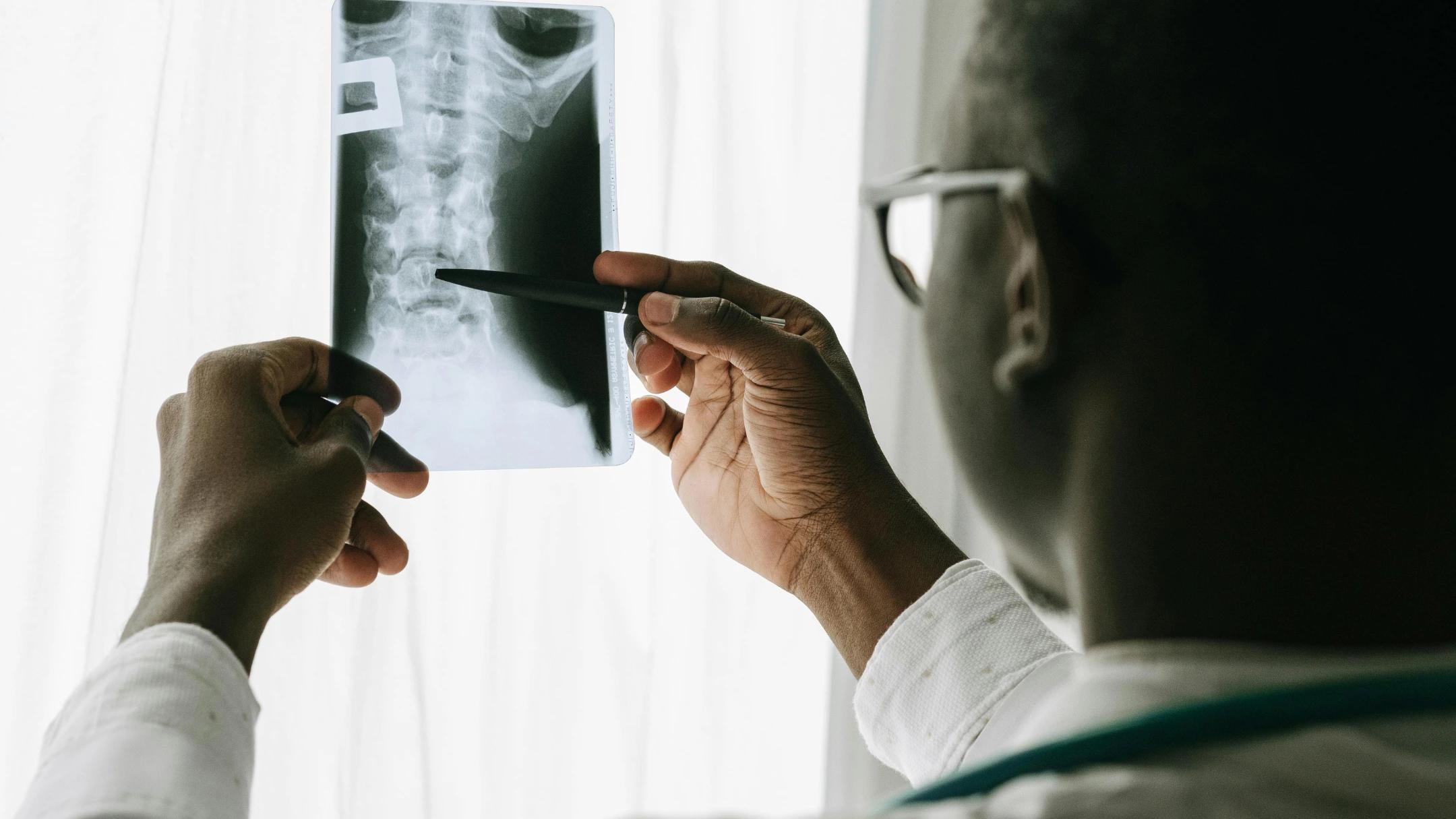
Wondering if you need an x-ray for lower back pain? Learn when an x-ray is actually helpful—and why your pain might be coming from fascia, not bones.
KEY TAKEAWAYS
- Most acute lower back pain does not need imaging in the first four to six weeks. The major clinical guidelines have said this for over a decade.
- An X-ray shows bone. It cannot see muscle, fascia, ligaments, discs, or nerves, which is where most lower back pain actually comes from.
- Imaging findings like disc bulges, disc degeneration, and facet wear are extremely common in people who have no back pain at all. Calling those findings the cause of your pain is often wrong.
- A small set of specific warning signs (red flags) does change the picture and is a reason to image early. Knowing those signs is more useful than rushing to imaging by default.
- The right first step for most lower back pain is movement, a real assessment, and a plan, not a scan.
You wake up. You can barely roll over. The pain is somewhere between a deep ache and a stab, and you cannot decide which is worse. By day three you are typing "do I need an X-ray for lower back pain" into your phone with one hand while holding your back with the other.
We get it. The instinct to find out what is wrong, fast, is reasonable. The problem is that for most lower back pain, rushing to an X-ray does not give you the answer you think it will, and the guidelines have been saying this clearly for over a decade. Here is what an X-ray can and cannot do, when it actually helps, and what to do first.
AN X-RAY IS A PICTURE OF BONE, NOT PAIN
An X-ray is a single type of imaging that captures bone density. It is good at showing fractures, bony alignment, certain arthritic changes, and structural issues like spondylolisthesis. It is not good at showing the soft tissue where most lower back pain actually starts: muscles, fascia, ligaments, intervertebral discs, and the nerve roots that come out of the spine.
This matters because most acute lower back pain is what clinicians call non-specific. The actual generator of the pain is somewhere in the soft tissue. A normal X-ray in that situation does not mean nothing is wrong. It means the bones look fine, which is most of what the X-ray can tell you.
For soft tissue, the better imaging tool is MRI, and even that comes with its own caveats. Which brings us to the next problem.

MOST IMAGING FINDINGS ARE NOT THE CAUSE OF YOUR PAIN
This is the most important thing for any patient with lower back pain to understand, because it changes how you interpret the report you get back.
A 2015 systematic review in the American Journal of Neuroradiology pooled imaging studies of people who had no back pain at all and looked at what their spines showed. The findings are striking. In pain-free 20-year-olds, 37 percent had disc degeneration on imaging. In pain-free 80-year-olds, 96 percent did. Disc bulges showed up in 30 percent of pain-free 20-year-olds, and 84 percent of pain-free 80-year-olds. Disc protrusions, annular fissures, facet degeneration: all of these are common in people with no symptoms.
The authors' conclusion is worth quoting in spirit, not in quote: many of these imaging findings are part of normal aging, not the cause of the patient's pain. They have to be interpreted in the context of the clinical picture, not in isolation.
That is why "the MRI showed a disc bulge" or "the X-ray showed degenerative changes" so often turns into a treatment dead end. The finding is real, but it may have been there for fifteen years without bothering you, and treating the picture instead of the person is one of the more reliable ways to end up still in pain after expensive interventions.
THE GUIDELINES ON THIS ARE CLEAR (AND HAVE BEEN FOR YEARS)
The American College of Physicians published a clinical practice guideline on diagnostic imaging for low back pain in 2011 that still reads as current. The full guideline in Annals of Internal Medicine is direct: routine imaging in patients with lower back pain is not associated with clinically meaningful benefits and can cause harm. Imaging is indicated only in patients with severe or progressive neurologic deficits or with signs and symptoms that suggest a serious underlying condition.
The 2017 ACP guideline on noninvasive treatments for low back pain in Annals of Internal Medicine is also worth knowing about. For acute and subacute lower back pain (less than 12 weeks), it recommends non-drug treatment first, including heat, massage, acupuncture, and spinal manipulation. For chronic low back pain, it recommends exercise, multidisciplinary rehabilitation, acupuncture, mindfulness, and other non-drug approaches as first-line. Medications come after non-drug care, not before. Imaging shows up almost nowhere in the early phase of these guidelines for a reason.
These are not fringe recommendations. They are the standard of care from the largest internal medicine professional body in North America. The reason most family physicians do not send you for an X-ray on day three is not that they are being cheap. It is that the guidelines are explicit, and the evidence behind them is solid.
WHEN AN X-RAY OR MRI ACTUALLY DOES MATTER (RED FLAGS)
There is a specific list of warning signs where imaging is appropriate sooner rather than later. If any of these apply to you, do not wait six weeks. Get assessed.
- Recent significant trauma (a fall from height, a motor vehicle collision, a major sports injury) producing the pain.
- Unexplained weight loss along with the back pain.
- Fever, chills, or signs of infection along with the back pain.
- History of cancer, especially cancers known to metastasize to bone (breast, prostate, lung, kidney, thyroid).
- Long-term steroid use, intravenous drug use, or a known immunocompromised state.
- New numbness or weakness in one or both legs that is progressive rather than mild and stable.
- Loss of bladder or bowel control, numbness in the saddle area (the inner thighs and genitals), or new sexual dysfunction. These can indicate cauda equina syndrome, which is a surgical emergency.
- Pain that is worse at night and does not change with position.
- Pain in someone under 18 or over 50 with no clear mechanical explanation.
If none of these apply, your low back pain is almost certainly the more common non-specific kind. That is the kind where imaging in the first month does not change what you should be doing, and where the time, money, and worry an X-ray costs is better spent on starting a real treatment plan.

WHAT YOUR BACK ACTUALLY NEEDS FIRST
Three things, in this order.
Keep moving, within reason. The old advice was bed rest. The new advice, supported by every major guideline, is to stay as active as the pain allows. Walking, gentle range of motion, normal daily activities. Lying flat for three days is one of the slower ways to recover from a back episode.
Get an assessment from someone who treats backs every day. A physiotherapist, an experienced massage therapist, or a chiropractor can assess what is moving, what is not, what is loaded, what is weak, and what kind of pattern your pain is following. That assessment, in person, gives you information an X-ray cannot.
Start a real plan, not a coping plan. Stretching for ten minutes is not a plan. Ice is not a plan. A specific, dosed program that addresses what the assessment found is a plan. Most acute lower back pain settles within four to six weeks when the plan is decent. The pain that does not settle in that window is the pain that needs a closer look, including imaging if a red flag has emerged.
WHAT WE DO AT UNPAIN CLINIC EDMONTON
A first visit at Unpain Clinic is a 60-minute one-on-one assessment. We take a history, including a careful look for red flags. We screen movement, strength, and how the lumbar spine and the structures around it are loading. We go through any imaging you have already had, and we explain what is relevant, what is incidental, and what is not.
If you are a fit for our approach, the plan usually has four pieces.
- Manual therapy targeted to the specific joints, muscles, and fascia that the assessment flagged. Not a generic full-back rub.
- Focused shockwave therapy to the muscles, ligaments, and fascia that are contributing to the pain. Focused shockwave is a non-invasive, in-clinic treatment that uses acoustic waves to influence the tissue, improve blood flow, and restart a stalled healing response. Sessions are about 15 to 20 minutes.
- EMTT when the irritation is more diffuse, covering muscle, joint, and ligament rather than a focal spot. EMTT uses pulsed electromagnetic fields delivered through a loop applicator over the back.
- A specific home exercise program. Short, dosed, and progressed as the pain settles. This is the part you own, and it is what tends to keep the gains.
For patients whose pain has clearly sensitised the nervous system over a long history, we sometimes add NESA neuromodulation as an additional layer. It is not used on every back case.

”My husband and I both were suffering from tennis elbow for about half a year and tried many different things to alleviate the pain. I have done shockwave before for sciatica and tendinitis in my foot. I scheduled an appointment with Dr. Lacina Barsalou. Within 3 sessions each our tennis elbow was cured.
She was very thorough and knowledgeable. She did an absolute bang up job.
A couple of weeks ago, my back went out and I could barely walk. The only solace I had was sleeping and sitting on the floor. I went for one shockwave treatment with Lacina and she also adjusted my hips while I was there. The relief I feel now is like night and day. I definitely recommend Dr. Lacina for all your shockwave and chiropractic needs!” Sherry Lucas
WHAT WE DO NOT OFFER
- We do not perform or order imaging. X-rays and MRIs are ordered by physicians, and if you need imaging, we will tell you and recommend a conversation with your family doctor.
- We do not perform injections or surgery. If your situation requires a surgical opinion or an injection, we will tell you and refer you to the right specialist.
- We do not prescribe oral or topical pain medications. We are physiotherapists and registered massage therapists, not physicians.
- We do not promise cures. Most lower back pain improves with the right combination of treatments, but not every case resolves completely. What we offer is an honest assessment, a clear plan, and a team that will tell you if we are not the right fit.
FREQUENTLY ASKED QUESTIONS
Do I need an X-ray for my back pain?
For most acute lower back pain, no. The current ACP imaging guideline is explicit: routine imaging is not associated with clinically meaningful benefits and can cause harm. Imaging is indicated only when specific warning signs are present, such as significant trauma, unexplained weight loss, fever, a cancer history, new progressive neurologic deficits, or loss of bladder or bowel control.
How long should I wait before considering imaging?
The general rule is four to six weeks of conservative care first, assuming none of the red flag warning signs are present. If your pain is not improving in that window, or it is getting worse, that is the time to talk to a physician about whether imaging is now appropriate.
If my X-ray or MRI shows something abnormal, does that mean it is causing my pain?
Not necessarily. A 2015 systematic review in the American Journal of Neuroradiology found that disc degeneration, disc bulges, disc protrusions, and facet wear are extremely common in people with no back pain at all, and the prevalence increases with age. Up to 96 percent of pain-free 80-year-olds have disc degeneration on imaging. Whether the finding is causing your pain depends on the rest of the clinical picture, not on the image alone.
Can a physiotherapist or massage therapist tell what is wrong without imaging?
Often, yes, for non-specific lower back pain. A thorough movement assessment, strength testing, and a careful history identify the pattern of what is loading, what is not moving, and what is contributing to the pain. That information guides treatment more directly than most imaging would. We still recommend imaging when the assessment flags something that warrants it.
What are the red flags that mean I should get imaging soon?
Significant trauma, unexplained weight loss, fever, a history of cancer, long-term steroid use, IV drug use, new and progressive numbness or weakness in the legs, loss of bladder or bowel control, saddle-area numbness, pain that is worse at night and unchanged by position, and pain in someone under 18 or over 50 with no mechanical explanation. If any of these apply to you, see your physician.
Does shockwave therapy help with lower back pain even without imaging?
It can. Focused shockwave addresses the soft tissue layer (muscles, fascia, ligaments, tendons) that often drives lower back pain and that an X-ray cannot see. We assess what is going on first, decide whether shockwave is a fit, and explain the plan before starting.
Do I need a doctor's referral to come to Unpain Clinic?
No referral is needed. Physiotherapists and registered massage therapists in Alberta are primary contact providers, so you can book directly. Some extended health plans require a doctor's referral for reimbursement, so it is worth checking your benefits.
ABOUT THE AUTHOR
Written by Uran Berisha, PT, RMT, Founder of Unpain Clinic and Medical Shockwave Institute. Uran is a physiotherapist based in Edmonton, Alberta, and an International Educator in Shockwave Therapy. Medically reviewed by Uran Berisha, PT, RMT.
READY TO FIND OUT WHAT IS ACTUALLY DRIVING YOUR BACK PAIN?
If your lower back pain has not improved with rest and basic care, the next step is a 60-minute one-on-one assessment in Edmonton where we look at your back and the chain around it, review any imaging you have, and build you a clear, written plan. No referral needed. No pressure. We will tell you honestly whether our approach is the right call, and we will tell you just as honestly if you need to start with your family doctor first. You can book a one-on-one assessment when you are ready.
REFERENCES
The following sources are linked inline in the body above. The full citations are listed here for completeness.
- Brinjikji W, Luetmer PH, Comstock B, Bresnahan BW, Chen LE, Deyo RA, Halabi S, Turner JA, Avins AL, James K, Wald JT, Kallmes DF, Jarvik JG. Systematic literature review of imaging features of spinal degeneration in asymptomatic populations. American Journal of Neuroradiology. 2015;36(4):811-816. doi:10.3174/ajnr.A4173. PMID: 25430861. https://pubmed.ncbi.nlm.nih.gov/25430861/
- Chou R, Qaseem A, Owens DK, Shekelle P; Clinical Guidelines Committee of the American College of Physicians. Diagnostic imaging for low back pain: advice for high-value health care from the American College of Physicians. Annals of Internal Medicine. 2011;154(3):181-189. doi:10.7326/0003-4819-154-3-201102010-00008. PMID: 21282698. https://pubmed.ncbi.nlm.nih.gov/21282698/
- Qaseem A, Wilt TJ, McLean RM, Forciea MA; Clinical Guidelines Committee of the American College of Physicians. Noninvasive treatments for acute, subacute, and chronic low back pain: a clinical practice guideline from the American College of Physicians. Annals of Internal Medicine. 2017;166(7):514-530. doi:10.7326/M16-2367. PMID: 28192789. https://pubmed.ncbi.nlm.nih.gov/28192789/
Related Topics