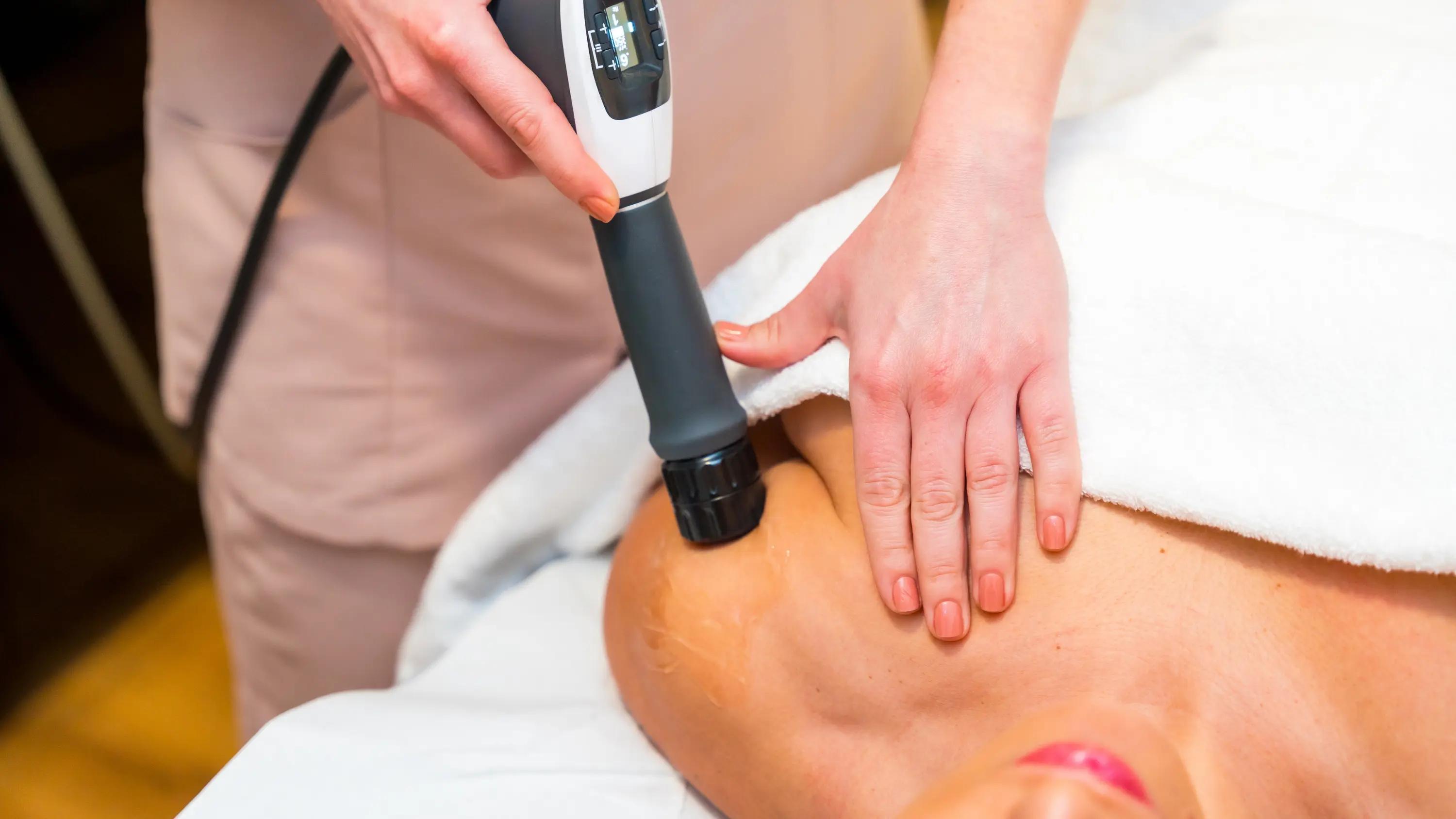
Discover how shockwave therapy helps relieve chronic pain by promoting healing and tissue regeneration. Book your assessment at Unpain Clinic today.
KEY TAKEAWAYS
- Chronic pain usually persists because the healing process has stalled, not because something is permanently broken. Painkillers mute the alarm. They do not restart the repair work.
- Shockwave therapy uses acoustic waves, not electricity, to wake up that stalled repair process at the tissue level.
- The published evidence is strongest for tendon problems like plantar fasciitis, tennis elbow, rotator cuff issues, and Achilles tendinopathy, with growing evidence for nerve, joint, and back pain.
- A typical course is three to six weekly sessions. Most people know within a few visits whether it is working for them.
- At Unpain Clinic in Edmonton, shockwave is the centrepiece of a layered plan that also includes EMTT, manual therapy, and progressive exercise. We tell you honestly if shockwave is not the right call for you.
If you have lived with chronic pain for a while, you have probably been through the standard menu. Rest. Painkillers. Maybe a cortisone shot. Maybe a course of physio that helped for a few weeks before things came back. At some point you start to wonder if anything will actually move the needle. Shockwave therapy is one of the few treatments developed to do exactly that, not by muting your pain signal but by acting on the tissue that is generating it. Here is how it works, what the evidence says, and how we use it at Unpain Clinic in Edmonton.
WHY DOES CHRONIC PAIN STICK AROUND IN THE FIRST PLACE?
Most chronic musculoskeletal pain does not come from something dramatically broken. It comes from something that was supposed to heal and did not finish the job.
In an acute injury, your body runs a normal three-phase repair process. Inflammation arrives first to clean up the damaged tissue. Cells start rebuilding the structure. The new tissue remodels and matures over weeks and months. Most acute injuries cycle through this and you go back to normal.
When pain becomes chronic, that cycle has usually stalled somewhere. The inflammation phase never fully resolves and becomes low-grade and persistent. The rebuilding phase produces tissue that is disorganized rather than properly aligned. The site develops abnormal nerve ingrowth, where nerves grow into tissue that should not have them, and stays painful long after the original problem should have settled.
Standard care often does not address any of this. Painkillers reduce your awareness of the signal but do nothing to the tissue. Cortisone calms inflammation in one spot for a window of weeks to months, then wears off. Rest gives the tissue a break but does not actively drive remodelling. None of these is wrong. They just are not enough on their own when the underlying problem is a stuck repair process.
That is the gap shockwave therapy was developed to fill.
WHAT DOES THE RESEARCH SAY ABOUT SHOCKWAVE THERAPY?
The published evidence on shockwave therapy is substantial and has grown sharply in the last few years.
A 2024 systematic review and meta-analysis of randomized trials in BMC Sports Science, Medicine and Rehabilitation found that shockwave therapy meaningfully reduced pain across a range of tendinopathies, including plantar fasciitis, lateral elbow pain, Achilles tendinopathy, and rotator cuff tendinopathy. The effect was consistent across studies and across body regions. A separate 2024 systematic review and meta-analysis specifically on upper limb tendonitis in Frontiers in Medicine reached a similar conclusion for shoulder and elbow conditions, with sustained pain improvements at 3 and 6 months and a strong safety profile.
The safety side of the evidence has held up across the broader literature. The foundational systematic review of shockwave therapy across orthopedic conditions in the British Medical Bulletin concluded that shockwave is a safe modality when applied by trained clinicians, with a low rate of serious adverse events. The most common reactions are mild and short-lived, mostly local soreness or warmth in the treated area for a few hours.
What this means in practice is that shockwave is one of the best-evidenced non-invasive options for chronic musculoskeletal pain, and the risk profile is favourable. It is not a magic switch. It does not work for everyone. But for the right conditions, it does what most passive treatments cannot.

HOW DOES SHOCKWAVE THERAPY WORK ON STUCK TISSUE?
Focused shockwave therapy uses acoustic waves, not electricity, delivered through a handheld applicator. The waves transfer mechanical energy through the skin into the tissue at depth. That energy does several things at once.
It improves local blood flow. Chronic injury sites are often poorly vascularised, which is part of why they do not heal on their own. Shockwave triggers the formation of new blood vessels in the area over the weeks following treatment, which gives the tissue more of what it needs to repair.
It restarts a stalled inflammatory response. The body's normal repair sequence relies on a controlled inflammatory phase to get going. Shockwave gives that phase a deliberate nudge, which is part of why we ask patients to avoid anti-inflammatory medications during a treatment course unless their doctor has specifically prescribed them.
It acts on the disordered nerve ingrowth that builds up in chronically painful tendons. A 2022 review of tendon pain mechanisms in the Scandinavian Journal of Pain describes how chronic tendon pain is driven by abnormal nerve growth into tissue that should not have nerves, along with sensitisation of those nerves over time. Treatments that target this disordered innervation, including shockwave, address something painkillers and rest cannot.
And it has a direct analgesic effect that often shows up early in a treatment course. Many patients notice the symptoms easing within the first one or two sessions, before any meaningful tissue change could have happened. That early relief is partly the nervous system response to the treatment. The bigger structural shifts take longer.

WHAT CONDITIONS DOES SHOCKWAVE THERAPY TREAT?
Shockwave is most effective for chronic, localised tissue problems where the body's repair has stalled. The conditions with the strongest evidence base include:
Foot and ankle conditions. Plantar fasciitis, Achilles tendinopathy, and chronic heel pain are some of the most-studied applications. Morton's neuroma and hallux rigidus also respond to shockwave, with growing published evidence.
Knee conditions. Patellar tendinopathy and chronic anterior knee pain often improve with shockwave, especially when combined with progressive loading exercise. Shockwave does not regrow lost cartilage in osteoarthritis, but it can reduce pain and improve function around an arthritic joint.
Hip and pelvic conditions. Greater trochanteric pain syndrome and gluteal tendinopathy are among the more responsive conditions.
Shoulder and elbow conditions. Rotator cuff tendinopathy, calcific tendinopathy of the shoulder, and tennis elbow are all backed by randomized trial evidence.
Stubborn scar tissue and old soft-tissue injuries. Adhesions and fibrosis from old injuries or surgeries often respond to shockwave even years after the original event.
The pattern across all of these is the same. Shockwave is most useful when the pain has been around for more than a few weeks, has not responded to basic rest and rehab, and is concentrated in a specific area we can target. It is less suited to diffuse, system-wide pain patterns where a sensitised nervous system is the main driver. For those cases, we usually combine it with NESA neuromodulation or recommend a different starting point.
WHAT DOES SHOCKWAVE THERAPY AT UNPAIN CLINIC EDMONTON ACTUALLY LOOK LIKE?
A typical first visit is a 60-minute one-on-one assessment. We take a history, look at the painful area, and assess the chain above and below it. The shoulder is not just the shoulder. The knee is not just the knee. A stiff thoracic spine can keep a shoulder problem from settling. A tight calf can keep a heel problem from settling. We map out what is contributing before we recommend a course.
If shockwave is a fit, sessions run about 15 to 20 minutes. You feel a strong tapping sensation that we adjust to your tolerance. There is no needle and no recovery downtime. Most plans run three to six weekly visits, with reassessment along the way.
We often pair shockwave with EMTT when the painful area is broader than what a focused handpiece can comfortably cover. EMTT uses pulsed electromagnetic fields delivered through a loop applicator placed over the area. You feel nothing during the session, just a faint clicking sound. A 2025 double-blind, placebo-controlled, randomized trial of EMTT in the Journal of Back and Musculoskeletal Rehabilitation tested it on patients with knee osteoarthritis, rotator cuff tendinopathy, or lumbar spondyloarthrosis. The EMTT group had significantly better pain and function than the sham group at 6 and 12 weeks. Shockwave and EMTT work in different ways, and combining them in the same visit gives broader coverage than either alone.
Manual therapy and exercise are always part of the plan. Stiff joints, tight soft tissue, and weak supporting muscles all push more load onto the painful area. A few minutes of hands-on work and a short, specific home exercise program protect the gains we make in clinic. The home exercise piece is the part you own. Most patients do these five to seven days per week, with adjustments at each visit.
For patients whose pain has clearly sensitised the nervous system, we may discuss NESA neuromodulation as an additional layer. It is not used on every case.

WHAT CAN I DO AT HOME TO SUPPORT SHOCKWAVE THERAPY?
What you do between sessions matters. A few habits help the treatment work as well as it can.
- Do your home exercises. The exercise program we give you is short and specific. Five to seven days a week of a 10-to-15-minute routine usually does more for long-term outcomes than any single treatment in clinic. It is the part of the plan you own.
- Avoid routine anti-inflammatory medications during the treatment course unless they are prescribed. Shockwave works partly by restarting a controlled inflammatory phase. Routine ibuprofen or naproxen can blunt that response. Acetaminophen is fine if you need something for pain. Discuss any prescribed anti-inflammatories with your doctor.
- Listen to mild soreness, not sharp pain. Some local tenderness or warmth in the treated area for a few hours after a session is normal and is part of the healing response. Sharp, escalating pain is not. Tell us if anything feels off.
- Hydrate and sleep. Tissue repair happens overnight and depends on basic resources. Most adults do better on 7 to 8 hours of sleep and adequate water intake. Boring advice, real impact.
- Pace the return to your activity. Once the pain starts coming down, the temptation is to go back to your old volume of running, lifting, or sport in one jump. That tends to flare things up. We coach the return to activity step by step.
If you have done all of this consistently for six to eight weeks without progress, that is the cue for us to reassess. Something in the plan is missing.
WHAT WE DO NOT OFFER
- We do not perform injections of any kind, including cortisone, platelet-rich plasma, or alcohol sclerosing injections.
- We do not prescribe oral or topical pain medications. We are physiotherapists and registered massage therapists, not physicians.
- We do not perform surgery. If your condition has not responded to a thorough conservative plan and surgery is on the table, we will tell you and refer you to the appropriate surgeon.
- We do not promise cures. Shockwave therapy is one of the better-evidenced non-invasive options, but it does not work for everyone. What we offer is an honest plan, regular review, and a team that will tell you if we are not the right fit.
FREQUENTLY ASKED QUESTIONS
Does shockwave therapy hurt?
The pulses are uncomfortable on an irritated area, and most people rate them four or five out of ten during the session. We adjust the intensity to what you can tolerate. After the session, a few hours of mild soreness or warmth is normal. There is no needle, no incision, and no medication to react to.
How many sessions will I need?
A typical course is three to six weekly sessions. Mild cases sometimes settle in three. More stubborn cases need five or six. We reassess as we go and will tell you honestly if a course is not moving you in the right direction.
How long until I feel relief?
Some people notice the symptoms calming down within the first one or two sessions. The bigger structural gains usually show up at the four-to-twelve-week mark, after the tissue has had time to respond. Be patient through the early sessions if the early relief is subtle.
Is shockwave therapy safe?
For most people, yes. The foundational safety review in the British Medical Bulletin concluded that shockwave is a safe modality when applied by trained clinicians. We do screen for contraindications such as pregnancy, active infection in the treated area, bleeding disorders, and certain implants before starting.
What is the difference between focused and radial shockwave?
Focused shockwave concentrates the energy at a specific depth in the tissue and is what most published research uses for deeper, more localised problems. Radial shockwave spreads the energy more broadly across the surface and is better suited to wider, more superficial areas. We use both depending on the condition.
Will my insurance cover shockwave therapy?
Many extended health benefit plans in Alberta cover the session under your physiotherapy or chiropractic coverage, since shockwave is delivered as part of a physiotherapy session. Coverage specifics depend on your plan. Our administrative team can help check.
Do I need a doctor's referral to come to Unpain Clinic?
No referral is needed. Physiotherapists and registered massage therapists in Alberta are primary contact providers, so you can book directly. Some extended health plans require a doctor's referral for reimbursement, so it is worth checking your benefits if that matters to you.

“Lacuna Barsalou is nothing short of pure magick. This providers total body head to toe approach changed my life. After 16 years of chronic back spasms and excruciating pain that made it difficult to go throughout my life, I have had the first flare-up free year since the accident. If you have long term chronic pain, even if you don't know why or what's going on, you'll be in wonderful hands with Lacina. Shockwave therapy is truly a game changer in the world of chronic pain. Either clinic is wonderful, clean, and friendly and worth every penny.”-
Mari
ABOUT THE AUTHOR
Written by Uran Berisha, PT, RMT, Founder of Unpain Clinic and Medical Shockwave Institute. Uran is a physiotherapist based in Edmonton, Alberta, and an International Educator in Shockwave Therapy. Medically reviewed by Uran Berisha, PT, RMT.
READY TO STOP CHASING THE PAIN AND START TREATING THE CAUSE?
If you have been stuck in the cycle of try everything, feel nothing, the next step is a 60-minute one-on-one assessment in Edmonton where we look for what is actually driving your pain and build you a clear, written plan. No referral needed. No pressure. We will tell you honestly whether shockwave is the right call. You can book a one-on-one assessment when you are ready.
REFERENCES
The following sources are linked inline in the body above. The full citations are listed here for completeness.
- Majidi L, Khateri S, Nikbakht N, Moradi Y, Nikoo MR. The effect of extracorporeal shock-wave therapy on pain in patients with various tendinopathies: a systematic review and meta-analysis of randomized controlled trials. BMC Sports Science, Medicine and Rehabilitation. 2024;16(1):93. doi:10.1186/s13102-024-00884-8. PMID: 38659004. https://pubmed.ncbi.nlm.nih.gov/38659004/
- Xiong Y, Wen T, Jin S, Lin L, Shao Q, Peng Y, Zheng Q, Li W. Efficacy and safety of extracorporeal shock wave therapy for upper limb tendonitis: a systematic review and meta-analysis of randomized controlled trials. Frontiers in Medicine. 2024;11:1394268. doi:10.3389/fmed.2024.1394268. PMID: 39139789. PMCID: PMC11319137. https://pubmed.ncbi.nlm.nih.gov/39139789/
- Schmitz C, Császár NB, Milz S, Schieker M, Maffulli N, Rompe JD, Furia JP. Efficacy and safety of extracorporeal shock wave therapy for orthopedic conditions: a systematic review on studies listed in the PEDro database. British Medical Bulletin. 2015;116(1):115-138. doi:10.1093/bmb/ldv047. PMID: 26585999. https://pubmed.ncbi.nlm.nih.gov/26585999/
- Ackermann PW, Alim MA, Pejler G, Peterson M. Tendon pain: what are the mechanisms behind it? Scandinavian Journal of Pain. 2023;23(1):14-24. doi:10.1515/sjpain-2022-0018. PMID: 35850720. https://pubmed.ncbi.nlm.nih.gov/35850720/
- Hollander K, Burgkart R, von Eisenhart-Rothe R, Vester J, Gerdesmeyer L. Extracorporeal magnetotransduction therapy (EMTT) for management of musculoskeletal disorders: a double-blind, placebo-controlled, randomised trial. Journal of Back and Musculoskeletal Rehabilitation. 2025 (Epub ahead of print). doi:10.1177/10538127251400083. PMID: 41313312. https://pubmed.ncbi.nlm.nih.gov/41313312/
Related Topics