Learn about plantar fasciitis, its causes, and effective treatments like shockwave therapy to relieve chronic heel pain and get back on your feet.
KEY TAKEAWAYS
- Most chronic plantar fasciitis is not really an inflammation. It is a degenerative change in the plantar fascia, which is why rest and ice alone often do not fix it.
- The pain becomes chronic when the underlying load on the foot (calf tightness, hip and core weakness, footwear, weight, and activity volume) does not change.
- Long-term reliance on supportive footwear and orthotics can help in the short term, but if your foot never gets stronger underneath them, the problem can keep coming back.
- The strongest evidence for stubborn plantar fasciitis supports two treatments: progressive loading exercise and shockwave therapy.
- At Unpain Clinic in Edmonton, plantar fasciitis care combines focused shockwave with manual therapy, a real strength program, and footwear guidance. We tell you honestly if we are not the right fit.
If your first steps in the morning feel like you are stepping on glass, and the pain has not budged through months of stretching, ice rolling, and supportive shoes, you are dealing with the chronic version of plantar fasciitis. The good news is that the chronic version has been studied a lot, and the evidence is clear on what actually moves it. Here is why your plantar fasciitis is stuck, why the usual fixes often plateau, and what we do at Unpain Clinic in Edmonton when the standard approach has not worked.
WHY DOES PLANTAR FASCIITIS BECOME CHRONIC?
Plantar fasciitis is irritation and degeneration of the plantar fascia, the thick band of tissue that runs along the bottom of your foot from the heel to the base of the toes. It does the work of a passive spring during walking and running, storing and releasing energy with every step.
In an acute episode, there is some inflammation, but if the pain has been around for more than about six weeks, the picture changes. The current understanding is that chronic plantar fasciitis is really a plantar fasciopathy, a degenerative change in the fascia rather than a classic inflammation. That is more than a semantic point. It changes what the right treatment looks like. Anti-inflammatory medications and ice can settle a flare, but they do not change degenerated tissue.
The reason the condition becomes chronic is usually some combination of three things.
- Mechanical load on the fascia stays high. Long days on hard floors, a job that keeps you on your feet, a sudden increase in running or hiking volume, a recent change in body weight, or shoes that have lost their support all keep the load on the fascia high enough that the tissue cannot finish repairing between sessions.
- The rest of the chain is not pulling its weight. A tight calf and a stiff ankle force the foot to work harder at push-off. Weak hip and gluteal muscles let the leg rotate inward during walking, which collapses the arch and stretches the fascia. A weak core lets the pelvis drop with each step, which loads the foot in awkward ways. The foot becomes the part that pays for those problems.
- The fascia itself has changed structurally. Chronic loading produces disorganised, weaker tissue with abnormal nerve ingrowth into areas where nerves should not be. That is part of why the pain can be intense and slow to resolve. A general review of tendon and fascia pain mechanisms in the Scandinavian Journal of Pain lays this out for similar tissues. The treatments that work tend to target this disordered structure rather than simply muting the pain signal.

WHY DOESN'T REST, STRETCHING, AND ICE FIX CHRONIC PLANTAR FASCIITIS?
Standard early care for plantar fasciitis is exactly what most people try on their own first. Calf stretches. Plantar fascia stretches. Ice or a frozen water bottle rolled under the foot. A more supportive shoe. Maybe a night splint. These are not wrong, and for mild cases caught early they can be enough.
For chronic cases they often plateau. Stretching alone has weak evidence as a stand-alone treatment for stubborn plantar fasciitis. Ice settles a flare but does not change the tissue. A new shoe reduces the load you put through a fragile fascia, but if the fascia never gets loaded enough to remodel, it does not get stronger.
Orthotics deserve a moment of nuance. A good orthotic can give the foot a break while you do the work to fix the underlying problem, and for some people it is a useful long-term tool. The danger is when an orthotic becomes the only intervention. The foot needs progressive loading to actually heal, and an orthotic that simply removes all load forever does not give it that.
Cortisone injections are another common stop. They can give meaningful short-term relief by calming the inflammation around the irritated fascia. But the relief tends to fade, and repeated injections into the heel come with real risks, including thinning of the fat pad and, in rarer cases, plantar fascia rupture. Cortisone has a role for short, targeted use. It is not a long-term solution.
That is the gap shockwave therapy and progressive loading exercise fill. Both work on the fascia itself rather than just on the pain signal.
WHAT DOES THE RESEARCH SAY WORKS FOR CHRONIC PLANTAR FASCIITIS?
Two treatments stand out in the recent evidence.
The first is shockwave therapy. A 2017 meta-analysis of randomized controlled trials in Medicine (Baltimore) pooled data from multiple high-quality trials and found that extracorporeal shockwave therapy was effective for chronic plantar fasciitis. The analysis looked separately at focused shockwave and radial shockwave, and both showed meaningful pain reduction compared with placebo. A broader 2024 systematic review and meta-analysis in BMC Sports Science, Medicine and Rehabilitation reached a consistent conclusion across plantar fasciitis and other tendinopathies. Shockwave is one of the best-evidenced non-invasive treatments for stubborn plantar fasciitis.
The second is high-load strength training. A 2015 randomized controlled trial in the Scandinavian Journal of Medicine and Science in Sports compared a high-load strength training program (a slow, heavy calf raise on a step with a rolled towel under the toes) against a stretching protocol. At three months, the strength training group had significantly better pain and function scores than the stretching group. That difference persisted to twelve months. Loading the fascia progressively, in a way that respects the tissue's capacity, drives the structural remodelling that stretching alone does not.
Safety for shockwave has held up across the broader literature. A systematic review of shockwave across orthopedic conditions in the British Medical Bulletin concluded that shockwave is a safe modality when applied by trained clinicians, with a low rate of serious adverse events.
So the honest summary is this. If you have chronic plantar fasciitis that has not budged with rest and basic stretching, the two treatments with the strongest evidence are shockwave therapy and progressive heavy loading of the calf and foot. Most plans get the best results when those are combined rather than chosen one or the other.

HOW DOES SHOCKWAVE THERAPY ACTUALLY WORK ON THE PLANTAR FASCIA?
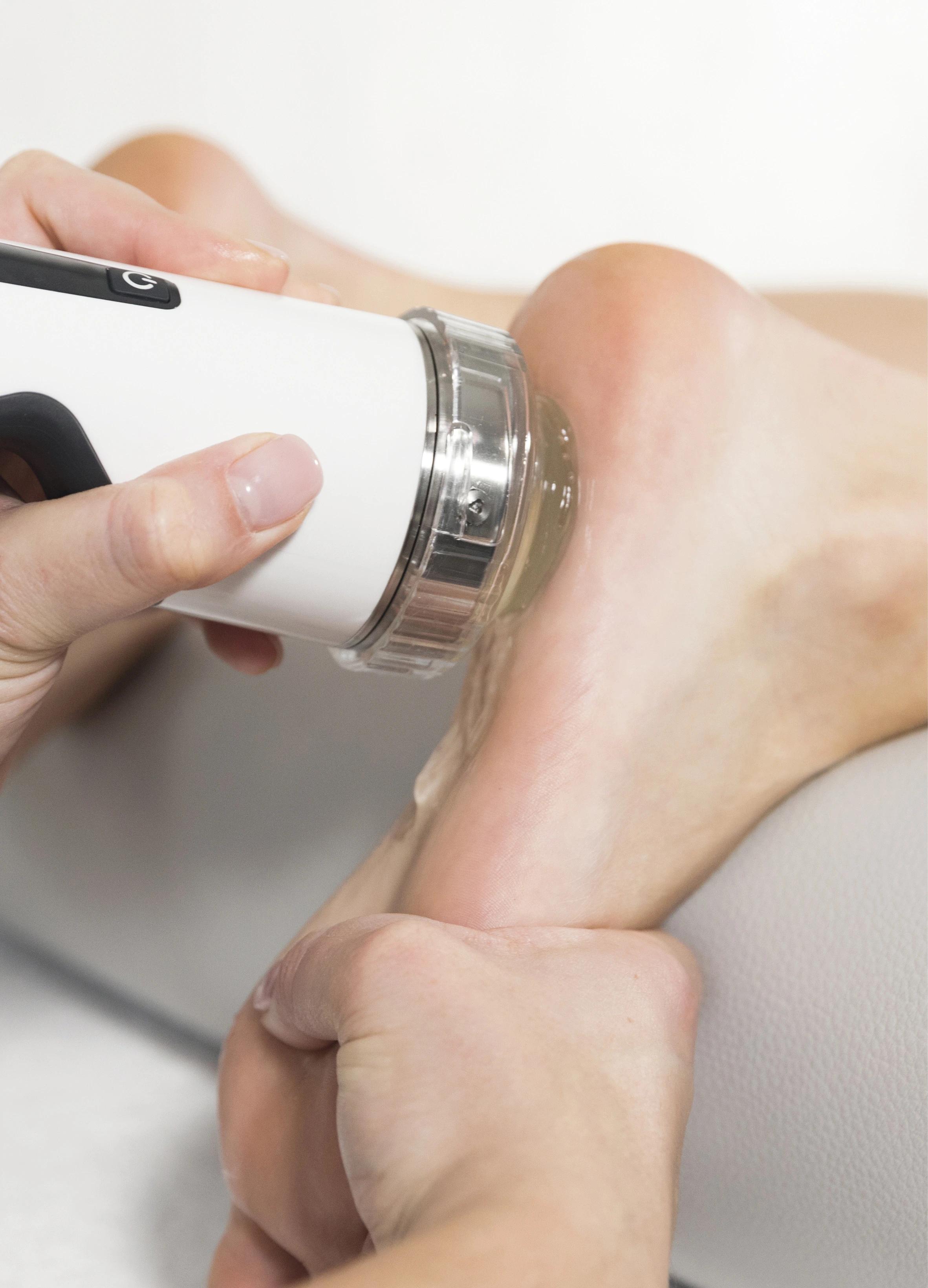
Focused shockwave therapy uses acoustic waves, not electricity, delivered through a handheld applicator placed against the bottom of the foot. The waves transfer mechanical energy through the skin into the plantar fascia and surrounding tissue. That energy does several things at once.
It improves local blood flow. Chronic plantar fasciitis sites are often poorly vascularised, which is part of why they do not heal on their own. Shockwave triggers the formation of new blood vessels in the area over the weeks following treatment, which gives the tissue more of what it needs to repair.
It nudges a stalled inflammatory response back into action. The body's normal repair process depends on a controlled, time-limited inflammatory phase. In chronic fasciopathy, that phase has often petered out into a low-grade chronic state. Shockwave restarts it deliberately, which is part of why we ask patients to avoid routine anti-inflammatory medications during a treatment course unless their physician has specifically prescribed them.
It acts on the abnormal nerve and tissue changes in the fascia. Chronic plantar fasciopathy involves disorganised collagen, microscopic tearing, and abnormal nerve ingrowth into tissue that should not have nerves. Shockwave appears to influence these changes in a way that simple anti-inflammatory treatment cannot.
There is also an analgesic effect that often shows up early in a treatment course. Many patients notice the morning pain easing within the first one or two sessions, before any meaningful structural change could have happened. The bigger structural shifts take longer. If you want to understand the technology behind shockwave in more depth, our article on how focused shockwave therapy works walks through the mechanics.
WHAT DOES CHRONIC PLANTAR FASCIITIS TREATMENT LOOK LIKE AT UNPAIN CLINIC EDMONTON?
A typical first visit is a 60-minute one-on-one assessment. We confirm what is going on (heel pain has several causes, and plantar fasciitis is only one of them), then look at the chain above the foot. We check ankle range of motion, calf flexibility, foot mechanics, hip and gluteal strength, and how you walk. The pattern that contributed to the problem usually shows up in this assessment.
If you are a fit for our approach, the plan has four pieces.
Focused shockwave delivered to the plantar fascia. Sessions run about 15 to 20 minutes. You feel a strong tapping sensation that we adjust to your tolerance. There is no needle and no recovery downtime. Most plans run three to six weekly visits. After most sessions, the heel feels slightly tender or warm for a few hours, which is part of the healing response.
EMTT for the broader region when appropriate. EMTT uses pulsed electromagnetic fields delivered through a loop applicator placed over the foot and lower leg. You feel nothing during the session. It pairs well with shockwave when the foot, calf, and ankle are all irritated rather than just the focal heel spot.
Manual therapy and joint mobility work. Calf release, ankle mobility, and work on the small joints of the foot all reduce the load that ends up at the plantar fascia. This is usually a few minutes per session, not the main event, but it changes how well the rest of the plan works.
A progressive home exercise program. The heel raise progression from the research above is usually our starting point, dosed to where you are right now and progressed from there. We add hip and gluteal strengthening when the assessment shows weakness in those areas. Most patients do these at home five to seven days per week, with adjustments at each visit. This is the part you own, and it is what tends to keep the gains.
Footwear matters, but in a balanced way. A shoe that supports you while the fascia is healing is helpful, especially during long days on your feet. A shoe that does so much work for you that your foot never gets stronger is not. We will look at what you are wearing and give you specific suggestions.
For patients whose chronic pain has clearly sensitised the nervous system, we sometimes add NESA neuromodulation as an additional layer. It is not used on every plantar fasciitis case.

“Uran is absolutely the most effective health care practitioner I’ve ever met. I suffered from severe tennis elbow for 2 years. Being a hairstylist for over 20 years, it greatly impacted my ability to work. I tried everything before I met Uran - acupuncture, chiropractor, massage, physio, IMS needling, RNFR massage plus multiple cortisone injections. Nothing had worked, until I saw Uran. He gets to the root of the issue, which is why his treatment is so effective. There is no other treatment like this in Edmonton. Save yourself some money and just go directly to him for ANY chronic pain issues.”- Chrystal Strader
WHAT CAN I DO AT HOME TO SUPPORT PLANTAR FASCIITIS RECOVERY?
What you do between sessions matters as much as what we do in clinic. A few habits make a real difference. None of them is a cure on its own.
- Do the heavy heel raise progression most days. A slow, controlled single-leg heel raise on a step, with a rolled towel under the toes to put the fascia under tension, is the exercise the strength training research used. Three seconds up, two-second hold at the top, three seconds down. Start with what you can do without pain, add resistance over weeks. We dose it specifically at the assessment.
- Stretch your calf, both versions. A calf stretch against a wall with the knee straight targets one part of the calf. The same stretch with the knee slightly bent targets the deeper part. Both matter for plantar fasciitis. Three sets of 30 seconds, two or three times a day.
- Roll the bottom of the foot gently, do not pound it. A small ball or a frozen water bottle, used for two to three minutes a day with comfortable pressure, can settle the fascia. Heavy, aggressive rolling on an irritated fascia tends to flare it.
- Use ice after long days, not on a routine schedule. Ten to fifteen minutes after a long shift or a hike helps. Routine ice every day blunts the inflammatory response that the fascia actually needs to remodel.
- Take a hard look at your shoes and your daily volume. If your shoes are dead, replace them. If you have just doubled your weekly running distance, dial it back. If you stand all day on concrete, see if a cushioned mat at the workstation helps. Most chronic plantar fasciitis has an environmental driver that does not go away on its own.
If you have done all of this consistently for six to eight weeks without progress, that is the cue to get reassessed. Something in the plan is missing.
WHAT WE DO NOT OFFER
- We do not perform injections of any kind, including cortisone injections or platelet-rich plasma.
- We do not prescribe oral or topical pain medications. We are physiotherapists and registered massage therapists, not physicians.
- We do not perform surgery, including plantar fascia release. If your plantar fasciitis has not responded to a thorough conservative plan and surgery is on the table, we will tell you and refer you to a foot and ankle surgeon.
- We do not promise cures. Most chronic plantar fasciitis improves with the right combination of treatments, but not every case resolves completely. What we offer is an honest plan, regular review, and a team that will tell you if we are not the right fit.
FREQUENTLY ASKED QUESTIONS
Does shockwave therapy actually work for plantar fasciitis?
The current evidence is strong. A 2017 meta-analysis of randomized trials in Medicine (Baltimore) concluded that extracorporeal shockwave therapy is effective for chronic plantar fasciitis. A more recent 2024 meta-analysis in BMC Sports Science, Medicine and Rehabilitation confirmed the picture across multiple tendinopathies, including plantar fasciitis. It is most useful when the condition has been around for more than six to eight weeks and has not responded to basic rest and stretching.
How many shockwave sessions will I need?
A typical course is three to six weekly sessions. Mild chronic cases sometimes settle in three. More stubborn ones may need five or six. We reassess as we go and will tell you honestly if a course is not moving you in the right direction.
Does shockwave on the heel hurt?
The pulses are uncomfortable on a tender heel, and most people rate them around four or five out of ten during the session. We adjust the intensity to what you can tolerate. After the session, a few hours of mild tenderness or warmth in the heel is normal. There is no needle, no incision, and no medication to react to.
How long until I feel relief?
Some people notice the morning pain easing within the first one or two sessions. The bigger structural gains usually show up at the four-to-twelve-week mark, after the fascia has had time to respond. Be patient through the early sessions if the relief is subtle at first.
Should I keep wearing my orthotics?
Often yes, in the short term, while the fascia is healing. The plan is not to keep relying on them forever, but they can take meaningful load off the foot while you do the work to make the foot stronger underneath them. We will give you a specific recommendation at your assessment.
Is plantar fasciitis the same as a heel spur?
No. A heel spur is a bony outgrowth at the heel bone. Plantar fasciitis is irritation of the fascia at its attachment to the heel. They often coexist, but most people with heel spurs have no pain, and most of the pain in plantar fasciitis is from the soft tissue, not the spur. Treating the fascia usually settles the pain even when the spur is still there on imaging.
Do I need a doctor's referral to come to Unpain Clinic?
No referral is needed. Physiotherapists and registered massage therapists in Alberta are primary contact providers, so you can book directly. Some extended health plans require a doctor's referral for reimbursement, so it is worth checking your benefits.
ABOUT THE AUTHOR
Written by Uran Berisha, PT, RMT, Founder of Unpain Clinic and Medical Shockwave Institute. Uran is a physiotherapist based in Edmonton, Alberta, and an International Educator in Shockwave Therapy. Medically reviewed by Uran Berisha, PT, RMT.
READY TO STOP CHASING THE PAIN AND START TREATING THE CAUSE?
If your heel pain has not budged with stretching, ice, and orthotics, the next step is a 60-minute one-on-one assessment in Edmonton where we look at the foot and the chain above it, and build you a clear, written plan. No referral needed. No pressure. We will tell you honestly whether shockwave is the right call. You can book a one-on-one assessment when you are ready.
REFERENCES
The following sources are linked inline in the body above. The full citations are listed here for completeness.
- Sun J, Gao F, Wang Y, Sun W, Jiang B, Li Z. Extracorporeal shock wave therapy is effective in treating chronic plantar fasciitis: a meta-analysis of RCTs. Medicine (Baltimore). 2017;96(15):e6621. doi:10.1097/MD.0000000000006621. PMID: 28403111. PMCID: PMC5403108. https://pubmed.ncbi.nlm.nih.gov/28403111/
- Rathleff MS, Molgaard CM, Fredberg U, Kaalund S, Andersen KB, Jensen TT, Aaskov S, Olesen JL. High-load strength training improves outcome in patients with plantar fasciitis: a randomized controlled trial with 12-month follow-up. Scandinavian Journal of Medicine and Science in Sports. 2015;25(3):e292-e300. doi:10.1111/sms.12313. PMID: 25145882. https://pubmed.ncbi.nlm.nih.gov/25145882/
- Majidi L, Khateri S, Nikbakht N, Moradi Y, Nikoo MR. The effect of extracorporeal shock-wave therapy on pain in patients with various tendinopathies: a systematic review and meta-analysis of randomized controlled trials. BMC Sports Science, Medicine and Rehabilitation. 2024;16(1):93. doi:10.1186/s13102-024-00884-8. PMID: 38659004. https://pubmed.ncbi.nlm.nih.gov/38659004/
- Schmitz C, Császár NB, Milz S, Schieker M, Maffulli N, Rompe JD, Furia JP. Efficacy and safety of extracorporeal shock wave therapy for orthopedic conditions: a systematic review on studies listed in the PEDro database. British Medical Bulletin. 2015;116(1):115-138. doi:10.1093/bmb/ldv047. PMID: 26585999. https://pubmed.ncbi.nlm.nih.gov/26585999/
- Ackermann PW, Alim MA, Pejler G, Peterson M. Tendon pain: what are the mechanisms behind it? Scandinavian Journal of Pain. 2023;23(1):14-24. doi:10.1515/sjpain-2022-0018. PMID: 35850720. https://pubmed.ncbi.nlm.nih.gov/35850720/
Related Topics