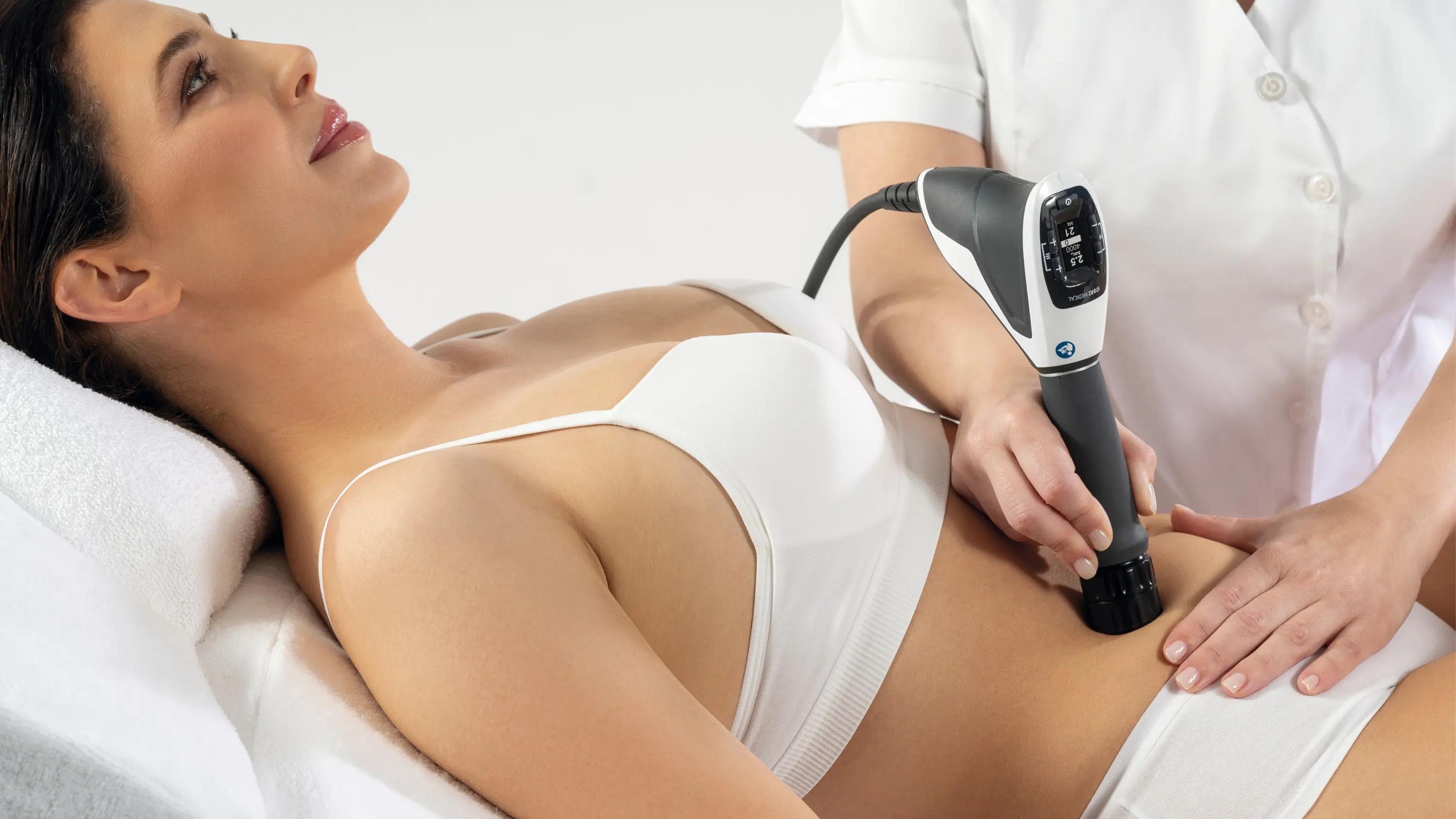
Discover how shockwave therapy helps C-section moms heal chronic pain. Unpain Clinic's proven scar treatment restores strength. Start healing today!
KEY TAKEAWAYS
- Chronic pain after a C-section is more common than the postpartum recovery conversation usually acknowledges. Persistent scar tenderness, abdominal wall tightness, low back pain, and pelvic floor or core weakness can all persist for months or years.
- Not every symptom after a C-section is from the scar. The pelvic floor, the abdominal wall (including diastasis recti), the hip and lumbar spine, and the broader postpartum kinetic chain all contribute. A proper assessment matters before treatment.
- Shockwave therapy has biological rationale and a small but growing evidence base for surgical scar tissue, including a 2019 pilot study on abdominoplasty scars and stronger evidence from the broader scar literature (mostly in burn scars). Direct, high-quality randomised trial evidence specifically for chronic C-section scar pain is still limited.
- A structured plan for chronic post-C-section pain is layered: pelvic floor and core rehabilitation as the foundation, manual therapy for the scar and surrounding tissues, and shockwave therapy as an adjunct in selected cases.
- Anything unusual about the scar itself (a hernia, persistent drainage or opening, severe abdominal pain, or signs of infection) needs to go to your OB-GYN or family physician before any rehabilitation work.
IN THIS ARTICLE
- Why chronic pain after a C-section is more common than people realise
- What is actually causing the pain (the scar is only part of the picture)
- What the research shows about shockwave therapy for surgical scars
- How treatment works at Unpain Clinic
- What to do at home between visits
- When to see a physician
- FAQ
INTRODUCTION
A C-section is major abdominal surgery. The medical conversation around recovery tends to last about six to twelve weeks, focused on wound healing, lifting restrictions, and the early return to walking. That conversation rarely extends to the women who, a year, five years, or fifteen years later, still notice a tugging at the scar, tightness across the lower abdomen, low back pain that started in pregnancy and never quite left, or a core that does not feel like it works the way it used to.
This article is for those situations. It walks through why chronic pain after a C-section is more common than people realise, what is actually driving it (because it is rarely just the scar in isolation), what shockwave therapy can and cannot do, and how a structured plan is built. The framing throughout is honest. There are not many high-quality randomised trials specifically on chronic C-section pain, and we will say so where it matters.
This is general education, not individual medical advice. If your scar is painful in a new way, draining, opening, or associated with a visible bulge or significant abdominal pain, that needs to go to your OB-GYN or family physician before any rehabilitation work.

WHY IS CHRONIC PAIN AFTER A C-SECTION MORE COMMON THAN PEOPLE REALISE?
The cesarean section rate in Canada was about 33% in 2023 to 2024 (one in three births), which means a substantial portion of the postpartum population is recovering from major abdominal surgery while also recovering from pregnancy and adapting to new-baby life. The traditional medical follow-up focuses on the surgical wound itself and on early postpartum recovery. The longer-term picture, particularly past the six-week postpartum appointment, gets much less attention.
That gap matters because chronic pain after a C-section is not rare. Published prevalence estimates for chronic pain at 6 to 12 months after C-section range widely (typically reported between 5% and 20%, depending on the study and how chronic pain is defined). The pain pattern is often a combination of the scar itself, the abdominal wall, the low back, the pelvic floor, and the hip and pelvis. It is rarely just one thing.
The reasons it persists are recognisable.
The first is that the abdominal wall took a real hit. A C-section involves cutting through several layers of tissue (skin, subcutaneous fat, fascia, sometimes a small portion of rectus abdominis muscle, peritoneum, and the uterus). The fascia heals, but with scar tissue rather than the original organised collagen. Scar tissue is thicker, less elastic, and can adhere to nearby structures.
The second is the pelvic floor. Pregnancy itself loads the pelvic floor for nine months. C-section bypasses the second-stage delivery, but it does not undo the pregnancy-related changes to the pelvic floor and the surrounding muscles. Pelvic floor function is part of the chronic-pain conversation in many of these cases, particularly when the symptoms include low back pain, pelvic pain, urinary or pelvic-floor symptoms, or pain with intimacy.
The third is the broader kinetic chain. The pregnancy load on the spine, the changes to gait, the postpartum pattern of carrying a child, sleeping in awkward positions, and the slow return to general fitness can leave behind a pattern of hip and low back tightness, weak gluteal stabilisers, and altered breathing mechanics. Each of these can keep the abdominal wall and the scar from settling.
The fourth is that the surgical scar can become symptomatic on its own. Some women develop scar tenderness, scar adhesions to underlying structures, or in some cases nerve entrapment in the scar (most commonly the ilioinguinal or iliohypogastric nerves where they pass near the lower abdominal incision). This is a recognised but under-discussed phenomenon, and it is the part of the picture where shockwave therapy and targeted manual treatment are most directly relevant.
WHAT IS ACTUALLY CAUSING THE PAIN? (THE SCAR IS ONLY PART OF THE PICTURE)
This is the most important point in the article. A C-section scar is the most visible part of the picture, but it is rarely the whole story.
The scar itself can be a contributor. Scar tissue that has adhered to underlying fascia or muscle, that is thicker or thinner than the surrounding skin, that is tender to touch, or that has nerve involvement can be a real source of symptoms. This is what shockwave therapy, manual therapy, and scar-specific work address directly.
The abdominal wall can be a contributor. A C-section affects the rectus abdominis fascia, and combined with pregnancy-related changes (diastasis recti, where the two halves of the rectus abdominis muscle have separated at the midline), the abdominal wall may not function as a coordinated unit. This shows up as a sense of weakness, a "doming" of the abdomen when sitting up, low back pain, or difficulty with rotational and lifting tasks.
The pelvic floor is often a contributor. Pelvic floor dysfunction is genuinely common after pregnancy, and a C-section does not protect against it. Symptoms include urinary urgency or leakage, pressure or heaviness in the pelvis, pain with intimacy, low back pain, and the sense of a core that does not connect. Pelvic floor physiotherapy (a specific sub-discipline of physiotherapy) is the right place for the targeted work here.
The lumbar spine and hips are often a contributor. Pregnancy and postpartum changes load the low back, the sacroiliac joints, and the hips in ways that can persist. Carrying a child habitually on one hip, sleep deprivation, and reduced general activity often compound the picture.
Breathing patterns are an under-discussed contributor. A surgical scar across the lower abdomen, combined with new-baby postural patterns, often shifts breathing to a more upper-chest pattern. This affects how the abdominal wall and the pelvic floor coordinate.
The clinical translation of all of this is that the right treatment plan looks at the whole picture, not just the scar. The scar work is part of it. It is rarely all of it.

WHAT DOES THE RESEARCH SHOW ABOUT SHOCKWAVE THERAPY FOR SURGICAL SCARS?
The honest framing first: direct, high-quality randomised controlled trial evidence specifically for shockwave therapy on chronic C-section scars is limited. The relevant evidence sits in two adjacent areas: a small pilot trial on abdominoplasty scars, and a larger body of work on burn scars.
The most directly relevant trial in the abdominal surgery space is the 2020 pilot study by Russe and colleagues in Lasers in Surgery and Medicine, which examined the effect of preoperative shockwave therapy on scar formation in 24 patients undergoing abdominoplasty. The trend favoured shockwave over placebo across a range of scar quality measures, but the differences did not reach statistical significance in this small sample. The authors concluded that shockwave "presumably reduces scar formation and postoperative symptoms after abdominoplasty surgery" and recommended larger trials to confirm. This is the closest direct evidence to C-section scars in the published literature, and it is worth being clear that it is a pilot, not a definitive trial.
The broader evidence on shockwave therapy for surgical and post-injury scars sits mostly in the burn scar literature, which has more randomised trials. The 2016 randomised placebo-controlled trial by Cho and colleagues in Medicine (Baltimore) examined shockwave therapy for scar pain in burn patients and reported significant reductions in scar pain compared with sham treatment. The 2020 randomised double-blinded trial by Joo and colleagues in the Journal of Clinical Medicine examined shockwave therapy on hypertrophic burn scars of the hand and reported improvements in scar characteristics and hand function.
Burn scars are not the same as C-section scars, and extrapolation has limits. But the underlying biological rationale is plausible: shockwave appears to influence fibroblast activity, scar collagen organisation, and local circulation in scar tissue across different scar types. The basic-science literature supports a real mechanism, even where the clinical RCT evidence specifically on C-section scars is not yet there.
The honest position. Shockwave therapy is a biologically plausible adjunct for chronic C-section scar pain and scar tightness, supported by direct pilot evidence in abdominoplasty and stronger evidence in adjacent scar types. It is not a stand-alone treatment, it is not appropriate for every post-C-section symptom, and the high-quality randomised trial evidence specifically for C-section scars is still emerging.
"Most of the chronic pain after a C-section is not just the scar. The scar is often a real piece, and it is the part where shockwave can earn its place, but the abdominal wall, the pelvic floor, and the broader kinetic chain usually need work alongside it." Uran Berisha, BSc Physiotherapy, Founder of Unpain Clinic
HOW DOES TREATMENT FOR CHRONIC POST-C-SECTION PAIN WORK AT UNPAIN CLINIC?
At Unpain Clinic in Edmonton, treatment for chronic post-C-section pain sits inside a structured assessment-and-plan process. The first visit is an assessment, not a treatment session, because the right plan depends on which parts of the picture are actually driving the pain.
A typical first visit includes a full history (when the C-section was, how many, what the recovery has looked like, what the current symptoms are, what has been tried), and an examination that covers the scar and abdominal wall, the lumbar spine, the hips, the breathing pattern, and a general kinetic chain assessment. Pelvic floor screening is included, with referral to a pelvic floor physiotherapist when targeted internal pelvic floor work is appropriate (we do not provide internal pelvic floor assessment ourselves, and we coordinate with trusted colleagues in that specialty when it is needed).
If the scar itself has features that need a physician's involvement first (suspected hernia, persistent drainage or opening, a clearly abnormal scar appearance, significant abdominal pain in an unusual pattern), we say so and coordinate that referral before continuing.
From there, the toolbox we draw on is built around what the picture shows.
Physiotherapy with progressive core, hip, and abdominal-wall work is the foundation. This includes diaphragmatic breathing work, deep core retraining (transversus abdominis and pelvic floor activation), progressive abdominal wall strengthening, hip and gluteal strengthening, and a paced return to the activities you want to get back to. For most chronic post-C-section cases, this work is the backbone of the plan.
Manual therapy and scar-specific work is layered in for cases where the scar itself is tender, restricted, or adhered. This includes soft-tissue work around the scar, scar mobilisation, and addressing the surrounding myofascial restrictions.
Focused shockwave therapy is selectively used as an adjunct in cases where the scar has been a persistent source of tenderness or tightness, where adhesions to underlying tissue are part of the picture, or where conservative scar work has not been enough. Shockwave is positioned honestly: a biologically plausible adjunct with supportive evidence from adjacent scar types, not a stand-alone treatment.
Radial shockwave therapy is layered in for surrounding muscle tension that contributes to the picture (the hip flexor group, the lateral abdominal wall, the lumbar paraspinals).
EMTT therapy is selectively used in cases where deep tissue inflammation and broader sensitisation are part of the picture, as a complementary modality alongside the other work.
Massage therapy supports the broader picture, particularly for the surrounding kinetic chain.
For deeper looks at related topics, our cluster also includes shockwave therapy for C-section recovery (which covers the earlier postpartum and recovery period in more detail) and C-section benefits, risks, and recovery tips (which covers the broader C-section conversation).

WHAT TO REALISTICALLY EXPECT FROM A COURSE OF CARE
A reasonable timeline for chronic post-C-section symptoms is 8 to 16 weeks of structured care, depending on how chronic the picture is and how much work needs to happen across the abdominal wall, pelvic floor, and kinetic chain.
The pattern of improvement is rarely dramatic in the first session. Many people notice the first shifts in the first 3 to 6 weeks, often as a reduction in the scar tenderness, easier breathing, improved core engagement, or improved tolerance for the daily activities that used to flare it (carrying a child, lifting, certain sleep positions). The bigger gains come later, as the rehabilitation work consolidates.
A course of shockwave therapy in this setting is typically 4 to 6 weekly sessions, layered on top of the rest of the plan. Sessions take a few minutes of actual shockwave application. The sensation is best described as a strong tapping or pulsing pressure on the area. Discomfort is adjustable in real time.
The boundary of what conservative care can and cannot do is worth stating clearly. It does not surgically correct a hernia or a significant diastasis recti that needs surgical repair. It does not resolve every pelvic floor presentation (some need targeted internal pelvic floor physiotherapy that we refer to). What it does, in the right cases, is change how the abdominal wall, the scar, the pelvic floor, and the broader kinetic chain work together so the chronic pain pattern can resolve.
WHAT CAN I SAFELY DO AT HOME BETWEEN VISITS?
This is general education, not individual medical advice. The principles below assume you have been cleared by a clinician and have an individualised program in hand. If you are still within the first 6 to 12 weeks after a C-section, follow your physician's specific post-operative guidance and do not start any of this without their clearance.
- Diaphragmatic (belly) breathing is the foundation. Lying on your back with knees bent, place one hand on the lower abdomen and one on the chest. Breathe in slowly through the nose so the belly hand rises first, then the chest hand. Slow exhale. Five minutes a day reconnects the breathing pattern with the deep core.
- Gentle scar mobilisation, after the scar is well-healed and your physician has cleared it. With clean hands and the scar fully closed, use light fingertip pressure to move the skin and underlying tissue in different directions over the scar. A few minutes a day. Never on a scar that is open, draining, or actively painful.
- Reconnect the deep core gradually. Transversus abdominis activation (a gentle drawing-in of the lower abdomen while breathing normally), pelvic tilts on the back with knees bent, and gentle bridges are reasonable starting points if your clinician has cleared them.
- Address the breathing-and-posture pattern of new-baby life. Habitually carrying a child on one hip, hunched feeding positions, and prolonged forward-rounded postures all compound chronic post-C-section patterns. Frequent posture resets and switching sides during carrying tasks help.
- Be patient with progression. The deep core, the pelvic floor, and the abdominal wall rebuild on a months-to-a-year timeline, not weeks. Two weeks of focused work and no dramatic change is not failure; it is normal.
- Build hip and gluteal strength. Side-lying leg raises, banded hip abduction, side planks, and bridges all support the broader kinetic chain and take pressure off the low back.
- Sleep position matters. Side-sleeping with a pillow between the knees, and avoiding prolonged sleep positions that put pressure on the scar, helps the recovery.
- If symptoms include pelvic floor concerns (urinary urgency or leakage, pelvic heaviness, pain with intimacy), seek out a pelvic floor physiotherapist for the targeted internal work. This is a specialised sub-discipline of physiotherapy and is the right place for that specific work.
WHEN SHOULD I SEE A PHYSICIAN INSTEAD OF (OR ALONGSIDE) REHABILITATION?
The following are not "wait and see" situations. Contact your physician promptly, or seek emergency care if symptoms are severe.
- A new bulge, lump, or hernia-like protrusion at or near the scar, particularly with discomfort or with effort (coughing, lifting, straining).
- The scar opening, draining, or developing significant redness, warmth, swelling, or fever (possible infection or wound complication).
- Sudden severe abdominal pain that is different from the usual pattern.
- Persistent bleeding, abnormal vaginal discharge, or other gynecological symptoms that need OB-GYN evaluation.
- Numbness, tingling, or weakness traveling into the legs.
- Symptoms of pelvic organ prolapse (a feeling of pressure or heaviness in the pelvis, or the sense of something dropping or coming down).
- Significant pain with intimacy that is not improving with general care.
- Symptoms of postpartum depression or anxiety, which are common and treatable and should not be carried alone.
- Any combination of abdominal or scar pain with unexplained weight loss, fever, or systemic illness.
FREQUENTLY ASKED QUESTIONS
Can chronic pain from a C-section show up years later?
Yes. Chronic pain related to a C-section can persist or appear months or years after the surgery, particularly when the abdominal wall, the pelvic floor, or the kinetic chain has not had structured rehabilitation. The pattern usually involves several contributors at once (the scar, the abdominal wall, the pelvic floor, the lumbar spine, the hips). A proper assessment helps identify which contributors are actually driving the pain in your case.
Is my old C-section scar the cause of my back pain?
Sometimes yes, often no. A surgical scar can be a real contributor to chronic abdominal and back pain, particularly when there is scar tenderness, restriction, or adhesion to underlying tissue. But chronic back pain after pregnancy and C-section is usually multi-factorial: pelvic floor changes, abdominal wall deconditioning, hip and gluteal weakness, and altered breathing patterns all contribute. The honest answer is that the scar might be a contributor, and a proper assessment helps clarify which parts of the picture need attention.
Does shockwave therapy work on old C-section scars?
The biological rationale supports it, and the direct evidence from a 2020 pilot study in abdominoplasty patients (Russe et al.) showed a trend favouring shockwave but did not reach statistical significance in that small trial. Broader evidence from burn scars (Cho 2016, Joo 2020) supports the general idea that shockwave can influence scar pain and scar characteristics. The honest framing is that shockwave is a biologically plausible adjunct with supportive evidence from adjacent scar types, not a stand-alone treatment, and the high-quality randomised trial evidence specifically for C-section scars is still developing.
How many shockwave sessions are needed for a chronic C-section scar? A typical course at Unpain Clinic is 4 to 6 weekly sessions, layered on top of the rest of the rehabilitation plan. The plan is laid out at the assessment and adjusted based on response.
Will treating my C-section scar fix my pelvic floor issues?
Usually not on its own. Pelvic floor dysfunction after pregnancy and C-section is a real and treatable issue, and it usually needs targeted pelvic floor physiotherapy (often including internal pelvic floor assessment and treatment) by a clinician with that specific training. We do not provide internal pelvic floor work at Unpain Clinic, and we refer to trusted pelvic floor physiotherapists for that part of the picture.
How long after a C-section is it safe to start scar work?
This is a question for your OB-GYN or family physician. As a general principle, the scar needs to be well-healed and fully closed, and your physician needs to have cleared you to begin rehabilitation work. Different protocols use different timeframes (often somewhere between 6 weeks and 3 months post-surgery for the start of light scar mobilisation, but earlier and later are both possible depending on individual healing).
Is shockwave therapy safe to use over a C-section scar?
In trained hands, with a well-healed scar and after clinician clearance, focused shockwave over scar tissue is generally well-tolerated, with mild local soreness or redness in the day or two after a session as the most common short-term effects. Contraindications include active infection, pregnancy, open wounds, certain implanted devices in the treatment area, and active malignancy in the area. A proper screening at the assessment determines whether shockwave is appropriate for your specific case.
Do I need a doctor's referral to come to Unpain Clinic?
No referral is needed. Physiotherapists and chiropractors in Alberta practice as primary contact clinicians. Some insurance plans require a physician's note for reimbursement, so check your plan if you intend to claim. If our assessment turns up something that needs a physician's involvement, we coordinate that referral.
Is post-C-section rehabilitation covered by insurance?
Most extended health plans reimburse physiotherapy, chiropractic, and massage therapy under standard categories. Adjunctive treatments like shockwave and EMTT are typically billed under the supervising clinician's category where applicable. Pelvic floor physiotherapy is typically covered under physiotherapy. Public provincial health insurance does not typically cover any of this in a private clinic setting. Confirm with your plan, and a Health Spending Account through your employer can usually be used as well.
PATIENT TESTIMONIAL
“I came to Dr. Lacina Barsalou with a shoulder injury that healed wrong, and a strong desire to feel some sense of normalcy pain wise. I’ve seen all the therapists and tried all of the different options. Specifically shockwave works great on releasing my scar tissue and tension. Prior to Dr. Lacey, I was getting consistent shockwave with some results but time between appointments always made it hard. With Dr. Lacey, she is working with my body, not against it, and targeting the areas I share with her where I feel physically “stuck.” She is a truly talented assessor with a deep knowledge of the human body. She is kind, gentle, and a true friend to her patients. Sometimes when I see her, I’ve had a bad day, and just a Doctor Lacey hug can help. She is beyond skilled as a health care professional and chiropractor and I will never choose to see anyone else again. Their treatments are worth every penny when they allow you to move properly again. There is a reason that it’s called the “Unpain Clinic.”"- Kristen Hyde
ABOUT THE AUTHOR
Written by Uran Berisha, Founder of Unpain Clinic and Medical Shockwave Institute. Uran has a Bachelor of Science in Physiotherapy and is an International Educator in Shockwave Therapy.
BOOK YOUR INITIAL ASSESSMENT
If you have chronic pain or persistent discomfort after a C-section (whether it has been a year or many years), and you want a clear, honest read on which parts of the picture are actually driving the pain, the next step is a proper assessment. We will look at the scar, the abdominal wall, the kinetic chain, and the rest of the picture, refer to a pelvic floor physiotherapist where appropriate, and tell you honestly which tools fit your case. No referral needed. No long contracts. Book your initial assessment with Unpain Clinic.
REFERENCES
- Russe E, Wechselberger G, Schwaiger K, Schoeller T, Russe-Wilflingseder K. Effects of Preoperative Extracorporeal Shockwave Therapy on Scar Formation: A Pilot Study on 24 Subjects Undergoing Abdominoplasty Surgery. Lasers in Surgery and Medicine. 2020;52(2):159-165. https://onlinelibrary.wiley.com/doi/10.1002/lsm.23089
- Cho YS, Joo SY, Cui H, Cho SR, Yim H, Seo CH. Effect of extracorporeal shock wave therapy on scar pain in burn patients: A prospective, randomized, single-blind, placebo-controlled study. Medicine (Baltimore). 2016;95(32):e4575. https://pmc.ncbi.nlm.nih.gov/articles/PMC4985341/
- Joo SY, Lee SY, Cho YS, Seo CH. Clinical Utility of Extracorporeal Shock Wave Therapy on Hypertrophic Scars of the Hand Caused by Burn Injury: A Prospective, Randomized, Double-Blinded Study. Journal of Clinical Medicine. 2020;9(5):1376. https://pmc.ncbi.nlm.nih.gov/articles/PMC7290924/
Related Topics